
Should You Use a Domain Hack (Like notion.so or bit.ly)?
Your dream .com is gone, and then you spot the loophole: spell the last part of your name with the extension. "Notion" becomes notion.so, "bit" plus ".ly" becomes bit.ly, and suddenly a taken name is available again. It feels clever, modern, and a little bit insider — the kind of move that says you know how the internet actually works. It can be exactly that. It can also be a name your own customers can't type, can't say, and can't remember, running on a registry in a country you've never thought about. This guide draws the line: what a domain hack really is, which ones read as one clean word and which turn into punctuation puzzles, the real-world friction they create, the registry risk nobody mentions, and a clear rule for when a hack is a smart launch move versus a trap.
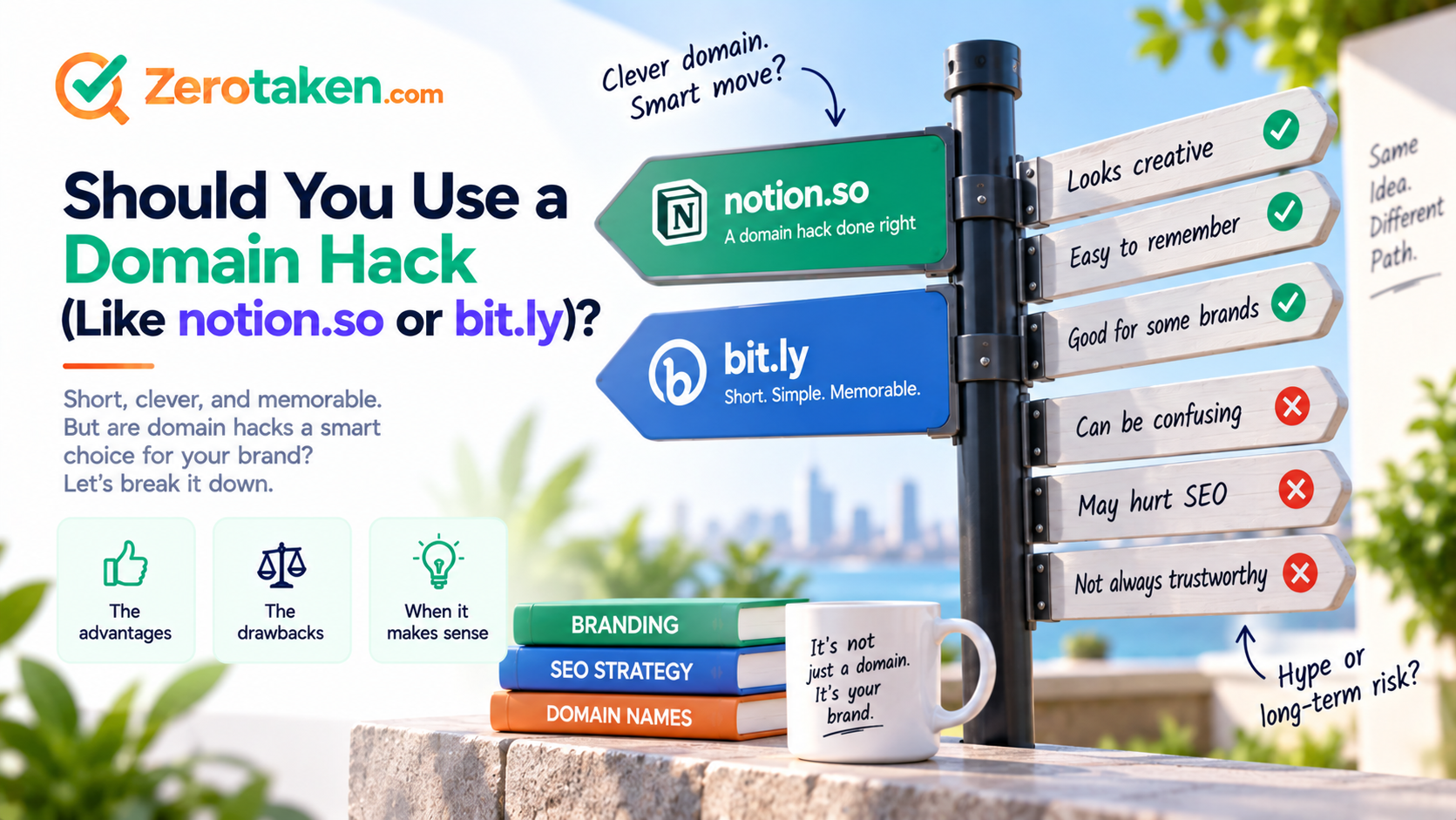
What exactly is a domain hack?
A domain hack is a domain where the top-level extension does double duty as part of the actual word or phrase, instead of sitting off to the side like .com does. del.icio.us reads as "delicious." bit.ly reads as "bitly." last.fm reads as "last FM." The dot stops being a separator you mentally skip over and becomes a letter in the name — that's the whole trick.
The reason hacks exist is that country-code extensions were never meant to be brand words, but a lot of them happen to spell useful English fragments: .ly (Libya), .so (Somalia), .me (Montenegro), .fm (Micronesia), .io (British Indian Ocean Territory), .sh, .to, .gg, .ai. Registries opened these up for open registration, founders noticed the wordplay, and a whole naming style was born. It is not a gimmick invented by domain sellers — some of the most-used links on the internet are hacks. But "famous companies did it" and "it's right for you" are two very different claims.
Why do domain hacks look so tempting right now?
Because the good .com is almost always taken, and a hack makes an unavailable name available again. If yourbrand.com is gone or priced at five figures on the aftermarket, restructuring it as your.brand or yourbra.nd can hand you the exact word you wanted at a standard registration price. For a founder staring at a wall of "registered" results, that feels less like a compromise and more like a cheat code.
Hacks also carry a specific signal: technical, current, a little playful. In developer tools, link infrastructure, and consumer apps aimed at a young, online audience, that signal is an asset — it reads as "we get it." The problem is that the same cleverness that makes a hack feel smart to you is exactly what makes it fragile in the hands of a customer who wasn't in the room when you thought it up.
What's the hidden cost of a domain hack?
The core problem is reconstruction: a hack asks the human on the other end to rebuild your name from a spoken or half-remembered version, and the dot is the part they drop. Say "delicious dot us" out loud and watch someone try to type it — most people reach for delicious.com, because their brain hears a normal word and a normal extension, not del.icio.us. The cleverness lives in the writing and evaporates in the saying.
Then there's the mundane friction that shows up every single day. Email addresses on a hack are a special kind of painful — reading "me at hello dot yourbra dot nd" down a phone line is a small humiliation your team will feel forever. Some forms and validators still choke on unfamiliar TLDs. And every time you write the name in running text, you have to hope the reader parses the punctuation the way you intended instead of seeing a typo.
None of this is fatal on its own. But it stacks: a name that's a hair harder to say, spell, email, and recall is a name that leaks a little traffic and a little trust at every touchpoint, forever. You only notice the sum, not the individual leaks.
Which domain hacks actually work — and which don't?
The dividing line is simple: a great hack reads as one natural word with the dot in a place your eye already wanted a break; a bad hack needs you to chop a word in an unnatural spot or lean on an obscure extension nobody recognizes. bit.ly works because "bit" and "ly" are clean, and .ly is now familiar. del.icio.us is the cautionary opposite — three fragments, two dots, an extension no one associates with a word. It was memorable precisely because it was hard, which is not a trait you want in a brand you're trying to scale.
Run any candidate hack through these tests before you fall for it:
- The break is natural. The dot lands where a syllable already breaks (bit.ly, back.to), not mid-sound (busi.ness reads worse than it looks).
- It survives being written with no styling. In plain text, an email signature, a legal doc — does it still read as your name, or as a typo?
- The extension is recognizable. .io, .me, .co, .ai, .fm are familiar; .us, .sh, .gg, .nu ask more of the reader.
- One dot, not two. del.icio.us fails here; notion.so passes.
- It passes the phone test. You can say it once and a stranger types it right — if not, it's a link, not a brand.
Will people remember and type a domain hack correctly?
This is the question that actually decides it, and the honest answer depends entirely on how people find you. If your growth runs through clicks — links shared in chat, buttons in an app, results in an app store — the hack barely matters, because nobody is typing it from memory. That's why link shorteners and infrastructure products (bit.ly, t.co) wear hacks so comfortably: the URL is machinery, not a billboard.
The hack turns dangerous the moment your growth depends on recall: word of mouth, a podcast mention, a conference name-drop, a billboard, a friend saying "you should check out…". Every one of those is someone reconstructing your name from sound, and the dot is where they'll guess wrong — usually landing on the .com you don't own. If a non-technical customer might hear your name and try to type it later, a hack quietly taxes you on your best marketing channel.
Is there a registry risk with hack extensions?
Yes, and it's the part founders almost never price in. A hack forces you onto a country-code registry whose rules are set by a foreign government, not by your convenience. Those rules can change, prices can jump, and in rare cases names get pulled. In 2010, Libya deactivated a .ly link shortener over its content, which sent a chill through everyone who had built a brand on .ly. .io has spent years under a cloud of geopolitical uncertainty about its long-term status. You're renting the second half of your own name from a landlord you can't call.
The practical takeaway isn't "never touch a ccTLD" — plenty of great companies run on .io, .me, and .fm for years without incident. It's that a hack concentrates more of your brand's fate in the extension than a normal domain does, because the extension is literally part of the word. Losing or having to abandon your TLD isn't a redirect; it's a rebrand. Weigh that before you build a logo around it.
How do the smart companies actually use a domain hack?
They treat it as a launch vehicle, not a final destination — and they back it up with the matching .com the day they can afford to. The pattern that keeps working is to start on the available hack to ship fast and claim the exact word, then quietly acquire the plain .com as the brand grows and buy yourself an escape hatch from the type-in problem. Notion launched and scaled on notion.so for years before moving onto notion.com; the hack got them going, the .com made them bulletproof.
The mistake is treating the hack as permanent and never securing the obvious .com — leaving your type-in traffic, your email dignity, and your radio-test moments in someone else's hands. If you're going to use a hack, know from day one whether the matching .com is available or ownable, and have a plan to get it. A hack you can graduate out of is a smart start; a hack you're trapped in is a slow leak.
Ready to test a hack against the plain .com?
Before you commit to a hack, you want two answers side by side: is the clever hack version free, and is the boring .com you'll eventually want free or already gone? ZeroTaken lets you check a name across .com, .io, .co, .ai and the ccTLDs that power most hacks in one search, so you can see the whole picture — including the .com you'll want as an insurance policy — before you print the stickers.
So should you use a domain hack?
Use a hack when it reads as one natural word, uses a recognizable extension, and your audience reaches you through links and search rather than by typing your name from memory — a developer tool, a link product, an app-store-native consumer app. In those cases a clean hack is a genuine edge: it gets you the exact word the .com hoarders took, and it signals that you're building for people who live online. Ship it and don't apologize for it.
Lean away from a hack when your name has to survive being spoken — sold by word of mouth, said on a podcast, typed by a mainstream customer who heard it once. And whichever way you go, refuse to treat the hack as the end of the story: know where the matching .com stands and have a plan to own it. The founders who win with hacks aren't the ones who love the wordplay most — they're the ones who use it to launch and never let it trap them.