
How Do You Pick a Domain for a Global, Multilingual Brand?
You pick a name that lands perfectly in English — short, brandable, the .com is even gettable. Then you launch in São Paulo, Berlin, and Tokyo and discover it's unpronounceable in one market, faintly rude in another, and already parked by a squatter on the local country-code domain in a third. Naming for one language is hard; naming for a brand that has to work in a dozen is a different problem, and most founders don't find out until after the logo is printed. This is a practical guide to picking a domain that survives contact with the rest of the world — the failure modes nobody warns you about, whether you actually need country-code domains, one domain or many, and how to pressure-test a name across languages before you commit.
Add ZeroTaken as a preferred source on Google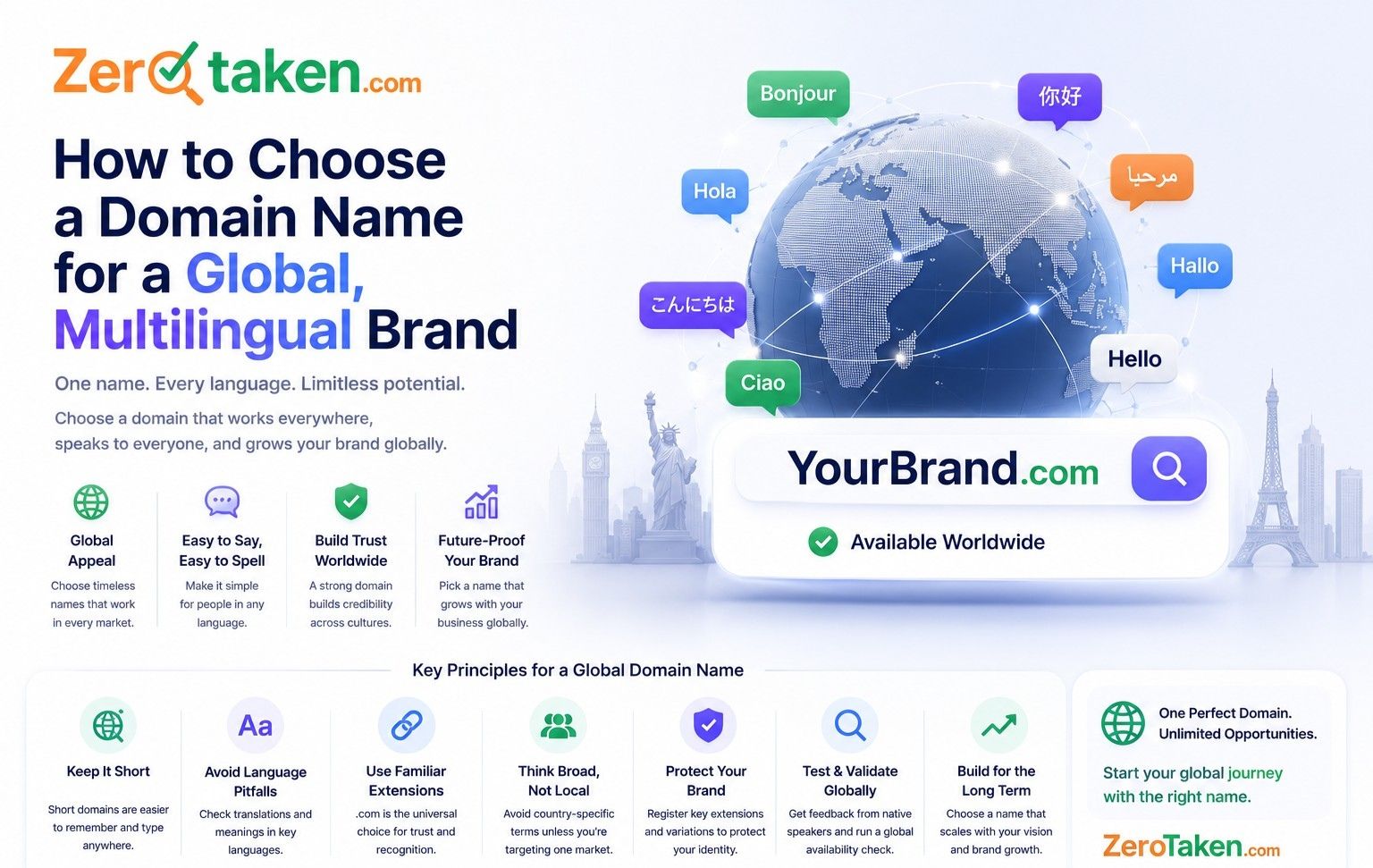
Why does a name that works in English quietly fail abroad?
A brand name is two things at once — a string and a sound — and both get reinterpreted the moment they cross a border. The string can collide with a real word in another language, sometimes an unfortunate one: German speakers read 'gift' as poison, not present. A confident English word can land as a shrug, a laugh, or an insult somewhere you plan to sell, and you won't hear about it until a local customer does.
The sound fails a different way. English is full of consonant clusters and vowel sounds that simply don't exist in other phonologies, so a name that rolls off a London tongue becomes a stumbling block in Madrid or Osaka. If your target customer can't repeat your name after hearing it once, word-of-mouth — your cheapest and most durable channel — quietly stops working in that market.
This isn't the discredited urban-legend stuff; the famous 'Chevy Nova means no-go in Spanish' story is a myth, and chasing myths misses the point. The real risk is subtler and far more common: not one catastrophic gaffe, but a name that's mildly awkward, hard to say, or forgettable across half your markets, bleeding a little reach in each one until international growth mysteriously underperforms.
How do you check whether your name means something bad in another language?
The cheap, reliable method is human, not software. Before you commit, run the name past a native speaker in each of your top three or four target markets and ask two questions: 'what does this sound like to you?' and 'is there any word this is close to?' Ten minutes with a real person catches what no dictionary lookup will, because the risk usually lives in slang and connotation, not the formal lexicon.
Focus the check on the failure categories that actually bite, and do it before the domain, the logo, and the trademark filing. Reversing a name after launch is one of the most expensive mistakes a young brand can make, and it's almost entirely avoidable with a few conversations up front.
- Real-word collisions — the string is an existing word somewhere (Spanish 'embarazada' looks like 'embarrassed' but means 'pregnant'; false friends run in both directions)
- Profanity and slang — a syllable that's neutral in English is crude in another language, or a perfectly clean foreign word reads badly to English ears
- Unpronounceable clusters — consonant stacks or sounds like the English 'th' or a hard American 'r' that don't exist in the target language
- Accidental competitors — the name is already a known brand, product, or generic category term in that market
Should a global brand buy country-code domains or just own the .com?
Your anchor should be a single, strong .com. It's the one extension every market recognizes as the 'main' site, it carries no geographic baggage, and Google treats it as global rather than tied to one country. Build your brand on it and point everything else back to it.
Country-code domains (.de, .fr, .co.uk, .com.br) earn their keep in exactly two situations: when you have a real, staffed operation in a country and want the local trust and geo-targeting a ccTLD signals, or when a specific market is strategically important enough that you can't risk a squatter or competitor sitting on the local version of your name. Outside those cases, blanket-registering forty ccTLDs 'to be safe' is a recurring tax that mostly enriches registrars.
The sane middle path: own the .com, register the two or three ccTLDs for markets you're actually operating in or about to enter, and skip the rest until a market proves it matters. Note that a handful of ccTLDs — .io, .co, .ai — are treated as generic by Google and carry no country signal, so they behave like a normal global extension rather than pinning you to a region.
One domain with language folders, or a separate domain per language?
For almost everyone, the answer is one domain with language subfolders — example.com/es/, example.com/de/ — not a separate domain per language. It concentrates all your SEO authority and backlinks on a single domain instead of splitting them across a dozen weaker ones, and it's dramatically simpler to run, secure, and measure.
Whichever structure you choose, hreflang tags are what tell Google which URL serves which language and region so the right version shows up in the right country's results. Get them right and one domain serves every market cleanly; get them wrong and Google may treat your translated pages as duplicate content and quietly pick a canonical for you — usually the English one, burying the localized pages you paid to translate.
Separate ccTLDs per country (example.de, example.fr) are worth the overhead only when you're running genuinely distinct local operations — different pricing, catalog, or legal entity in each market. For a single global product offered in many languages, the subfolder approach wins on cost, SEO, and sanity, and it's the model most well-run multilingual sites quietly use under the hood.
How do you handle non-Latin scripts and right-to-left languages?
You can register internationalized domain names in native scripts — Cyrillic, Arabic, Chinese — and they resolve fine, encoded behind the scenes as punycode. But for a global brand, a Latin-script domain almost always stays the primary. It's universally typeable, it renders in every browser and email client without surprises, and it dodges the homograph-spoofing warnings some systems throw at non-Latin URLs.
The harder problem isn't the domain string, it's the name's journey into other writing systems. Decide early how your brand transliterates — how it's spelled in Cyrillic, written in Japanese katakana, rendered in Arabic — because if you don't choose, the market chooses for you, and you'll wake up to three competing spellings of your own name that fragment your search traffic. Pick one, use it consistently everywhere, and register the transliterated version defensively in markets that matter.
Right-to-left languages like Arabic and Hebrew don't change your domain, but they stress-test the name and your layout: a Latin-letter brand still sits left-to-right inside RTL text, and some English phonemes have no clean equivalent. If those markets are core to your plan, have a native speaker confirm the name reads and sounds right in context — not just that it technically fits on the page.
What actually makes a name easy to say in any language?
The most portable names lean on sounds that exist almost everywhere. Open vowels, simple consonants, and clear syllable breaks travel; dense consonant clusters and English-only sounds don't. It's no accident that globe-spanning brand names tend to be short, vowel-heavy, and phonetically plain — they were built, or got lucky enough, to survive any accent that gets thrown at them.
- Short: two or three syllables at most — every extra syllable is another chance for a market to mangle it
- Vowel-friendly: open vowels and alternating consonant-vowel patterns are pronounceable almost everywhere
- Avoid English-only sounds: the 'th,' a hard American 'r,' and the v/w distinction trip up huge populations of speakers
- No ambiguous spelling: if it can be spelled two ways in English, it'll be spelled five ways abroad
How do you pressure-test a name across languages before committing?
Shortlist five to ten candidates and put each through the same gauntlet in one sitting: confirm the exact .com is available, verify the name carries no bad meaning in your top markets, and say it aloud in a couple of target accents. The name that clears all three — available, clean, sayable — beats the prettier name that fails any single one of them, and you want to find that out before design and legal spend a dime.
This is the sweep ZeroTaken is built to speed up: describe the idea, get brandable candidates, and see live .com/.io/.co availability side by side, so you can burn through twenty international-safe options in the time manual checking would eat on three. Pair the tool with a ten-minute native-speaker gut-check per market and you've de-risked the single most expensive-to-reverse decision in your brand.
So how do you name a brand for the whole world?
Anchor on a strong, phonetically simple .com; check every serious candidate for meaning and pronunciation in your real target markets; run one domain with language subfolders instead of a scattered pile of ccTLDs; and buy the country-code versions only for markets you're actually in. Do that and the same name travels — one asset that works everywhere instead of a brand that needs a patch in each new country.
The mistake to avoid is naming for English first and treating the rest of the world as a translation problem to solve later. Bake the global test into the naming itself and you'll never have to rip out a launched brand because it doesn't work in the third market you enter — the market that, often enough, turns out to be the one that mattered.
When you're ready to find a name that's both available and built to travel, ZeroTaken generates brandable options and live-checks .com, .io, .co and more — so you can shortlist for the whole world, not just your home market.