
Does Searching for a Domain Get It Snatched? The Truth About Front-Running
You find the perfect name, you check it, it's free — and then a little voice says: what if the site I just searched on grabs it and sells it back to me? It is one of the most common fears founders bring to a domain search, and it has a name: domain front-running. This guide gives you the straight answer instead of the paranoia. We'll cover what front-running actually is, the one famous case where a major registrar really did it, why it almost never happens today, where the genuine risk actually comes from (hint: it's usually you), and exactly how to check and secure a name without tipping anyone off.
Add ZeroTaken as a preferred source on Google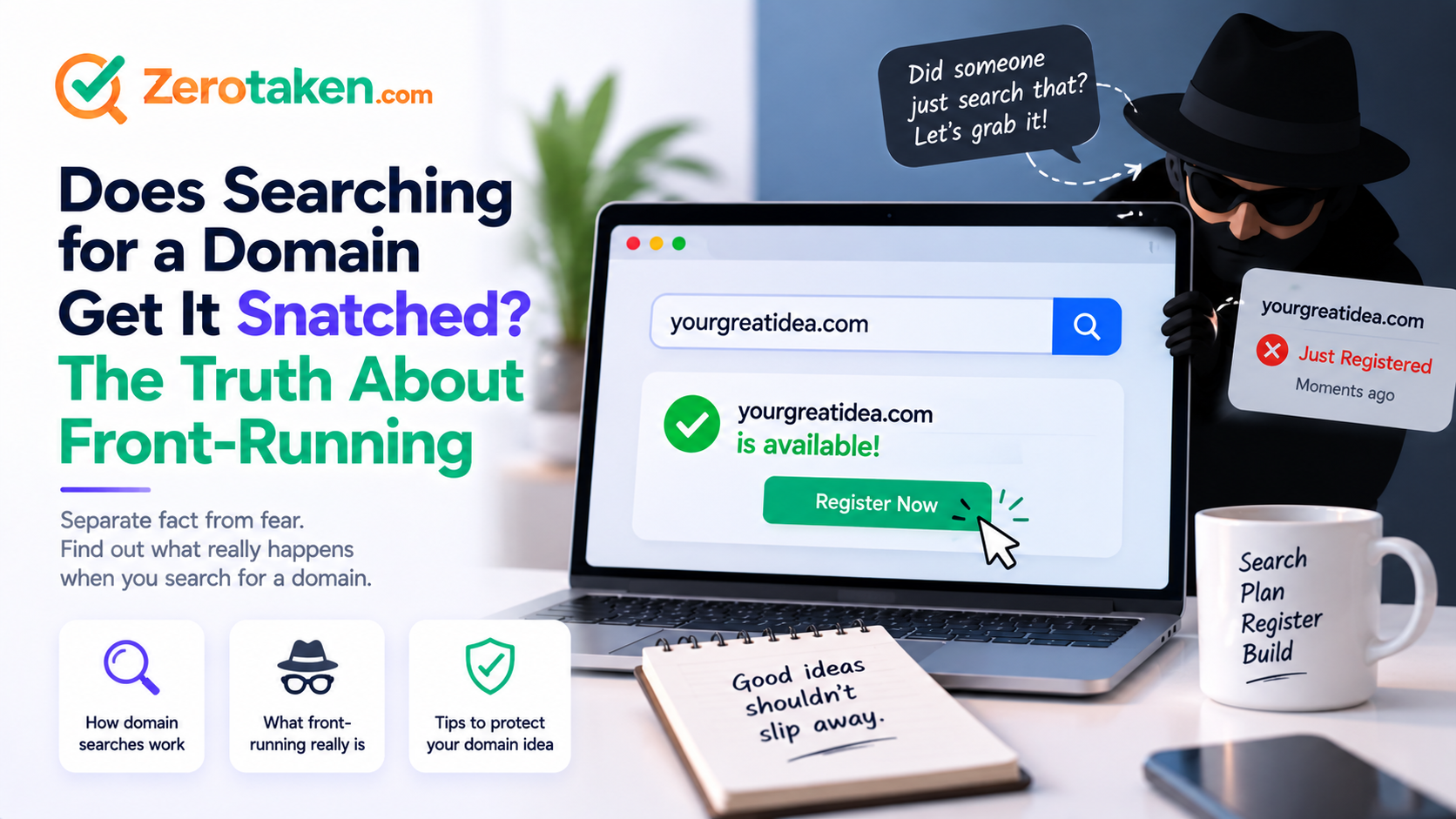
What is domain front-running, exactly?
Domain front-running is the idea that when you check whether a name is available, whoever you checked with quietly registers it themselves — so that when you come back to buy it, it's suddenly taken and being offered to you at a markup. The fear is specific: not that a name gets bought by coincidence, but that the act of searching is what tipped someone off and cost you the domain.
It's worth separating this from ordinary competition. Good names get registered every day by other people who simply had the same idea — that's not front-running, that's a busy market. True front-running requires that your private search itself leaked, and that someone acted on that leak faster than you did. That's a much narrower claim, and it's the one worth actually testing.
Did a registrar really get caught doing this?
Yes — and this is why the fear won't die. In 2008, Network Solutions, one of the oldest registrars on the internet, was caught placing a hold on domains that users searched for on its site. For up to four days after your search, the name was reserved on their systems, so you couldn't go register it cheaply somewhere else — you had to buy it from them. They defended it as "front-running protection," which was a remarkable piece of spin given that it was the exact behavior founders feared.
The backlash was immediate. ICANN and the domain community pushed hard, the practice drew formal scrutiny, and Network Solutions eventually walked it back. That episode is the origin of the modern myth — a real, documented case that everyone half-remembers. But it's also the reason the industry became allergic to the behavior: it turned into a reputational third rail that reputable registrars now go out of their way to avoid.
So does front-running actually happen today?
For reputable registrars and availability tools, effectively no. The incentives run the other way. A registrar makes a few dollars a year on a normal registration and stakes its entire business on trust; getting caught hoarding customers' searched names would be commercial suicide in an industry with long memories and low switching costs. ICANN scrutiny, the Network Solutions precedent, and the ease of naming-and-shaming on social media all make it a terrible bet.
The honest caveat is that "reputable" is doing real work in that sentence. A handful of shady free "domain generator" and bulk-checker sites do monetize what you type — not necessarily by registering names, but by logging searches, selling the data, or feeding it to aftermarket bots that watch for interest. The risk isn't your mainstream registrar front-running you; it's an obscure tool treating your best idea as its product. Which leads to the part most founders get wrong.
Where does the real risk actually come from?
Almost always: you. The most common way a founder loses a name between finding it and buying it isn't a registrar conspiracy — it's self-inflicted broadcasting. You tweet "just found the perfect name 👀," you drop it in a public pitch deck, you post it in a Slack community, you register the matching social handles first, or you sit on it for three weeks "to think about it." Every one of those is a louder signal of intent than any private availability check.
Registering social handles before the domain is an especially sneaky leak, because handle registrations are public and searchable. So is querying a public WHOIS record over and over on a name you don't own yet — it's visible activity around a specific string. The uncomfortable truth is that the search box is rarely the leak. The leak is enthusiasm: telling the world about a great name you haven't paid for yet.
How do you check a domain without tipping anyone off?
Use a tool that checks availability directly against DNS and the domain registry rather than one that hammers public WHOIS or exists to upsell you, and use one that doesn't log or sell your queries. A clean availability check reads the same public records your registrar reads at checkout — it doesn't broadcast your intent to an aftermarket. The problem was never "checking"; it was checking on the wrong kind of site.
ZeroTaken was built with exactly this in mind: it verifies names against DNS and the registry, checks multiple extensions in a single search, and never logs your queries — so you can test dozens of ideas without handing your best one to a bot. Check quietly, check as many names as you like, and keep the winners to yourself until they're registered.
Should you register the moment a name clears?
If you're serious about it, yes — same session. The only window that genuinely matters is the gap between "this is free" and "this is mine," and the way to close that window is to stop treating registration as a separate decision for later. A .com costs about $10–15 a year. Against the cost of losing the name you built a deck around, that's not a purchase you deliberate over; it's insurance you buy on the spot.
This is also the practical answer to the whole front-running worry. Even in a world where some obscure tool did leak your search, the leak only hurts you if there's time to act on it. Register within minutes of confirming availability and you've eliminated the window entirely — no bot, no reseller, and no coincidental competitor can beat you to a name you've already paid for.
What should you never do before you own the name?
There's a short list of moves that turn a private idea into a public target. Avoid all of them until the domain is actually in your account:
- Don't post or tweet the name — not even a teasing hint — before it's registered
- Don't put it in a public deck, Product Hunt draft, or open community channel
- Don't register the matching social handles first; handle activity is public and signals intent
- Don't run the name through five random free checkers in a row — pick one tool you trust
- Don't 'sit on it' for weeks; if it clears and you're serious, buy it now
- Don't repeatedly query public WHOIS on a name you haven't bought yet
So what's the verdict on domain front-running?
Registrar front-running is mostly a ghost story with one real origin. It happened, famously, once — and the industry reaction to that single case is exactly why your mainstream registrar won't do it to you today. The odds that a reputable availability check costs you a domain are vanishingly small, and they drop to zero the moment you register.
The risk that's actually worth managing is the human one. Check names with a tool that doesn't log or sell your queries, resist the urge to announce the good one, and register it the same session you fall in love with it. Do those three things and front-running becomes what it mostly already is: a fear, not a threat.