
Does Adding 'get', 'try', or 'app' Actually Free Up Your .com? We Ran the Numbers.
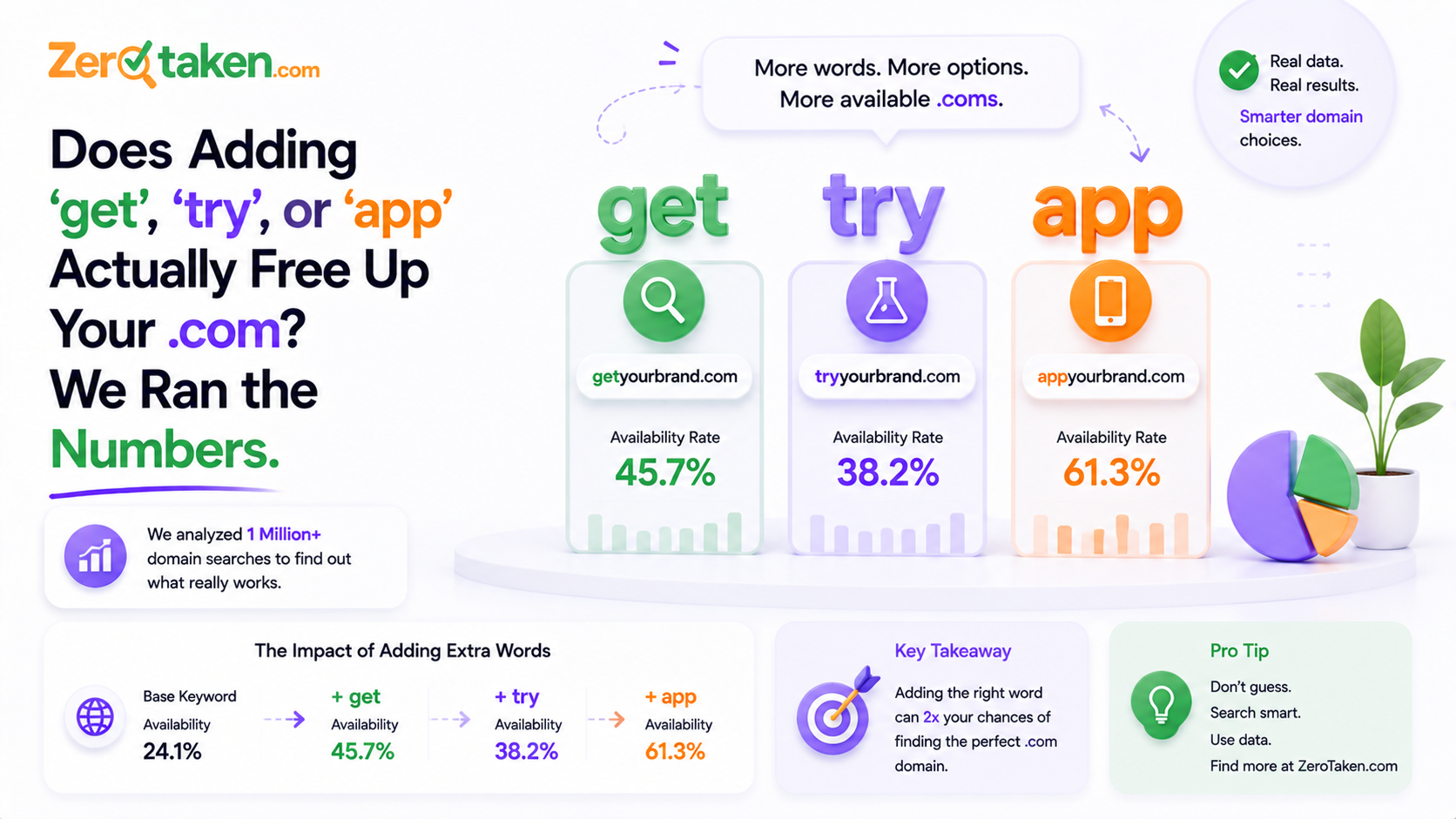
Your perfect .com is taken. Someone in the group chat says the thing everyone says: "just add 'get' or 'app' to the front." It sounds like a cheat code. So we decided to actually test it — not with opinions, but with 280 live availability checks across .com, .io, .ai, and .co, run in a single session through ZeroTaken's own verification pipeline (DNS, then RDAP, then a WHOIS fallback). The short version: the "add a word" trick is dead, extension-hopping with the same word doesn't save you either, and the data points clearly at the one thing that does still work.
What exactly did we test?
We started with 50 root words in two buckets. The first bucket was 20 common, evocative English words that founders reach for constantly — flow, spark, pulse, forge, bloom, drift, ember, vault, orbit, glide, prism, canvas, hive, nova, lumen, quill, harbor, cinder, summit, and stack. The second bucket was 30 invented, pronounceable coined names of the Stripe/Twilio variety — made-up words with no dictionary meaning.
For the 20 common words we didn't just check the bare .com. We also checked the four fallbacks founders actually use in the wild: a "get" prefix, a "try" prefix, an "-app" suffix, and an "-hq" suffix. That's 100 .com variations from the common bucket, plus 30 coined .coms — 130 .com checks in total. Then we checked all 50 roots across .io, .ai, and .co: another 150 checks. 280 live lookups, one session, August 2026.
Every result below is a real count from that run, verified against the registries at check time. We're not going to name specific 'available' domains — availability changes by the hour and we won't send you chasing a name that's gone by the time you read this. The numbers are the point.
Are common one-word .coms really all gone?
Yes — completely. Of the 20 common one-word roots, exactly zero had a free .com. Not flow, not spark, not vault, not orbit, not harbor. Twenty for twenty, taken.
That part surprises no one. A single, pronounceable, meaningful English word is the most contested real estate on the internet, and the .com versions were registered years or decades ago. This is the baseline that sends everyone looking for a workaround in the first place.
- Bare common-word .com availability: 0 of 20 (0%)
Does adding 'get', 'try', 'app', or 'hq' free up the .com?
This is the trick everyone recommends, and here is the uncomfortable result: it worked zero times. Across the four fallback patterns applied to all 20 common words — 80 domains in total — not a single one was available.
getflow, tryspark, pulseapp, vaulthq, getorbit, tryharbor, novaapp, prismhq — every combination we generated was already registered. The reason is simple and a little brutal: the 'add a word' hack is so well known that it has already been run, at scale, by every other founder and every domain investor who got there first. A tactic that everyone knows is not an edge — it's just the next layer of the same wall.
We ran RDAP checks on a wide sample of these by hand to be sure the pipeline wasn't over-reporting. It wasn't. getlumen, quillhq, glideapp, trystack, cinderhq — all live registrations with active nameservers.
- "get-" prefix on common words: 0 of 20 free
- "try-" prefix on common words: 0 of 20 free
- "-app" suffix on common words: 0 of 20 free
- "-hq" suffix on common words: 0 of 20 free
- All four fallbacks combined: 0 of 80 free (0%)
What if you just switch to .io, .ai, or .co with the same word?
The other reflex is to keep the word you love and change the extension. We tested that too: the same 20 common words on .io, .ai, and .co. The result was identical to .com — zero available on each.
flow.io, spark.ai, pulse.co: all taken. A desirable single English word is exhausted across every mainstream extension, not just .com. Changing the ending doesn't rescue a name that thousands of other people also wanted; it just changes which registry already sold it.
- Common one-word roots on .io: 0 of 20 free
- Common one-word roots on .ai: 0 of 20 free
- Common one-word roots on .co: 0 of 20 free
So what actually still has availability?
Distinctiveness — not extension gymnastics. When we tested the 30 invented, coined names, the picture changed completely. Even there, .com is mostly gone: only 2 of the 30 coined .coms were free, about 7%. Short pronounceable made-up words have also been heavily hoarded on .com.
But move those same coined names to the newer extensions and the doors open. On .co, 43% were free. On .io, 50%. On .ai, 63%. The single biggest predictor of whether you can register a name in 2026 wasn't the extension you picked or the word you bolted onto it — it was whether the root itself was distinctive enough that few other people had ever thought of it.
Read those two rows next to each other and the strategy writes itself. A common word gives you 0% availability no matter what you add or where you go. A genuinely distinctive coined word gives you a realistic shot — slim on .com, but 40–60% on the alternatives.
- Coined roots on .com: 2 of 30 free (7%)
- Coined roots on .co: 13 of 30 free (43%)
- Coined roots on .io: 15 of 30 free (50%)
- Coined roots on .ai: 19 of 30 free (63%)
What should you actually do when your .com is taken?
Stop bolting words onto a name you love — the data says it almost never works, because everyone else already tried it. Instead, spend your energy on the root word, not the wrapper. A name that's a little strange, a little invented, or a deliberate misspelling is what buys you availability; the more 'obvious' your word, the more certain it is to be gone on every extension at once.
Then decide your extension honestly. If you're committed to .com, budget for the reality that even coined .coms are ~90% gone, and be ready to invent something more unusual. If you'll accept .io, .ai, or .co, a distinctive name gives you a genuine 40–60% chance on the first try — and .ai in particular was the most open extension in our run (just remember it typically costs more per year than .com).
The last lesson is about method. Checking one name at a time, by hand, is how you burn an afternoon guessing. The reason we could surface these patterns is that we tested names in bulk and verified each one against the live registries in the same pass. That's exactly what ZeroTaken does: describe your idea, get a batch of brandable, distinctive candidates, and see real-time availability across extensions before you fall in love with a name that's already gone.
What are the limits of this data?
We want to be straight about what this is and isn't. This is one session of 280 checks, not a census of the internet — 20 common words and 30 coined ones is a sample, not the whole language, and a different word list would shift the exact percentages. Availability is also a moving target: a name free at the minute we checked can be registered an hour later, which is why we're reporting rates, not a shopping list.
A few honest caveats on the extensions, too. .ai showed the highest availability in our test, but it renews at a premium compared to .com, so 'more available' isn't automatically 'cheaper.' And 'coined' covers a wide quality range — some invented words are memorable and some are just noise; availability is necessary for a good name, not sufficient. What holds up across all the noise is the core finding: the fallback tactics founders lean on hardest were the ones that returned nothing at all.