
.org vs .com: When Should You Actually Choose .org?
Your .com is taken or you're weighing the alternatives, and the .org is sitting right there — same word, standard price, and a faint air of being more "legitimate" than the .net or .co next to it. Before you grab it, here's the thing nobody spells out: .org carries a specific signal, and that signal helps you or hurts you depending entirely on what you're building. This guide gives you the straight version — where the nonprofit reputation comes from, whether Google or your customers care, the exact projects where .org is the right call, and the one mismatch that quietly undermines commercial brands that reach for it.
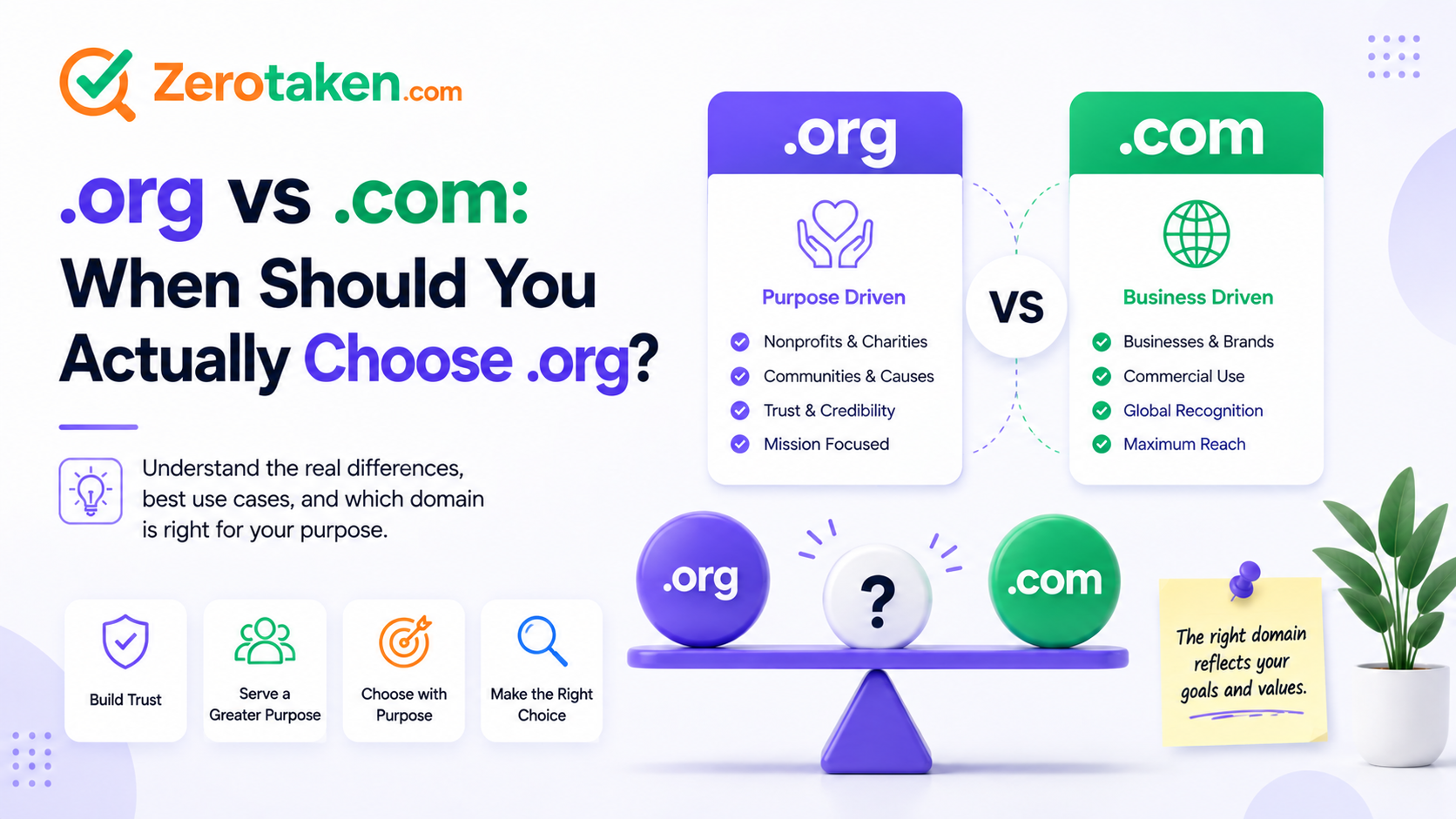
What actually separates .org from .com?
.org and .com were both switched on in 1985, part of the original handful of top-level domains. The split was one of intent: .com for commercial entities, .org as the catch-all for "organizations" that didn't fit the commercial, network, government, or education buckets — so it became the home of nonprofits, charities, NGOs, foundations, open-source projects, and community sites. That's where the reputation was built, and unlike .net's faded "network" association, the .org halo is still very much alive.
The technical reality is that .org is an open, generic top-level domain (gTLD) with no restrictions — anyone can register one, for anything, no proof of nonprofit status required. It's run by the Public Interest Registry (PIR), itself a nonprofit, which took over stewardship in 2003. So the letters carry a public-interest connotation the registry actively leans into, even though the rules behind them are wide open. That gap between what .org signals and what it actually requires is the whole story, and we'll come back to it.
Is .org only for nonprofits?
No — and this is the single most common misconception about the extension. There is no eligibility check. A for-profit company can register a .org this afternoon, and plenty have. The restriction is not in the registry; it's in your visitor's head. When a mainstream audience sees .org, a large share of them assume charity, cause, community, or reference material — not a company that's going to charge them money.
That assumption is a tool, not a rule. Point it in the right direction and it does free branding work: instant credibility for a nonprofit, an open-source project, or a standards body. Point it the wrong way — a paid SaaS or a store on a .org — and it creates a quiet dissonance. Visitors can't articulate why, but "why is this product on a .org?" sits in the back of their mind, and a few of them wonder whether you're a real business or whether you simply couldn't get the .com.
Is .org worse for SEO than .com?
No. Google treats .org exactly like .com — both are generic gTLDs with no geographic targeting and no ranking penalty baked into the extension. A .org can and does rank on page one against .com competitors on identical footing; Wikipedia, one of the most-visited sites on earth, lives on .org. Relevance, backlinks, content depth, and site speed decide your position. The letters after the dot do not.
The honest caveat is about people, not algorithms. For a commercial query, a slice of a mainstream audience reads .com as the "real business" default and may click it over a .org competitor. But the effect cuts the other way for the right context: on a charity, research, or public-resource query, .org can actually read as more authoritative and trustworthy than a .com. As with every extension, the bigger SEO-adjacent risk isn't ranking — it's that if someone else owns the matching .com, a share of the people searching for you will land on them instead.
Does .org cost more than .com?
Not in any way that should drive the decision. Both register and renew in the same rough $10–15 per year range at mainstream registrars. .org is worth a quick note of history here: ICANN removed the price caps on .org in 2019, and in 2020 a proposed sale of the registry to a private-equity firm was blocked after public backlash — a reminder that the extension's "nonprofit" governance is a real, watched thing, not just marketing. Prices ticked up afterward but stayed in normal territory.
So there's no money argument either way. If both the .com and the .org of your name are available at standard price, cost gives you zero reason to prefer one. The decision comes down entirely to signal — what your audience should read into the extension — and whether you can hold both.
When is .org actually the right choice?
More often than .net, and for a clearer reason: sometimes the nonprofit-and-community signal is exactly what you want to broadcast. Choose .org deliberately when one of these is genuinely true:
- You're a nonprofit, charity, NGO, or foundation. Donors and grantmakers expect .org, and the extension does trust-building work before anyone reads a word. Here .org is the default and .com is the afterthought — the reverse of the usual advice.
- You're launching an open-source project or a developer community. Some of the most respected names in software live on .org on purpose — python.org, kernel.org, mozilla.org — because the extension reads as non-commercial and contributor-owned, which is exactly the trust an OSS project needs.
- You're building a community, forum, membership association, or standards body. "Organization" is the literal use case, and .org signals "this belongs to its members," not "this is someone's revenue engine."
- You're publishing a public-interest resource — an educational reference, an open dataset, a watchdog or advocacy site. .org lends the neutrality and authority a commercial extension can't fake.
- You specifically want to signal "we're not here to sell you something." If non-commercial trust is your core asset, the extension can reinforce it for free.
When does .org quietly hurt you?
When you're a commercial product wearing a non-commercial signal. If you run a SaaS, an e-commerce store, a consumer app, or an agency, a .org creates a mismatch between what you are and what your domain says. Nobody rejects you outright, but the friction is real: prospects hesitate for a beat, some assume you're a nonprofit and are confused when there's a pricing page, and a few quietly read it as "couldn't get the .com." For a business trying to look established, that's a headwind you're choosing on purpose.
The second cost is the same type-in leak every non-.com brand pays. Say your name on a podcast, print it on a card, or get recommended out loud, and a predictable chunk of that audience types yourname.com on muscle memory. If you don't own it, you're handing those visitors to whoever does — and because .org's halo attracts a bit of impersonation, an unrelated or parked .com sitting on your word is worth checking before you commit, not after.
So .org or .com — what should you actually pick?
Default to .com for anything commercial. Consumer apps, SaaS, stores, agencies — the .com is worth reaching for first, whether that means a slightly longer name, a different word, or a modest aftermarket purchase, because it's the extension people type without thinking and it carries no "are you a charity?" question. Reach for .org on purpose, when the nonprofit-community-public-interest signal is an asset you actually want: a charity, an open-source project, a standards body, a public resource.
And whichever you lead with, own both when you can. A nonprofit on .org should still grab the .com so a competitor or a scammer can't; a project that builds its brand on .org should redirect the .com to it to plug the type-in leak. Fifteen dollars a year is cheap insurance. Before you commit, check the whole shortlist across both extensions — running your candidates through ZeroTaken shows the .com and .org status side by side, so you find out who owns what before you're attached to a name.
The rule in one line: pick .com unless your entire value is non-commercial trust — and if you build on .org, own the .com too.