
Verb, Noun or Made-Up Word? Which Kind of Name Makes the Best Domain
Most naming advice stops at "make it memorable." That is not a decision. The decision you actually face is which *type* of name to build: a real noun (Stripe), a verb (Zoom), a compound (Dropbox), or an invented word (Spotify). Each type has a predictable relationship with domain availability, spelling, trademark risk and word of mouth. Pick the type first, and the shortlist writes itself. Pick it by accident, and you end up with a name that is either already taken or impossible to type.
Añade ZeroTaken como fuente preferida en Google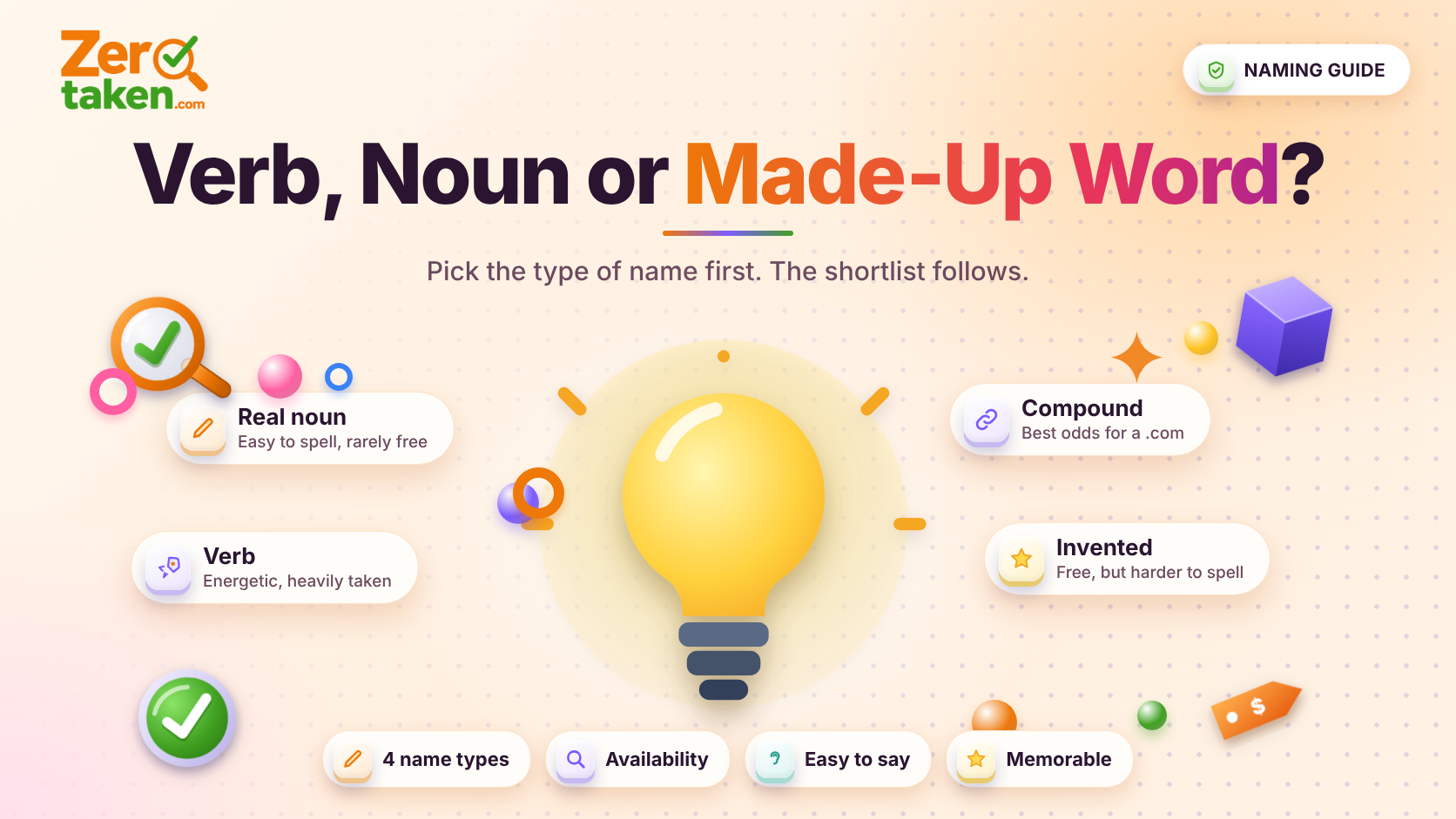
Why does the type of name matter more than the name itself?
Because the type decides your constraints before you have typed a single candidate. Real dictionary nouns are overwhelmingly registered on .com already. Invented words are almost always free but cost you in spelling and recall. Verbs and compounds sit in the middle. If you do not know which bucket you are fishing in, you will waste hours generating names that were never going to be available, or names nobody can spell back to you.
Think of it as choosing a fishing spot before choosing a lure. The four types below cover nearly every successful tech brand.
What are the four types of brand name?
Every name you are likely to consider falls into one of these:
- Real noun: a common word used out of context (Stripe, Notion, Slack). Instantly spellable, nearly always taken as a .com.
- Verb or action word: says what the user does (Zoom, Shopify-style "-ify" forms, Gather). Energetic, but short verbs are heavily registered.
- Compound: two real words joined (Dropbox, Mailchimp, Basecamp). The sweet spot for availability, because the combination is unique even when each word is common.
- Invented word: coined or altered (Spotify, Figma, Canva). Almost always available, but you pay for it in explanation and marketing.
Which type is easiest to find a .com for?
Invented words, by a wide margin, then compounds, then verbs, then real nouns. That ordering is not a rule of nature but it is what you will see the moment you start checking candidates: every single dictionary word you try on .com will come back registered, and the more common the word, the more certain that is.
The practical consequence is blunt. If your plan is "one real English word, as a .com, for the registration fee," you are planning for something that almost never exists. Either choose a type further down the list, or budget for buying a taken domain from its owner, which is a different and much more expensive project.
Which type is easiest to say and spell?
The reverse ordering. Real nouns win because everybody already knows how to spell them. Compounds follow, provided both halves are plain words. Verbs depend on whether you used a standard spelling. Invented words lose here: if you hear "Figma" on a podcast you have to guess whether it is one G or two.
This is the trade-off nobody escapes. Availability and effortless spelling pull in opposite directions, and your job is to choose where on that line you want to sit. A founder with a large marketing budget and a visual product can afford an invented word. A founder relying on word of mouth and podcast mentions usually cannot.
When should you choose a compound name?
Most of the time, if you are bootstrapped. A compound gives you a name that is spellable by default, hints at what you do, and has a realistic chance of being free on .com. The trick is the quality of the pairing. "Cloud" plus "Tools" is a descriptor, not a brand. Two words that do not usually sit next to each other, or one concrete word plus one abstract one, produce something that feels like a name rather than a category label.
Two guardrails. Keep the total under about twelve characters when you can, because every extra letter is another place to make a typo. And read the joined string aloud for accidental word breaks, since compounds are where unfortunate readings hide.
When is an invented word worth the cost?
When you can afford to teach people your name, and when your category is so crowded that any real word will be confused with an existing brand. Invented words also travel well across languages, because they carry no meaning that can collide with a local one. That makes them a reasonable choice for a product aimed at several countries from day one.
The cost is real, though. Expect to spell your name in every sales call, and expect early support emails with the name misspelled. Keep invented names phonetic: if a stranger can write it correctly after hearing it once, you are fine. If they cannot, you have built a permanent tax on your own growth.
Should you pick a verb for your startup's name?
Only if the verb is the product's core promise and you have a distinctive form of it. A verb gives you a free marketing hook, because users can turn the brand into an action ("just zoom me"). But plain verbs are the most contested real estate on the internet, and the common workaround of tacking on a suffix like "-ly" or "-ify" now reads as dated. If you go this route, look for an unusual verb rather than the obvious one for your category.
One more caution: a verb that is too generic is hard to protect. The more ordinary the word, the weaker your claim on it if someone else in a nearby field uses it too.
How do you choose between the four types?
Answer three questions in order. First, how will most people learn your name: by reading it, or by hearing it? If they hear it, favour real nouns and plain compounds. Second, what is your marketing budget for the first year? If it is close to zero, avoid invented words. Third, how crowded is your category? The more crowded it is, the more distinctive the name needs to be, which pushes you toward compounds with an unexpected pairing or toward invented words.
Then generate candidates only within the type you chose, and check each one on your target extension before you get attached. A tool such as ZeroTaken can check a batch of candidates at once, which keeps you from falling in love with a name that is already registered.
- Learned by ear, small budget: plain compound.
- Learned by eye, crowded category: distinctive compound or invented word.
- Product is one clear action: unusual verb.
- Aiming at several languages from day one: invented, phonetic word.
What is the bottom line?
Decide the type before you brainstorm. For most bootstrapped founders that type is a compound of two plain words with an unexpected pairing, kept short and checked for accidental word breaks. If you have budget and a crowded market, go invented but phonetic. Treat a single real noun on .com as something you will have to buy, not register, and plan accordingly.