
Someone Already Runs Your Name on .com. Can You Still Launch on .io or .co?
You have the name. You love it. Then you type it into a browser and find a live business on the .com, with customers, a logo, and a Google ranking. The tempting move is to grab the .io or .co and ship. Sometimes that works. Often it quietly hands your traffic, your email and your credibility to someone else. The deciding factor is not the extension. It is how much the other site overlaps with you, and that is something you can score in about twenty minutes.
Añade ZeroTaken como fuente preferida en Google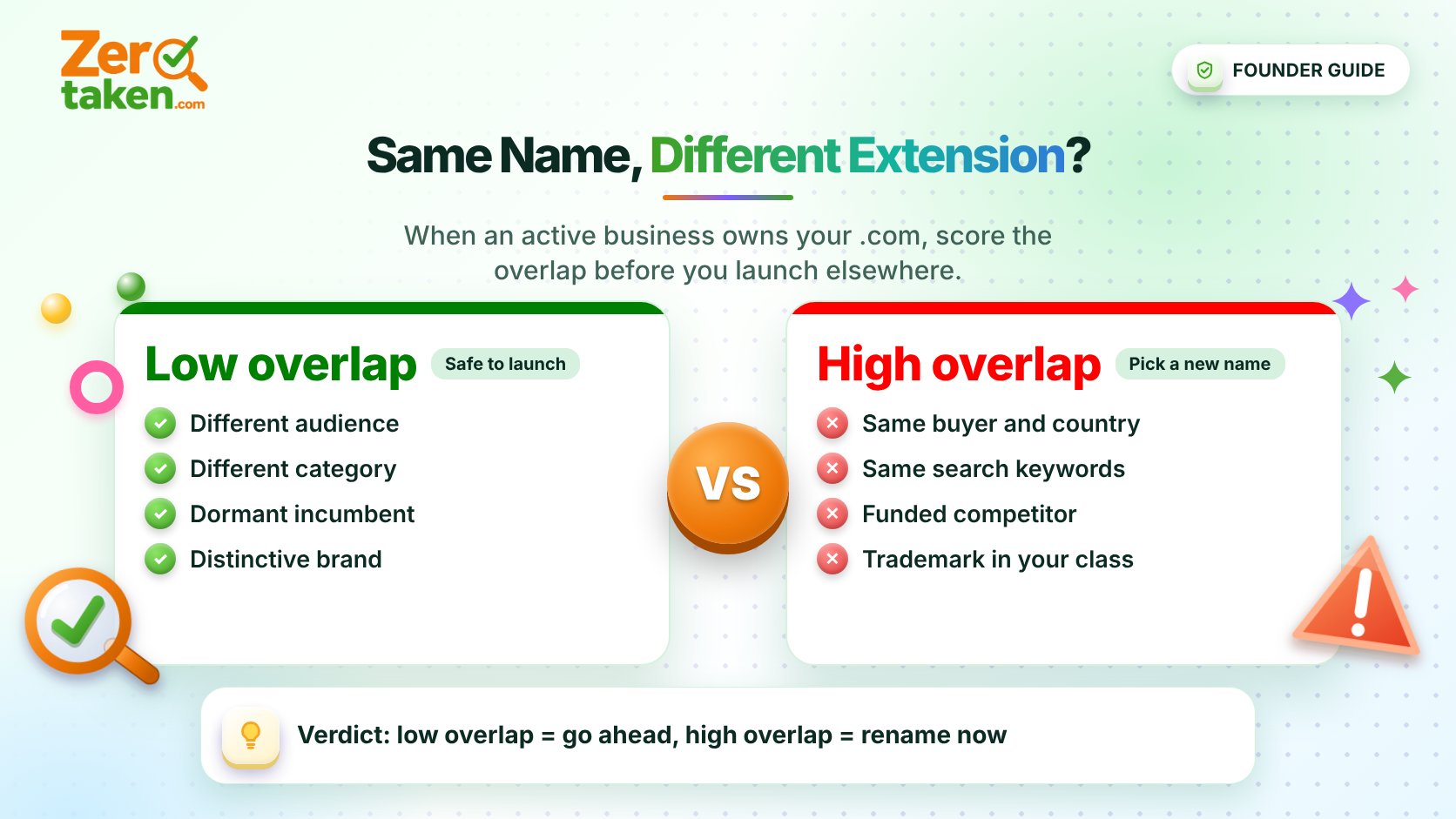
Why is this different from a parked or abandoned .com?
A parked or dormant .com is a negotiation problem: you can usually find the owner and make an offer. A live business with the same name is a collision problem. You cannot buy your way out, and the other company has every incentive to keep the name.
Your customers will not read extensions the way you do. They hear a name, type the name plus .com, and land on the incumbent. Every mention of your brand in a podcast, a conference talk or a friend's recommendation is a small donation to the site that owns the .com.
How much do you and the other business actually overlap?
Score the overlap before anything else. This single check decides most cases, and it takes minutes.
If you score two or more 'high' answers below, treat the name as compromised and pick a different one. If you score zero or one, the other extension is a workable path.
- Same audience: do you target the same buyer, in the same country and language? High overlap is the worst case.
- Same category: would a search for the name plus your product keyword surface them? If yes, you will fight them on every query.
- Same stage: a funded, growing competitor will outrank and outspend you. A dormant hobby site will not.
- Same handles: are the main social usernames already taken by them?
- Same trademark class: check your national trademark database for a registration covering your category.
When is launching on another extension a reasonable call?
It works best when the incumbent serves a completely different market. A bakery in one city and a developer API sharing a name can coexist for years, because no customer is ever confused about which one they wanted.
It also works when your brand is the more distinctive of the two. If you are building a product people will find by name through app stores, referrals and direct links, a modest search collision matters less than it would for a business that depends on organic discovery.
The pattern to avoid is the opposite one: a descriptive, search-driven business that lives or dies by Google, launching in the shadow of an established site with the exact same name. You would be competing for your own brand query.
What are the real costs people underestimate?
Misdirected traffic is the obvious one, but three quieter costs usually hurt more.
- Misdirected email: people will mistype your address with the .com ending. Some of those messages, including customer inquiries and invoices, will reach a stranger.
- Branded search: for the first year or two, searching your own name returns the incumbent first. Your own site may sit below theirs.
- Legal exposure: if the other business holds a trademark in your category, a different extension is not a defence. Common-law rights can apply even without registration.
How do you reduce the damage if you go ahead?
Decide to differentiate on purpose rather than hoping nobody notices. A distinctive modifier in the brand itself, not just the extension, does more than any technical fix. 'Northwind' on .io is a collision; 'Northwind Labs' with a distinct logo and tone is a separate brand.
Then lock down the basics: register the common mistyped variants you can afford, set up email with a clear display name, and make your site title and structured data say who you are and what you do so search engines separate you from the incumbent faster. Keep a record of when you started using the name, since priority of use matters if a dispute ever arises.
Should you just pick a different name?
If the overlap score is high, yes, and sooner is better. Renaming at the idea stage costs you an afternoon. Renaming after launch costs you backlinks, printed material, customer trust and often a legal letter.
A good test: would you be comfortable if the other company's customer service line got calls meant for you? If that sounds like a daily irritation instead of a rare joke, the name is not worth it. Run a few fresh candidates through ZeroTaken to see which exact-match options are open, and choose one with a clean search page.