
Your Perfect .com Is Taken. Here's How to Actually Buy It.
You typed your dream name into a search box, the .com came back taken, and it is not even a real website — just a parked page with an ad grid or a "this domain may be for sale" banner. That is the moment most founders give up and settle for a hyphen or a weird spelling. But a registered domain is not a locked door; it is a price you have not learned yet. A large share of registered domains sit idle — parked, expired-and-flipped, or held by an investor waiting for exactly your email — and many of those owners will happily sell. This guide is the practical version: how to tell whether the name is actually gettable, how to find and contact the owner, what a fair price really is, and how to negotiate without wiring five figures to a stranger or tipping off the seller that you are funded.
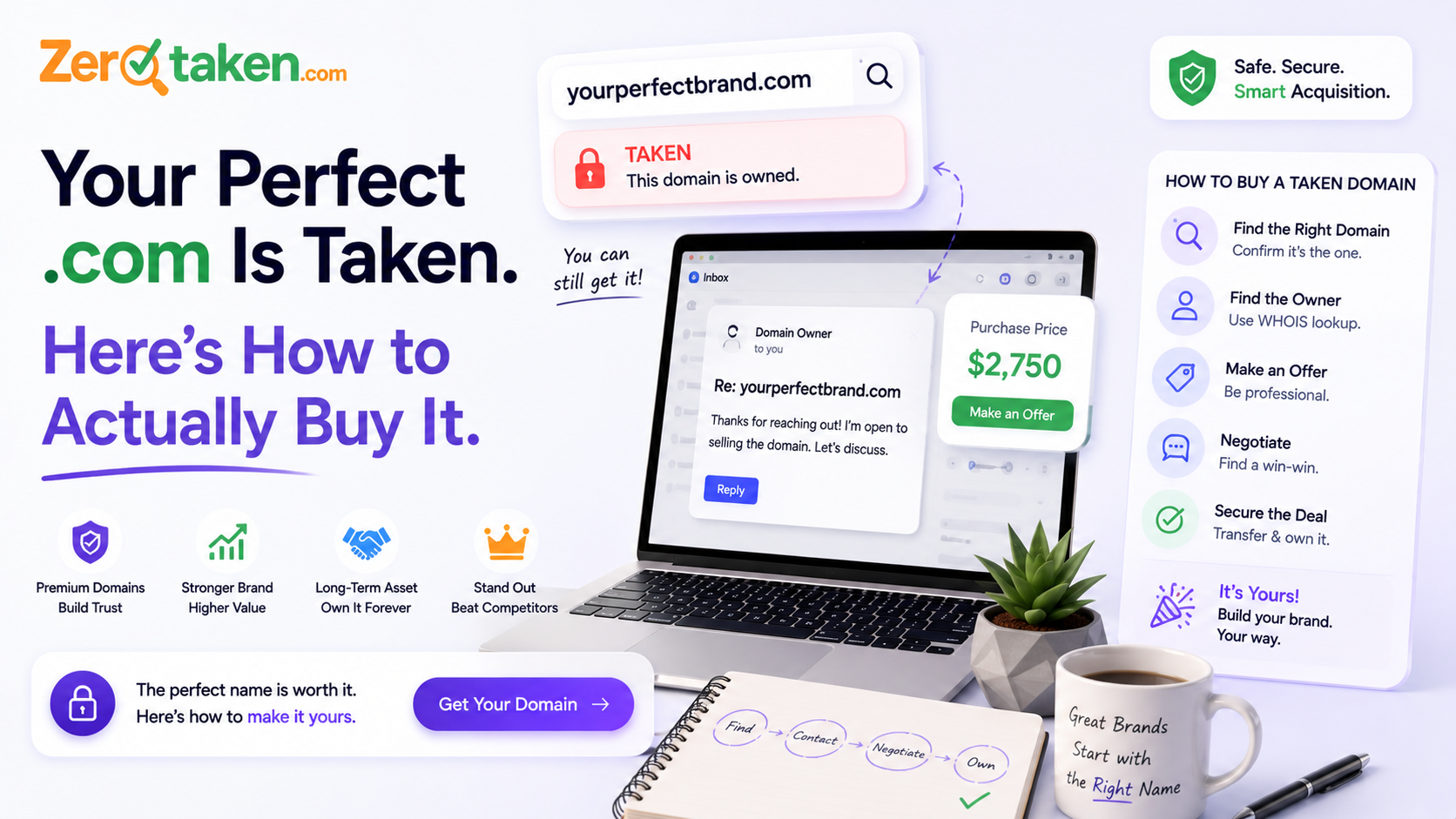
Is the domain actually for sale, or just sitting there?
Before you spend a minute chasing a name, figure out which of three states it is in, because they have completely different odds. A domain in active use — a real product, a company, a live blog with recent posts — is almost never for sale at a sane price, and cold-emailing an operating business to buy its address usually gets you ignored or quoted a number designed to make you leave. A parked domain — a placeholder page with generic ads, a "buy this domain" link, or nothing but a registrar default page — is the opposite: it is inventory, and the owner is often actively waiting for an offer. The third state is a premium listing, where a marketplace shows an instant "buy now" price; that is the fastest path but also the most expensive.
The quick test: open the domain in a browser and look at what actually resolves. A functioning product means walk away or expect to pay dearly. A parking page, a for-sale lander, or a dead connection means there is real room to make a deal. Then check the age and status with a WHOIS lookup — a domain that has changed hands or lapsed recently behaves very differently from one a founder has quietly held since 2011.
How do you find out who owns it?
Start with WHOIS, but set your expectations: since GDPR and the rise of registrar privacy, the registrant's name and email are redacted on the vast majority of domains. You will usually see "Redacted for Privacy" or a proxy service instead of a person. That is not a dead end — it is just a forwarding wall. Most registrars publish a contact form or a privacy-relay email that forwards your message to the real owner without exposing them. The WHOIS record still tells you useful things even when the identity is hidden: the registrar, the creation date, the expiration date, and whether the domain is locked or pending deletion.
When WHOIS is masked and there is no lander with a contact link, do a little open-source detective work. Search the exact domain in quotes, check the Wayback Machine to see what the site used to be (old sites often listed a real email or company), and look for a matching brand on LinkedIn or a personal site. If the domain is listed on a marketplace like Afternic, Sedo, or Atom, the "make offer" button routes straight to the owner and is by far the cleanest channel. The goal of this whole step is one working line of contact — you only need one.
- Run a WHOIS lookup first: registrar, creation date, expiry date, lock status
- Use the registrar's privacy-relay contact form when the email is redacted
- Check the Wayback Machine for an old email or company name on the site
- Look for the name on Afternic, Sedo, Atom, or Dan — a listing means a ready channel
What is a fair price for a domain someone already owns?
This is where founders get fleeced, so be clinical. There is no official price for a domain — it is worth exactly what someone will pay, and automated appraisals from tools like GoDaddy or Estibot are rough machine guesses that skew high. Treat any appraisal as a loose ceiling, never as "the value." What actually anchors a fair number is comparable sales: short, common one-word .coms trade in the tens of thousands, but the overwhelming majority of aftermarket domains — two-word brandables, invented names, longer phrases — change hands for somewhere between $500 and $5,000.
Sort the seller into a tier, because it predicts their floor. A hobbyist who registered a name years ago and forgot about it may say yes to $300 just to be rid of the renewal. A part-time investor wants a few hundred to a couple thousand and will haggle. A professional domain flipper prices to a formula and rarely moves far. A premium registry name (some new-extension domains carry permanently elevated registry pricing) is set by the registry itself, not a person, and is non-negotiable. Knowing which one you are dealing with tells you whether to counter hard or just pay the buy-now.
How do you make an offer without overpaying?
The single biggest mistake is negotiating as yourself, from your company email, sounding excited. The moment a seller sees a funded startup that has clearly already built a deck around this exact name, your price triples — you have told them you cannot walk away. Reach out from a neutral personal email, keep it short and unbothered, and never reveal that you are venture-backed, that the name is your brand, or that you have a launch date. "I'm interested in this domain for a small project — is it available, and what were you thinking?" leaks nothing.
Let them name a number first when you can; it sets a real ceiling. If you must anchor, anchor low but not insultingly — a serious opener around a quarter to a third of what you would actually pay leaves room to meet in the middle. Expect the first quote to be 3–10x the seller's true floor. Be patient across a few emails rather than accepting fast; silence is leverage, and a willingness to walk is the only leverage that reliably lowers a price. And decide your real maximum before the first message, in writing to yourself, so the negotiation cannot talk you past it.
- Use a neutral personal email, not your company address
- Never disclose funding, your brand, or a launch deadline
- Let the seller quote first; assume the opening number is 3–10x their floor
- Set your walk-away max before you send a single message
Should you use a broker or an escrow service?
Two different tools for two different problems. A broker negotiates for you and is worth it when the domain is expensive enough that a professional buffer changes the outcome — brokers stay unemotional, hide your identity, and know the comps. They typically take 10–20% of the sale, so they earn their fee mostly on four- and five-figure deals, not on a $400 name you can handle yourself with a calm email.
Escrow is non-negotiable on any real purchase. Never wire money directly to a stranger for a domain and hope they push the transfer — domain sales are a known playground for scammers. Use Escrow.com or a marketplace's built-in escrow (Afternic, Sedo, and Dan all handle the money and the transfer together): you pay into escrow, the seller initiates the registrar transfer or push, and the funds release only once the domain is verifiably in your account. For buy-now marketplace listings the escrow is automatic, which is a real part of why paying a listed price is sometimes worth the premium — it is simply safer and faster than a cold negotiation.
Is chasing the taken one even worth it?
Run the honest math before you fall in love. If the .com you want is going to cost $4,000 and three weeks of negotiation, ask what that buys you versus a genuinely available name you could register today for $12. For a pre-launch startup with no brand equity yet, the answer is often that a strong, available alternative is the smarter move — nobody has heard your name yet, so there is nothing to protect and everything to save. The domains founders overpay for are usually ones they anchored on emotionally, not ones the market rewards.
The disciplined workflow is to exhaust the free options first and only chase an owned domain when nothing available is good enough. This is exactly what ZeroTaken is built for: describe your idea, get brandable names, and see which are actually available to register right now across extensions — no query logging, so you are not handing your best idea to an aftermarket bot that raises the price the moment you search. If you run that first and still decide the taken name is the one, at least you are buying from strength, with a real alternative in your pocket.
What if the owner won't sell or never replies?
Silence is common — a lot of domains are held by people who check that inbox once a year, if ever. You have a few real moves. First, watch the expiration date you pulled from WHOIS. If the domain is close to expiring and the owner is genuinely inactive, it may lapse; a domain that is not renewed goes through a grace period and then a redemption window before it is finally released, usually around 75 days after expiry. You can set a backorder with a drop-catch service (DropCatch, SnapNames, Namejet) that tries to grab it the instant it releases — though popular names attract competing backorders and can go to auction.
Second, monitor rather than obsess. A domain expiration monitor tells you the moment a name's status changes so you are not manually re-checking WHOIS every week. Third — and usually the best outcome — treat the wall as a signal to pivot the name, not the mission. A small tweak to the root word, a different but equally strong two-word combination, or a matched pair on a different extension frequently lands you something available, brandable, and yours today, with none of the acquisition risk. The name is a vehicle for the idea, not the idea itself.
- Note the expiry date; a truly abandoned domain releases roughly 75 days after it lapses
- Set a backorder with a drop-catcher if you expect it to drop (popular names may go to auction)
- Use an expiration monitor instead of re-checking WHOIS by hand
- Be ready to pivot the root word — an available, brandable name beats a risky chase
So what's the verdict?
A taken domain is a negotiation, not a wall — but it is a negotiation you should enter cold-eyed. Confirm the name is parked rather than in real use, find one working line to the owner, price it against comparable sales instead of an inflated appraisal, and make your move from a neutral email without ever revealing how much you want it. Use a broker only when the number justifies one, and use escrow every single time. Those five habits are the difference between paying a fair price and funding a stranger's vacation.
The deeper discipline is knowing when not to buy at all. Before you spend four figures and three weeks chasing one name, make sure a free, available, equally strong alternative isn't sitting one search away. Buy the taken domain if it is genuinely worth it — but buy it from a position of having a plan B, not from the panic of thinking it is the only good name left. It almost never is.