
www or Non-www? Pick One in Five Minutes and Never Think About It Again
Founders spend weeks choosing a domain name and then lose an afternoon to a question that feels trivial: should the site live at www.yourbrand.com or just yourbrand.com? It's not trivial in one way — if you serve both without a plan, you get duplicate URLs, split analytics, and cookies that behave differently on each. But the decision itself is small. Pick the bare domain unless you have one of two specific reasons not to, redirect the other version permanently, and move on. Here's the reasoning, the two exceptions, and the setup checklist.
Add ZeroTaken as a preferred source on Google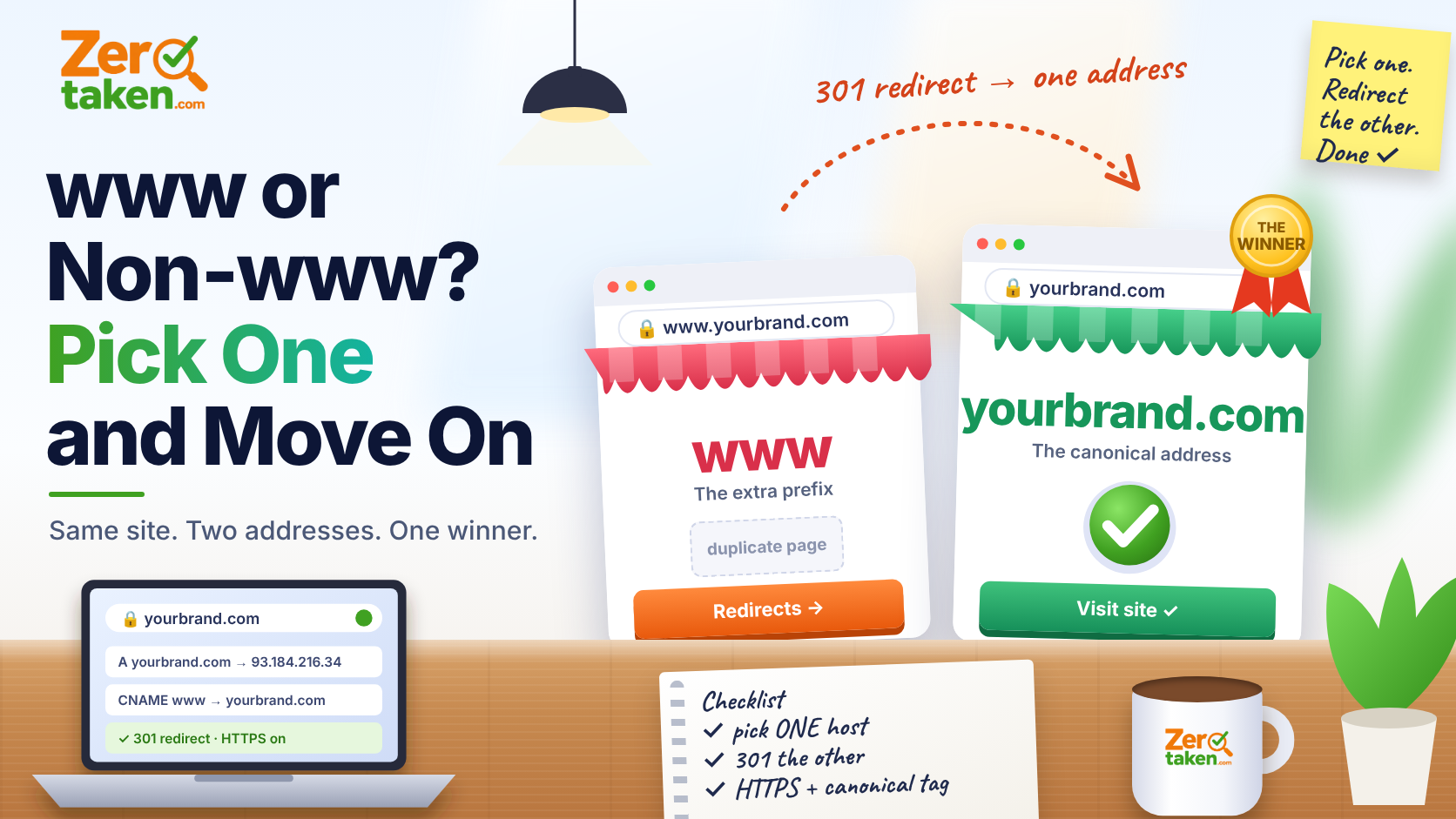
Does it actually matter which one you choose?
For rankings and users, no. Google treats www and non-www as different hostnames, but it doesn't prefer either. What it dislikes is ambiguity: the same page reachable at two addresses with no clear winner. That splits links, muddles reporting, and occasionally leaves the wrong version indexed.
So the real rule is not 'choose www' or 'choose non-www'. It's 'choose exactly one canonical host and make every other version redirect to it with a permanent (301) redirect'. Consistency is the entire game.
Which should most startups pick?
The bare domain, yourbrand.com. It's shorter to say, shorter to print on a card, shorter in a tweet, and it matches how people already type and share brands. Nobody says 'dub dub dub' out loud anymore, and modern browsers hide the prefix anyway.
It also looks cleaner in your own product: email addresses are already name@yourbrand.com, so a bare-domain website keeps everything visually consistent. For a new brand with no legacy infrastructure, there is no strong argument for adding three characters and a dot to every URL you'll ever share.
When is www the smarter choice?
There are two real exceptions, and both are about DNS, not taste.
First, the apex problem. A bare domain (the 'apex' or root) can't hold a CNAME record under the DNS standard, because it must carry other records like MX and NS. If your host tells you to point your site at a hostname rather than an IP address, www is the clean place to do it. Many modern hosts and CDNs work around this with 'CNAME flattening' or ALIAS/ANAME records, so check whether yours does before assuming you're stuck.
Second, cookie scope. Cookies set on the apex are sent to every subdomain, including ones you may not control, like a support desk or a marketing tool on a subdomain. Cookies set on www stay on www. If you run a large site with many subdomains and need tight control, a www host gives you a cleaner boundary. For a typical early-stage startup this rarely matters, but it's the reason big, old, multi-property sites often stick with www.
- Host only supports CNAME to a hostname and no flattening → use www
- Many subdomains with different owners and strict cookie isolation → use www
- Everything else → bare domain
How do you set up the redirect correctly?
Whichever you choose, make both hostnames resolve and make the loser 301 to the winner, preserving the path and query string. So www.yourbrand.com/pricing?ref=x should land on yourbrand.com/pricing?ref=x, not on the homepage.
Then make sure HTTP redirects to HTTPS in the same hop where possible, and that your TLS certificate covers both hostnames. A redirect from a hostname whose certificate is invalid shows visitors a browser warning before the redirect ever runs, which defeats the point.
Finally, set the canonical host in your sitemap, your canonical tags, and your search console property, so every signal agrees. Mixed signals are how the 'wrong' version ends up indexed.
- Publish A/AAAA (or flattened ALIAS) for the apex and a record for www
- 301 the non-canonical host to the canonical one, keeping path and query
- Force HTTPS and cover both hostnames in the certificate
- Use the canonical host in sitemaps, canonical tags and internal links
What mistakes do founders make here?
The most common is configuring only one hostname. The site works at yourbrand.com, but someone types www.yourbrand.com from habit, and gets an error. Always set up both, even if one only exists to redirect.
The second is using a temporary (302) redirect and forgetting about it, which tells search engines the move isn't permanent. The third is switching later: changing your canonical host after you've built links and indexed pages is possible, but it's a migration, and it's an avoidable one if you decide now.
How can you verify your setup in two minutes?
Run a DNS lookup on both the apex and the www hostname and confirm each resolves to where you expect. Then load all four combinations — http and https, with and without www — and check that every one ends on a single address. ZeroTaken's DNS lookup tool shows the records for each hostname, which makes it easy to spot a missing www record or an apex pointing at the wrong place.
If all four land on one canonical URL after a single 301, you're done. Write down your choice, use it everywhere, and spend the saved afternoon on the part of the brand that customers actually notice.