
What Actually Happens When a Domain Expires? The 80-Day Timeline Founders Miss
Most founders think an expired domain is gone the next morning, or that it sits safely in their account until they get around to paying. Both are wrong. A .com moves through a fixed sequence of stages over roughly two and a half months, and the cost of getting it back climbs at each step. The part that hurts first isn't losing the name. It's that your website and your email can stop working within hours, long before anyone else could register it.
Add ZeroTaken as a preferred source on Google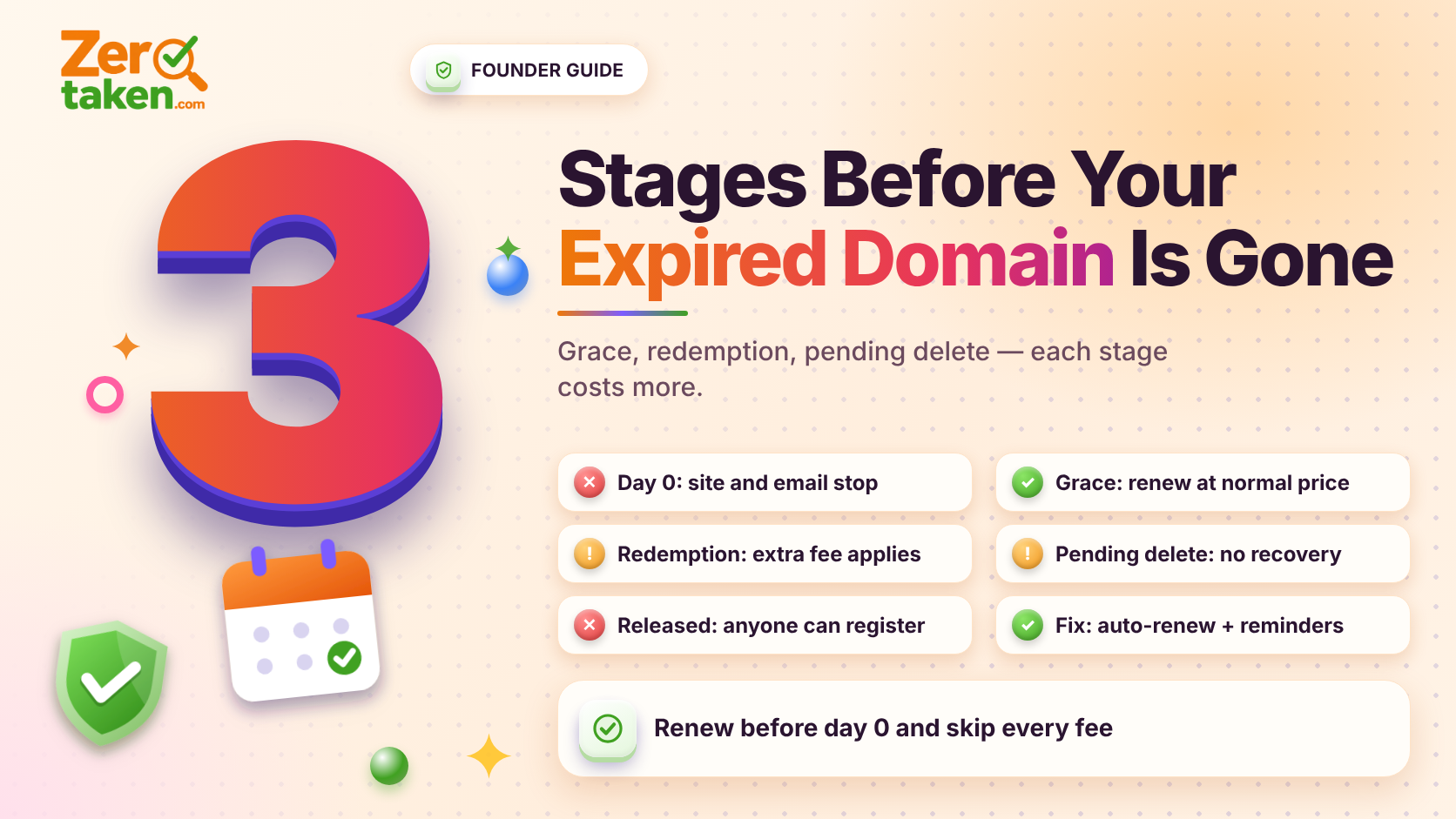
Does your domain really disappear the day it expires?
No. Expiry is the start of a process, not the end of ownership. For most generic extensions like .com, .net and .org, the name passes through three stages: a renewal grace period, a redemption period, and a short pending-delete window. Only after all three does it return to the public pool.
The exact length of the first stage is set by your registrar, not by a universal rule. The second and third stages are standard across the major gTLDs. Add them up and a typical .com is not publicly registrable for around 75 to 80 days after the expiry date. Country extensions (.de, .uk, .io and others) each have their own rules, so check yours instead of assuming this timeline applies.
What are the stages, in order?
Here is the sequence for a typical .com. Treat the day counts as approximate, since registrars vary on the first one.
- Day 0, expiry: the registration lapses. Many registrars immediately swap your nameservers for a parking page, which is the moment your site and email actually break.
- Auto-renew grace period (up to about 45 days): you can usually still renew at the normal price. Some registrars give you the full window, some give you a few days, and a few give you none.
- Redemption period (about 30 days): the name is now flagged for deletion at the registry. You can still recover it, but only by paying a redemption fee on top of renewal, which commonly runs from tens to a couple of hundred dollars depending on the registrar.
- Pending delete (about 5 days): no recovery at all. The name is locked and counting down.
- Release: the domain becomes available to anyone, and the fastest buyer wins.
What breaks first: the name or your business?
Your business. A lapsed domain stops resolving, so the site goes down, but the more damaging failure is email. If your team uses addresses on that domain, mail to it bounces or disappears the moment DNS stops pointing at your mail provider. Password-reset emails for every service you signed up to with that address stop arriving too.
Worse, some registrars replace your DNS records with a parked page showing ads. Visitors land on a page you don't control, search engines see thin content on your URL, and anyone who clicks an old link sees a brand that looks abandoned. A week of this does more reputational damage than a clean, short outage would.
Why do most domains get lost to a failed card, not forgetfulness?
The usual story isn't that someone forgot. It's that auto-renew was on, the card on file expired or was reissued after a fraud alert, the charge failed, and the warning emails went to an address nobody reads. Often that address is on the very domain that is about to lapse, which means the warning arrives in a mailbox that stops working the moment it matters.
ICANN rules require registrars to send expiry reminders before and after the date, but a reminder only helps if a human sees it. Put the renewal contact on an address at a different domain, ideally one that reaches more than one person.
Should you pay the redemption fee or let it go?
If the domain carries traffic, customers, backlinks or an email setup your team depends on, pay. Redemption fees are annoying, but rebuilding a brand's search presence and re-onboarding customers costs far more, and by then the name may belong to someone else.
If it was a spare idea, a parked defensive name, or a project you've dropped, let it run out. Paying a premium to rescue a name you never used is how people end up with a drawer full of domains and no product. The rule: rescue what's earning or protecting something today, and release what only represented a plan.
What happens in the last few seconds before release?
Names don't sit on the shelf waiting for a casual shopper. Drop-catching services monitor the deletion list and try to register a name the instant it is released, so desirable domains are typically taken within seconds, often by automated systems, and then listed for resale at a markup.
That is why a lapsed domain that gets snapped up is so hard to buy back. You are no longer dealing with a registrar's standard fee but with a speculator who knows exactly what the name means to you. If someone else grabs it, your realistic paths are negotiating a purchase or, if they're abusing your trademark, a formal dispute, and both are slower and costlier than a renewal would have been.
How do you make sure it never happens to you?
None of this takes much effort, but it has to be set up before the date, not after.
- Turn on auto-renew and also put a calendar reminder 60 days before expiry as a backstop for failed payments.
- Register for multiple years once the name is core to the business. Ten years takes the question off the table for a decade.
- Keep a payment method that doesn't depend on one person's personal card, and a backup card on file.
- Set the registrant and billing contacts to an email on a different domain, monitored by at least two people.
- Keep your domains in one registrar account that the company controls, not in a former contractor's login.
- Track every expiry date in one place. The ZeroTaken expiration monitor emails you ahead of each date, so a failed charge can't be the first sign of trouble.
What should you do if it has already expired?
Act today, not this week. Log into the registrar and look at the status: if it's in the grace period, renew at the normal price right away. If it's in redemption, pay the fee, since every day of waiting adds risk without lowering the price. Then re-check your nameservers and mail records, because some registrars reset them during the lapse and your site can stay broken even after the renewal goes through.
If it has already dropped and someone else owns it, stop and assess before you spend: check who holds it with a WHOIS lookup and whether it's being used or just parked for sale. Then decide whether the name is worth a negotiated price, or whether a close alternative is the better use of your time.