
Someone Already Owns the Domain You Want. Here's How to Buy It.
You found the perfect name, typed it into the search bar, and there it is: registered. Not parked by a squatter with a $50,000 asking price, not obviously abandoned — just owned by someone. Before you settle for a worse name with an extra syllable bolted on, understand this: most domains are for sale, they just don't advertise it. The catch is that buying a taken domain is full of ways to overpay, tip your hand, or wire money to someone who doesn't even own the name. Here's how to do it properly.
Add ZeroTaken as a preferred source on Google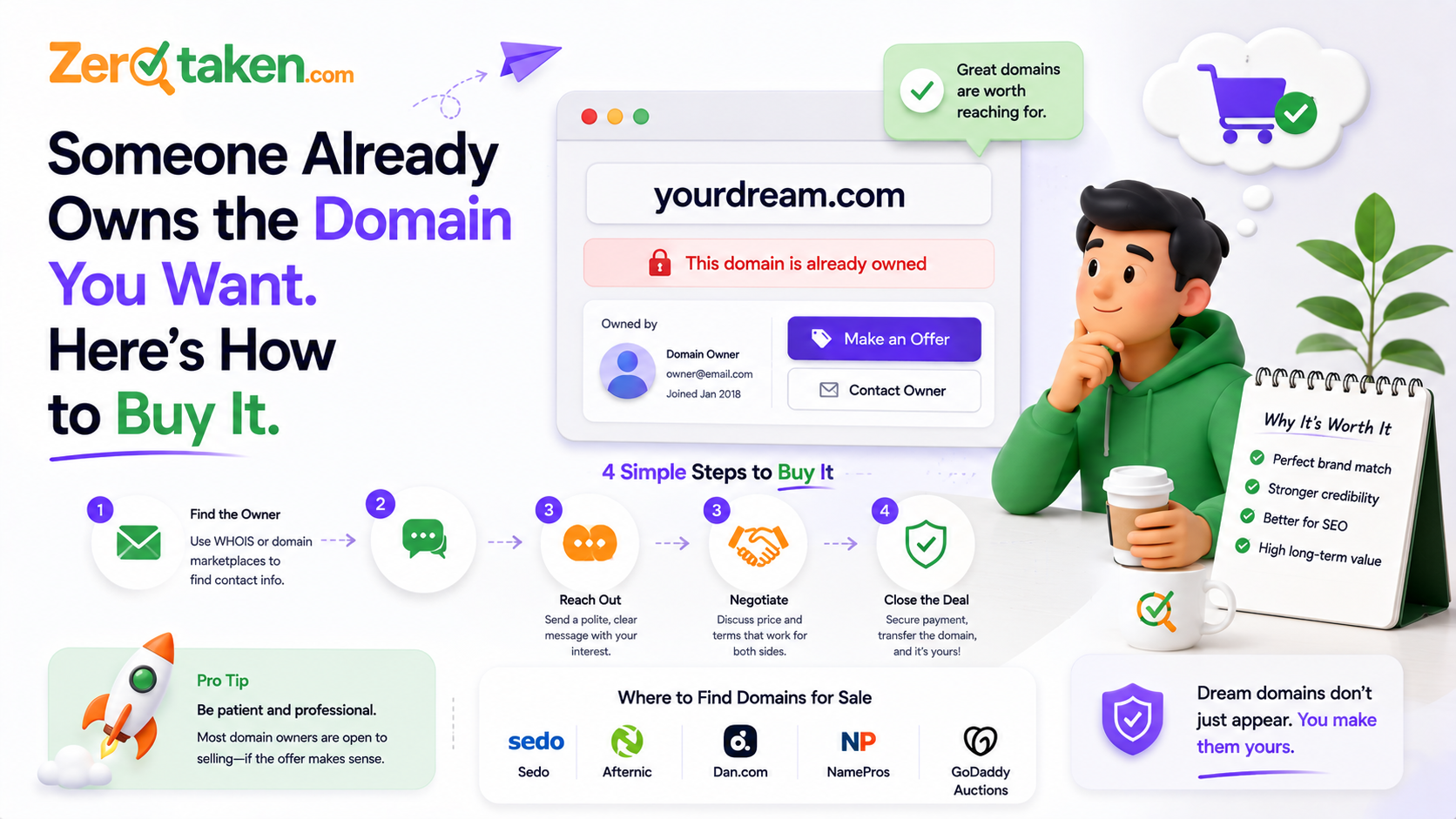
Is the domain actually for sale?
The first thing to figure out is which of three states the domain is in, because it changes everything about your approach. Type the domain into a browser and run a WHOIS lookup, then read the signals.
A domain that resolves to a real, working business is the hardest case — it may not be for sale at any price you'd rationally pay, because the owner is using it to make money. A domain showing a "this domain is for sale" landing page (Afternic, Sedo, Dan) is the easiest — it's actively listed with a path to buy. The most common and most workable case is the dormant one: registered, no website, no traffic, just sitting there. That owner will often sell, but you'll have to reach out first.
- Resolves to a live product or brand → treat as "probably not for sale," temper expectations.
- Shows a for-sale parking page → it's listed; go make an offer through that marketplace.
- Blank, error, or a bare registrar holding page → dormant; the owner may sell but won't come to you.
What's a realistic price for a taken domain?
Forget the $12 renewal fee — that is not the market, and anchoring on it is the fastest way to insult a seller and get ignored. The aftermarket has its own pricing, and it's wide. A dormant, brandable made-up word with no traffic might change hands for a few hundred to a couple thousand dollars. A clean, pronounceable one- or two-word .com that a business would obviously want typically trades in the low-to-mid four figures. Short dictionary words and premium single terms run five, six, sometimes seven figures.
Two things keep you sane here. First, a listed "asking price" is a ceiling, not a fixed price — sellers on marketplaces expect offers, and many list high on purpose. Second, the domain is worth what it's worth to *you*, not what a valuation tool spits out. Decide what the exact name is actually worth to your business before anyone quotes you a number.
Where do you actually make the offer?
There are three real channels, and the right one depends on how the domain is being held.
If it's already listed on a marketplace, use that marketplace — it's the cleanest path and the payment is handled for you. If it's dormant and unlisted, you'll have to find the owner and reach out directly. And if it's a name you genuinely can't replace, a broker is worth the cut.
- Marketplaces (Afternic, Sedo, Dan.com): if the domain is listed, make your offer here. Escrow is built in and the transfer is handled through the platform.
- Direct outreach: for dormant domains, check WHOIS for a contact; if it's privacy-protected, use the site's contact page or a generic address like hello@ or contact@. Keep the first email short and plain.
- Brokers (Namecheap, GoDaddy, Sedo brokerage): for a must-have name, a broker negotiates anonymously so you don't tip your hand. Expect a commission of roughly 10–20%.
How do you make an offer without overpaying?
The single biggest mistake founders make is negotiating with their guard down. If you email a seller from you@your-well-funded-startup.com, you've just told them you have a budget and a deadline — and the price goes up accordingly. Reach out from a neutral personal email, or let a broker front for you, so the seller can't price you by who you are.
Open below your maximum, but not so low it reads as a joke — a rational fraction of what you'd actually pay, with room to climb. Then use the most underrated tool in any negotiation: patience. Most domain owners are not in a hurry, and neither should you appear to be. Set your walk-away number before the first message goes out and write it down somewhere you'll see it, because the temptation to blow past it in the moment is real.
How do you pay without getting scammed?
This is the part that goes wrong. Never wire money directly to a stranger for a domain — the classic scam is someone who doesn't even own the name collecting your payment and vanishing. Use escrow, every time. Escrow.com is the standard for private deals; marketplaces like Sedo and Afternic have it built in. The way it works is simple: you deposit the funds, the seller transfers the domain, and the money is only released once the transfer is confirmed on your side.
A few things to watch for. Once you've shown interest, expect phishing emails impersonating the marketplace or the "seller" — verify every link and never pay outside the agreed escrow. Confirm the seller can actually deliver: the domain gets unlocked, you receive an authorization (EPP) code, and it's pushed to your account or transferred to your registrar. No transfer, no release.
When should you stop chasing and pick a different name?
Here's the unpopular truth: most founders overvalue the exact name and undervalue shipping. If the owner won't come down to a number that's rational for your business, or the domain belongs to a live company that clearly isn't selling, walking away is usually the smart move — not the consolation prize. A slightly different name you own outright for $12 will serve you better than a five-figure purchase that drains your runway to satisfy an attachment to one specific string of letters.
The trick is to have a strong alternative ready *before* you get emotionally locked in, so a "no" from the seller isn't a crisis. Describe your idea to ZeroTaken and it'll generate brandable names and live-check what's actually free across extensions in seconds — which is often how founders discover the name they end up loving more than the one they were fighting for.
So — should you buy the taken domain?
Buy it if three things are true: it's the exact brand you're genuinely committed to, the price is a rational fraction of what that name is worth to your business (not to your ego), and you're paying through escrow. Hit all three and a domain acquisition is a perfectly sound investment — plenty of great companies bought their name on the aftermarket.
Miss any of them and you should pivot. The taken domain isn't a wall; it's a fork. One path is a disciplined negotiation with a number you set in advance. The other is finding a name that's free right now — and shipping this week instead of next quarter.