
Should Your Startup Name End in -ly, -ify, -hub or -labs? The Suffix Playbook
Every founder hits the same wall: the clean one-word .com is gone, so you bolt on a suffix. Grammarly, Shopify, GitHub and Calendly all did it and won, which makes the shortcut feel safe. But for every famous suffix name there are hundreds of forgettable ones, and the pattern has aged. This guide gives you a blunt rule for when a suffix earns its place, when it makes you sound like a template, and how to test the result before you register anything.
Add ZeroTaken as a preferred source on Google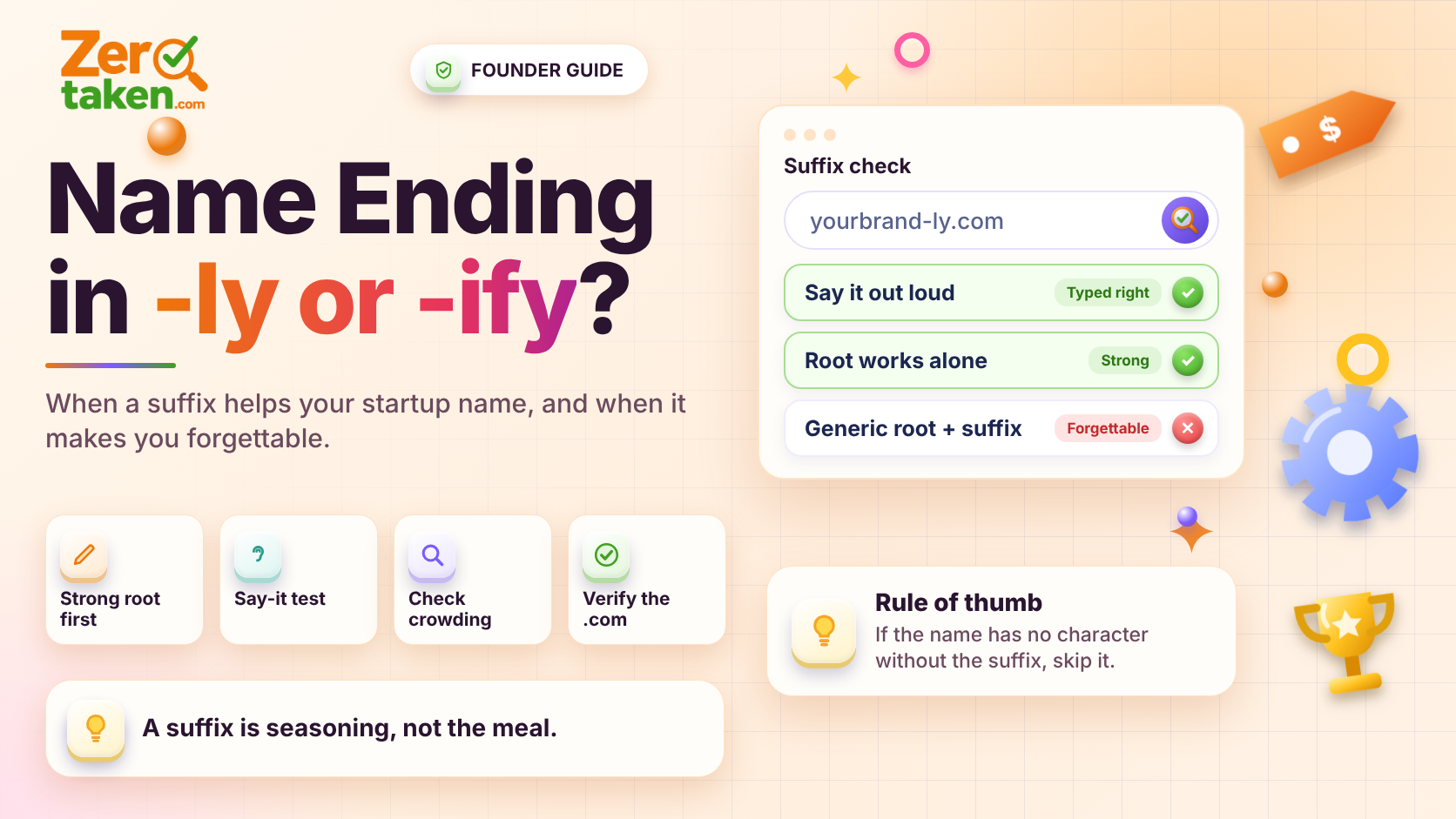
Why do so many startups reach for a suffix?
Because it solves a real problem fast. Common English words are almost all registered as .com, but a root plus a suffix is a string nobody has claimed yet. A suffix also tells people what kind of company you are before they read a word of your homepage: -ly feels like a lightweight web tool, -ify promises to transform something, -hub says community or central place, -labs says technical and experimental.
That signalling is the genuine upside. The downside is that you are borrowing someone else's pattern, and borrowed patterns are crowded. The question is never whether suffix names work. It is whether yours will still stand out in a list of fifty similar names.
What does each common suffix actually signal?
Each suffix carries a baggage of associations, whether you intend them or not. Pick on purpose:
- -ly: friendly, casual, web-tool energy (Bitly, Grammarly, Calendly). Now the most overused of the group, and easy to misspell or mix up.
- -ify: a verb meaning 'make this thing X' (Shopify, Spotify). Works only when your product genuinely transforms one noun into another.
- -hub: a central place where things or people gather (GitHub, HubSpot). Fits marketplaces, communities and directories, not single-purpose tools.
- -labs: technical credibility and experimentation. Reads well for developer tools and research-led products, and awkward for consumer brands.
- -base / -stack / -kit: infrastructure and builder tools. Strong for developer audiences, cold for everyone else.
- -io / -ai as a word ending (as in 'yourbrand.io'): that is a TLD choice, not a suffix. Don't confuse the two when planning your name.
When does a suffix help you?
A suffix helps in three situations. First, when the root word is strong and distinctive but its bare .com is taken, and the suffix is short, so the full name is still easy to say and type. Second, when the suffix carries real meaning for your product, such as -hub for a marketplace or -kit for a toolkit. Third, when your audience already expects it: developer tools live comfortably with -labs and -stack, and nobody blinks.
In all three cases, the root does the branding and the suffix does the categorising. If you remove the suffix and the name has no character left, the suffix was doing too much work.
When does a suffix hurt you?
A suffix hurts when it is the only interesting part of the name. 'Datafy', 'Cloudly' and 'Techhub' could belong to any of a thousand companies, which means they belong to none. Generic root plus generic suffix is the worst combination: it is hard to trademark, hard to search for, and hard to remember a week later.
It also hurts when it forces a spelling problem. If someone hears your name once and has to guess whether it ends in -ly, -lee or -li, you have lost direct traffic every time. Run the spoken test from our radio-test guide: say the name out loud to someone, and see whether they can type it correctly.
Finally, watch the trend problem. A pattern that signals 'modern startup' in one era can signal 'dated template' a few years later. The suffix names that look timeless are the ones where the root is memorable enough that nobody notices the pattern.
How do you pick a suffix that won't box you in?
Treat the suffix as a commitment to a product category. A name ending in -hub tells the world you are a gathering place, so it becomes awkward the day you pivot to a single-purpose app. A name ending in -labs sets the expectation of research and experiments, which sits oddly if you later sell to non-technical buyers. If there is a realistic chance you change direction, pick a root that can stand alone and skip the suffix entirely.
Prefer a suffix you can drop. The best outcome is a brand people shorten naturally, so 'Shopify' stays itself and the suffix quietly disappears from how people talk. If your name only makes sense with the suffix attached, it will never get that shorthand.
What are the alternatives to a suffix?
If the suffix route feels generic, three other moves usually beat it. Invent a short, pronounceable word with no suffix at all. Combine two real words into a compound with a clear picture in it. Or add a prefix that is a real verb, such as 'get' or 'try', though that has its own trade-offs for brand strength. If the exact name matters more than the extension, a different TLD is also an option, and our guides on .io vs .com and .co vs .com cover that decision in detail.
The rule behind all of these is the same: spend your creative effort on the root, because the root is the part people remember.
How do you test a suffix name before you register it?
Run a four-step check before paying for anything. Say it out loud to three people and ask them to type it. Search the root plus suffix on Google and in your app store of choice to see how crowded the space is. Check the trademark databases for near-identical names in your category. Finally, check the .com and your top two extension alternatives with a tool like ZeroTaken, which verifies availability live rather than guessing.
If the name passes all four, a suffix is fine. If it fails the spoken test or lands in a crowded search results page, drop the suffix and go back to the root. A weaker .com variant of a stronger name nearly always beats a perfect-looking domain for a forgettable one.
So, should you use a suffix?
Use one only if the root is distinctive, the suffix is short and means something for your product, and the finished name passes the say-it-and-type-it test. Skip it if the suffix is the only thing making the name sound like a company. A suffix is seasoning, not the meal: it should sharpen a strong name, never rescue a weak one.