
Should Your Domain Name Match Your Social Media Handles?
You finally found a name where the .com is open — and then you check Instagram, and there it is: @yourbrand, taken since 2019, three posts, zero followers, run by someone who will never reply. Now you're stuck on a question nobody warns founders about until it's too late: does your domain actually have to match your social handles, and if it can't, is the whole name ruined? This guide gives you a real answer instead of a shrug. We'll cover which one is the anchor, the prefix trick every startup uses when the exact handle is gone, when a taken handle is a genuine red flag you should walk away from, and how to check the domain and the handles together before you commit to anything.
Add ZeroTaken as a preferred source on Google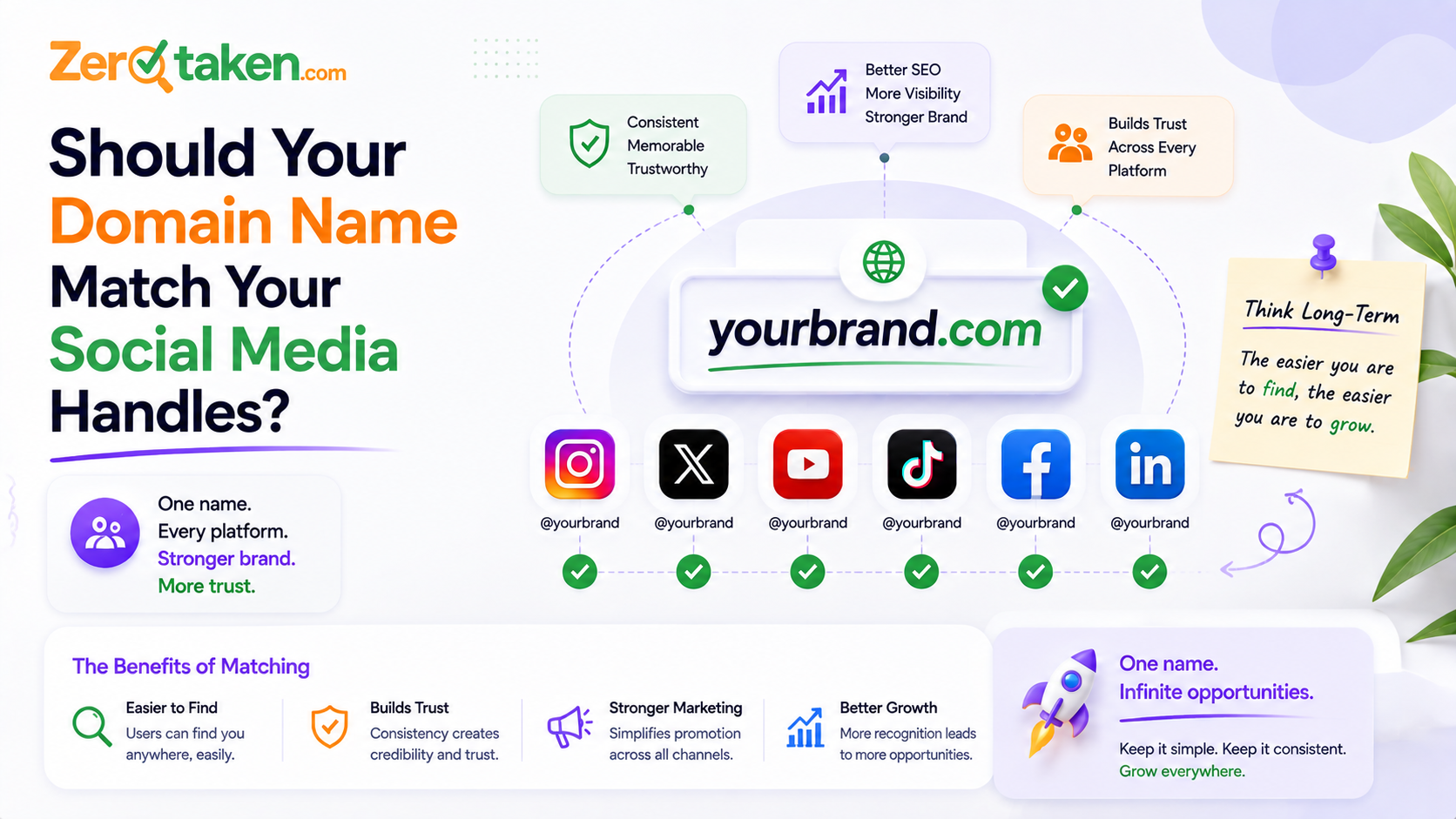
Which comes first — the domain or the handle?
The domain wins, every time. Your domain is the one piece of your identity you fully own, that never changes its rules, and that outlives whichever social platform is fashionable this year. Handles live on someone else's land: the platform can suspend them, reclaim them, merge them, or invent a new network next year where your name is up for grabs all over again. So the correct order is to lock your name on the .com first, and treat handles as things you fit around that anchor — not the other way around.
This matters because founders routinely get it backwards. They fall for a name because the TikTok handle is free, build a brand around it, and only later discover the .com is a five-figure aftermarket listing. That's optimizing for the rented thing over the owned thing. Pick the name your domain can support, then go make the handles work.
Does the handle really have to match the domain exactly?
No — and believing it does will send you chasing a perfection that barely moves the needle. What actually matters is that a person who finds you in one place can find you in the others without guessing. If your site is acme.com and your handle is @acmehq, nobody is confused for even a second; the root word is intact and the brain fills in the rest. The failure case isn't a suffix — it's incoherence, where your domain, your Instagram, and your X account each carry a different word and a visitor can't tell whether they've found the real you or an impostor.
So the bar is 'recognizably the same brand,' not 'byte-for-byte identical string.' A consistent root word plus a consistent modifier across platforms reads as one confident brand. Three unrelated handles read as three abandoned side projects. Aim for the first and stop agonizing about the exact characters.
What do you do when the exact @handle is already taken?
You reach for the same move nearly every modern startup has used: add a short, consistent modifier and apply it everywhere. The established conventions are action prefixes — get, try, use, join, hey — or brand suffixes — hq, app, io, co. So if @acme is gone, you become @getacme or @acmehq, and critically, you use that exact same variant on every platform. The consistency is the whole trick: @getacme on Instagram, @getacme on X, and getacme as your TikTok makes the pattern obvious and searchable.
The one rule that makes or breaks this: choose the modifier once and never mix them. @getacme here and @acmehq there and @tryacme somewhere else is worse than any single imperfect handle, because now there's no pattern for anyone to follow. Pick your variant, grab it on all the platforms that matter to you in one sitting, and write it down so you never second-guess it later.
- Action prefixes: getacme, tryacme, useacme, joinacme, heyacme
- Brand suffixes: acmehq, acmeapp, acmeio, acmeco
- The rule: pick ONE variant and use the identical handle on every platform
Should you change your domain name because a handle is taken?
Almost never for a single dormant account — but a taken handle can be an early warning worth heeding. If @yourbrand is a ghost account with three posts from 2019 and no activity, that's a non-event; add a prefix and move on. The domain is your anchor and a dead handle doesn't threaten it. Reworking a perfectly good name because one platform's handle needs a 'get' in front of it is throwing away the owned asset to protect the rented one.
The real signal to respect is different: an active, growing account in your own industry already using your exact name. That's not a handle inconvenience — it's a collision. It means real customers are already associating that word with someone else's product, your ads and search results will fight theirs, and you're wandering toward a trademark problem, not just a username one. When the person holding the handle is a live competitor rather than a ghost, that's your cue to reconsider the name itself. When they're a ghost, keep the name and add a modifier.
How do you check the domain and the handles together before you commit?
Do it in the right order, and do it before you're emotionally attached. Start with the domain, because it's the hardest to get and the one you can't route around — if the .com (or your chosen extension) is gone or absurdly priced, the name is effectively dead no matter how many handles are free. ZeroTaken checks your name across .com, .co, .io, and .ai side by side in one search and never logs your queries, so you can pressure-test a shortlist of names in minutes without leaking your best idea to an aftermarket bot that then jacks the price.
Only once the domain clears do you go handle-hunting. Check the two or three platforms that genuinely matter for your kind of company — not all twelve — and see whether the exact handle is free or whether you'll be adding a prefix. The goal of this pass isn't perfection; it's to catch the dealbreakers (domain gone, or an active competitor squatting the name) while you can still cheaply pick a different name.
Which social platforms' handles should you actually care about?
Only the ones your customers actually live on — chasing a matching handle on a platform you'll never post to is wasted worry. A developer tool cares about X, GitHub, and maybe a Discord or npm namespace; a consumer product cares about Instagram and TikTok; a B2B company cares about LinkedIn and X. Rank your platforms by where your audience is, and let a taken handle on a platform that doesn't matter to you be a genuine non-issue rather than a source of anxiety.
This ranking also tells you where a collision is fatal versus survivable. If you're a consumer brand and the exact Instagram handle belongs to an active account, that stings and deserves a hard look. If you're a B2B SaaS and the same account exists but you'll never market on Instagram, shrug and take @getbrand there. Match the intensity of your concern to how much the platform actually matters to your growth.
Should you grab handles on platforms you're not using yet?
Yes — this is the one place a quick defensive land-grab is worth it, because unlike domains, most handles are free to reserve. The moment you settle on a name and its variant, spend twenty minutes registering that exact handle everywhere plausible: the platforms you use now, plus the one or two you might grow into. It costs nothing but time, and it stops a squatter or a competitor from planting your name next to their content two years from now when you finally launch that YouTube channel.
This is different from the domain question, where a sprawling defensive purchase across a dozen extensions is usually wasted money. Handles are free, so reserving them broadly is rational; extensions cost real annual fees, so there you buy only the matched pair you'll actually use. Reserve handles wide, buy domains narrow.
What about handles held by inactive or squatter accounts?
Assume you will never get them, and build no plan that depends on it. Platforms occasionally talk about reclaiming inactive usernames, and every few years a purge makes headlines, but from where you sit as a founder it's effectively a lottery you can't schedule your launch around. Filing an impersonation or trademark claim can sometimes free a handle if you hold a real registered mark and the account is clearly infringing, but that's a slow legal process, not a naming strategy — and it only works when you actually own the trademark.
The practical move is to design around the taken handle from day one using your chosen prefix, and treat ever acquiring the exact handle as a pleasant surprise rather than a milestone. If the account is a dormant personal user with no commercial use, a polite direct message occasionally works and costs nothing to try. But your brand should be able to thrive on @getbrand indefinitely, because the honest base rate on prying a handle loose from a squatter is low.
So what's the rule on domains and social handles?
The domain is the anchor and the handle is the accessory — pick the name your .com can support, then fit the handles around it with a single consistent modifier applied identically everywhere. An exact match is a nice-to-have, not a requirement; @getbrand used the same way on every platform beats a mismatched jumble of 'perfect' handles that share no pattern. Reserve handles wide because they're free, buy domains narrow because they're not.
The only time a taken handle should change your actual name is when it belongs to an active, growing company in your own space — that's a brand collision and a trademark warning, not a username hiccup. Everything else you solve with a 'get' or an 'hq' and get back to building. Lock the domain first, apply your variant everywhere in one sitting, and stop letting a stranger's dead Instagram account hold your launch hostage.