
Should You Use Hyphens or Numbers in a Domain Name?
You found the perfect name. The clean .com is gone. So the domain registrar helpfully suggests my-cool-app.com or getapp24.com, and for about ten seconds it looks like a rescue. It isn't. Hyphens and numbers are the two most common shortcuts founders take to force a taken name to fit — and they're two of the fastest ways to make a brand harder to say, harder to remember, and easier to lose to a competitor with the cleaner version. There are real exceptions, and we'll cover them precisely. But start from the default: skip both, and only break the rule when you can name the specific reason.
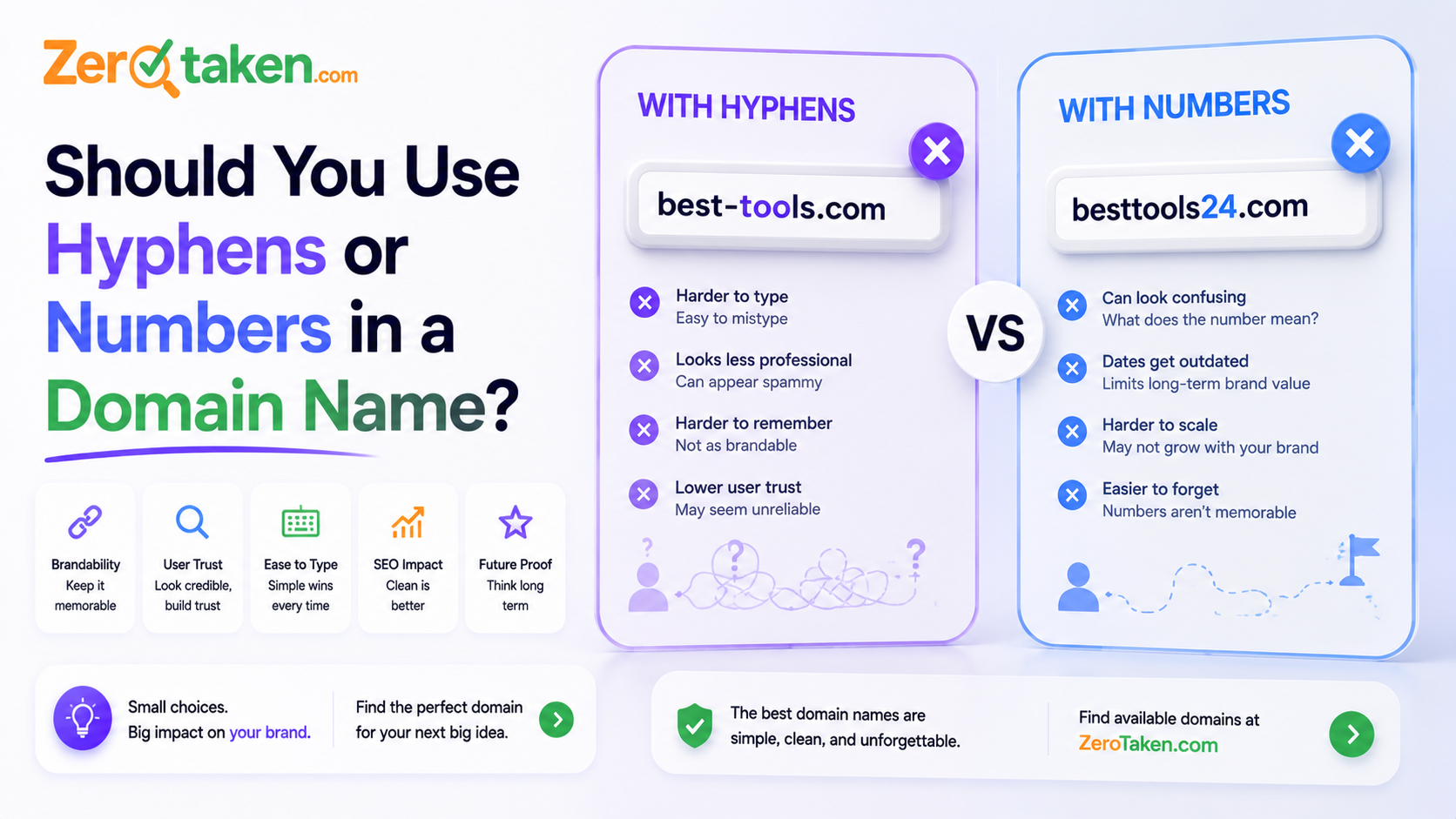
What's the short answer?
Avoid hyphens. Avoid numbers. In almost every case, a name with either one is a compromise you'll spend years apologizing for out loud.
The reason is simple: a domain has to survive being spoken. Someone recommends your product at a dinner, on a podcast, in a Slack message read aloud on a call. The moment your name leaves the screen and becomes a sound, every hyphen and every digit turns into a question — "is that spelled out or the number?", "wait, is there a dash in there?" Each question is a chance for the listener to land on the wrong URL, and often that wrong URL belongs to someone else.
So the working rule is: if you can't say the domain once, out loud, and have a stranger type it correctly, it's the wrong domain. Hyphens and numbers both fail that test far more often than a plain word does.
Why do hyphens hurt a domain name?
A hyphen is invisible when spoken and easy to forget when typed. That single gap creates four distinct problems, and they compound.
First, the traffic leak. If you own get-invoice.com, the person who owns getinvoice.com collects every visitor who forgets the dash — and people forget the dash constantly. You're paying to build awareness for a name whose un-hyphenated twin someone else controls. Second, the credibility signal. For over a decade, low-effort and spammy sites leaned on hyphenated domains because the clean versions were taken. Fair or not, a chain of dashes still reads as second-choice to a lot of users, and first impressions on a landing page are measured in seconds. Third, the dictation tax. "It's get, hyphen, invoice dot com" is a sentence you will say thousands of times, and it makes you sound like the runner-up to whoever owns the version without the hyphen. Fourth, the multi-hyphen cliff: one dash is a nuisance, but best-cheap-crm-tool.com is unusable — nobody remembers the order or the count of the dashes.
- Traffic leaks to the un-hyphenated version of your name that someone else may own
- Lingering association with low-quality, second-choice sites
- Every verbal recommendation needs the awkward "hyphen" clarification
- Typo and copy-paste errors multiply with each additional dash
Are hyphens ever actually okay?
Yes — but the exceptions are narrow, and none of them are "the clean version was taken."
The strongest case is genuine ambiguity between two words. When the un-spaced version creates an accidental second reading, a hyphen can rescue clarity: the classic examples are word collisions where letters at the seam form an unintended word. If your two words smash together into something confusing or unfortunate, a hyphen (or, better, a different word) fixes it. The other legitimate case is regional: in some markets — German-language sites are the common example — hyphenated domains are more culturally normal and read as perfectly professional, partly because compound words there get long and a separator genuinely aids reading.
Even then, treat the hyphen as a signal to reconsider the name, not a fix to ship. If your name only works with a dash, the underlying name probably has a collision problem you can solve by choosing a cleaner root word instead. A hyphen should be your third choice, after "pick different words" and "pick a different extension."
What about putting a number in the domain?
Numbers carry a problem hyphens don't: they can be written two ways, and you never control which one your listener chooses.
Say your name out loud with a digit in it and the ambiguity is immediate. Is invoices4you spelled with the numeral 4 or the word "four"? Is it 2fast or twofast? Every time someone hears the name, they have to guess the spelling, and half of them guess wrong — landing on a domain you don't own. Worse, competitors and squatters know this: if you buy the numeral version, the spelled-out version is the obvious defensive buy, and if you skip it, someone else can sit on your near-identical name.
Numbers used as filler are the worst offenders — app24, tool360, hub101 where the digits don't mean anything and exist only because the plain name was gone. That's not a brand, it's a placeholder, and it tells visitors the same thing a hyphen does: you got here second.
When can a number in a domain actually work?
There's one condition that flips a number from liability to asset: the number has to be part of how people already say the concept, not a spelling workaround.
When a digit is a recognized idiom, the ambiguity disappears because everyone converges on the same spelling. "24/7" is understood as digits. "360" as in a 360-degree view reads as a number to everyone. "101" for a beginner's guide, "99" as a price signal, "W3" in web contexts — in each case the number is the meaning, so there's no fork in how it's written. The test is whether a stranger, hearing the name for the first time, would spell the number the same way you do without thinking about it. If yes, it can work. If they'd have to pause and guess, it won't.
Be honest about which side you're on. "Product360" where 360 evokes an all-around view is defensible. "Invoices2" because "Invoices" was taken is not — the 2 means nothing, and you'll spend the life of the brand explaining it.
- Works: the number is an established idiom everyone spells the same way (24/7, 360, 101)
- Works: the digit carries real meaning central to the brand, not filler
- Fails: the number is only there because the clean name was unavailable
- Fails: the digit could plausibly be written as a word by half your audience
How do you test a name before you commit?
Before you buy anything, run the name through three quick, brutal checks. They take thirty seconds and save you from a name you'll quietly resent.
The radio test: say the full domain out loud, once, the way you'd say it on a phone call — no spelling it out. If you have to add "that's with a hyphen" or "the number four, not f-o-u-r," it fails. The stranger test: have someone who's never seen the name type it after hearing it spoken once. Watch where they land. If they hesitate or type the version you don't own, that's your future support inbox and your leaked traffic in miniature. The glance test: show the written name for one second, then hide it. Can they type it from memory? Extra characters — dashes, digits — are exactly what people drop when recalling from a glance.
The cleaner move is to stop forcing a taken name and generate names that are clean from the start. That's the whole point of a tool like ZeroTaken — you describe the idea, it proposes brandable names and checks availability live, so you're choosing among names that don't need a dash or a digit to be free.
What should you do instead when the clean name is taken?
A hyphen or a number is almost never the best answer to "it's taken" — it's just the fastest. Here's the order of moves that actually protects your brand.
Change the root word before you change the punctuation. A slightly different, still-brandable word gives you a clean domain with none of the baggage; a hyphen keeps the exact word but ruins the delivery. Add a real word, not a symbol — a meaningful prefix or suffix (get, try, use, hq, app, labs) reads as intentional in a way "24" or a dash never will. Consider a different extension on the clean name: a solid modern TLD on the un-hyphenated word usually beats the .com with a dash bolted on. And only if the exact name genuinely matters should you look at acquiring the taken one outright — a WHOIS lookup and a polite outreach, or watching for it to expire, is a real path, and a cleaner one than living with a compromised spelling forever.
The through-line: protect how the name sounds and how it's typed. Those two things are what a hyphen and a number quietly damage, and they're the two things that decide whether word-of-mouth actually reaches your site.
- Swap the root word for a clean, still-brandable alternative — first move, not last resort
- Add a real word (get, try, use, hq) instead of a symbol or filler digit
- Put the clean name on a different extension rather than dashing the .com
- If the exact name is essential, pursue the taken domain directly — don't settle for its hyphenated shadow
So what's the bottom line?
Default to no hyphens and no numbers. They feel like a rescue when your name is taken, but they tax every conversation, leak traffic to the versions you don't own, and signal second-place before anyone reads a word of your copy.
Break the rule only for a reason you can name out loud: a hyphen to fix a genuine word collision or fit a regional norm, a number that's a real idiom everyone spells the same way. Everything else is a placeholder wearing a domain's clothes. Pick a name that survives being spoken once — and if the clean one is gone, change the word, not the spelling.