
Should You Pay for Domain Privacy? WHOIS Privacy, Honestly Explained
You've picked the name, added it to your cart, and there it is at checkout: a pre-ticked box offering to "protect your personal information" for another ten dollars a year. Skip it and you feel exposed; buy it and you suspect you're being upsold. Both instincts are half right. Domain privacy is a real and useful thing — and also something you're frequently already getting for free, and occasionally something you're not even allowed to have. This guide cuts through the checkout guilt: what domain privacy actually is, why GDPR quietly changed the math, when it's genuinely worth paying for, and the cases where hiding your WHOIS is a mistake.
Add ZeroTaken as a preferred source on Google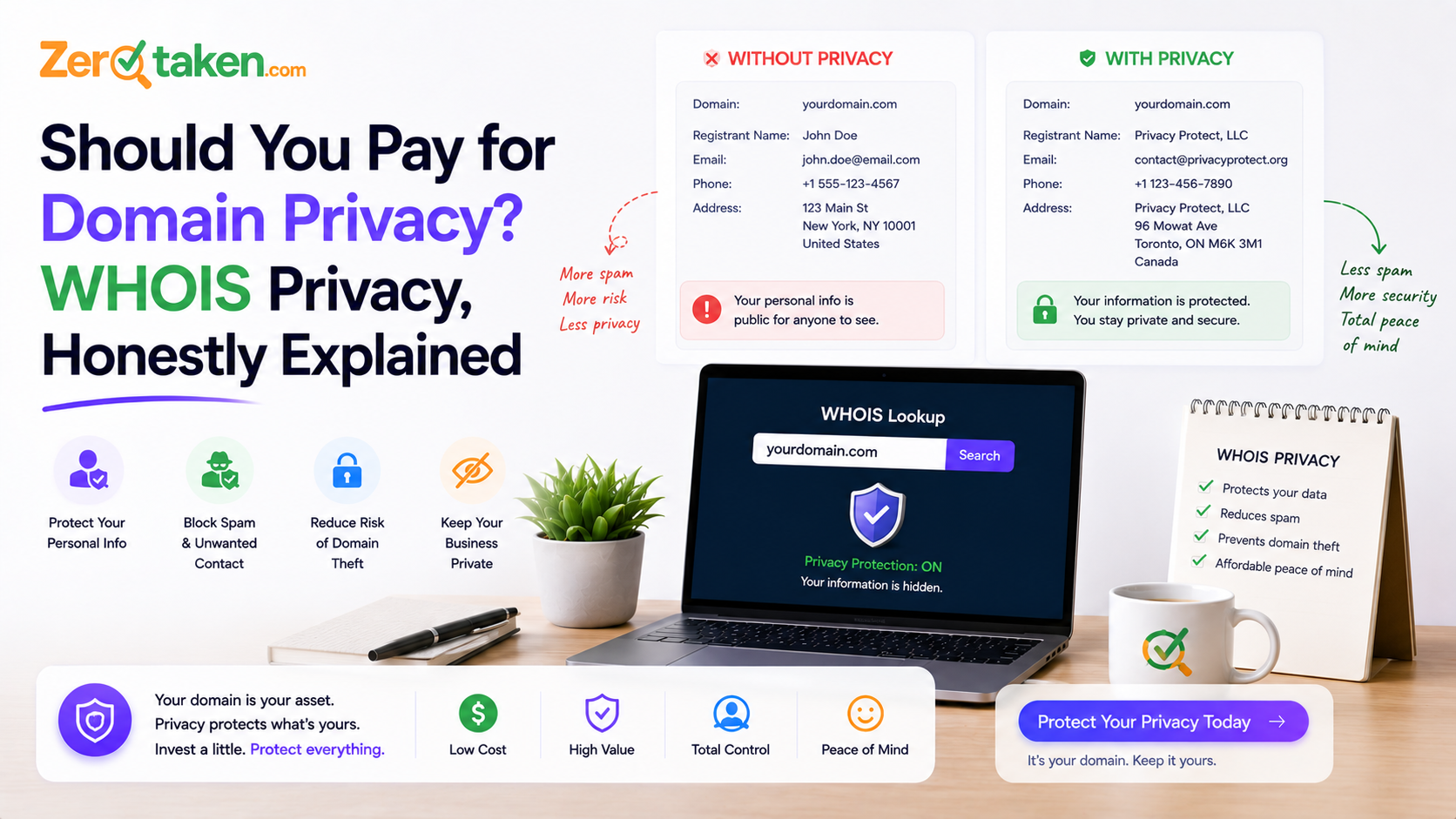
What is domain privacy, really?
Every domain has a WHOIS record — a public registration directory that historically listed the registrant's name, organization, mailing address, email, and phone number for anyone to look up. It exists so that domains have accountable owners: it's how a trademark holder, a security researcher, or a would-be buyer finds who's behind a name. The catch is that "anyone" includes spammers, scammers, and people you'd rather not hand your home address to.
Domain privacy — sold as "WHOIS privacy," "domain privacy protection," or a "proxy registration" — is a service that swaps your real details in that public record for the privacy provider's. You stay the legal owner of the domain; the world just sees a forwarding address and a relay email instead of your name and street. Crucially, it's a display layer. Your registrar still holds your real information, and it can still be disclosed through the proper legal channels.
So the question is never "do I want strangers to have my home address" — obviously not. It's narrower and more practical: given how WHOIS already works in 2026, are you paying for protection you don't already have?
Didn't GDPR already hide my details for free?
For most people buying a .com, .net, .org, or another mainstream extension: largely, yes. When the EU's GDPR took effect in 2018, ICANN — the body that governs these generic extensions — forced registrars to stop publishing registrants' personal data by default. Look up a typical gTLD domain today and the registrant fields usually read "REDACTED FOR PRIVACY" whether or not the owner ever bought a privacy add-on. That redaction is now baked into ICANN's standing registration-data policy, not a temporary emergency measure.
This is the single fact that reframes the whole checkout decision. A large chunk of what the paid upsell promises — "we'll hide your name and address from the public WHOIS" — is already done for you, for free, the moment you register. Before you pay, do a WHOIS lookup on any domain you already own and see what's actually exposed. Often the answer is: almost nothing.
Redaction isn't identical to a full privacy service, though, and the difference is worth knowing. Redaction hides your data from the public view but your registrar still stores it and must disclose it to legitimate requesters (law enforcement, trademark disputes). A paid proxy service adds a genuine relay in front of your email so people can still contact you without ever seeing your address — useful, but a smaller upgrade than the checkout copy implies.
So do you actually need to pay for it?
For a standard gTLD, usually not — and definitely not at any registrar that charges extra. The best registrars now include full WHOIS privacy for free, for the life of the domain: it's a standard, no-cost feature at Cloudflare, Namecheap, Porkbun, and Squarespace (which absorbed Google Domains), among others. If your registrar is one of these, the box is already ticked at zero dollars and there's nothing to decide.
The only registrars still charging a separate annual fee for privacy — the classic example being the big-box upsell page that pre-checks "Domain Privacy & Protection" for $10–$20 a year — are selling you something their competitors give away. That's not a reason to leave your data exposed; it's a reason to reconsider the registrar, or at minimum to know you're paying a premium for a commodity.
The honest rule: never pay extra for WHOIS privacy on a mainstream extension. Either it's free (most good registrars), or your gTLD data is already redacted by default (everywhere), or you should move the domain somewhere that treats privacy as table stakes.
When is domain privacy genuinely worth it?
There are real cases where you want an active privacy or proxy service, not just default redaction — and where paying a small fee is defensible if your registrar makes you. The common thread is that your name or address would otherwise be personally exposed and that exposure has a concrete cost.
If any of these describe you, make sure privacy is switched on (free wherever possible), and don't feel silly paying a few dollars if your registrar is the only holdout:
- You register domains as an individual using your home address — a freelancer, indie hacker, or solo founder with no office. Privacy keeps your house off a public list.
- You're building a personal brand, portfolio, or blog under your own name and don't want your physical address one lookup away from every reader.
- You want to cut the flood of scam "domain renewal" letters, fake SEO pitches, and spam calls that harvest fresh WHOIS registrations — even redacted domains attract some, and a full proxy address cuts it further.
- You're registering a domain for a project you'd rather not tie publicly to your name yet — an unannounced product, a stealth idea, a side venture your employer doesn't need to see.
When should you NOT hide your WHOIS?
Privacy isn't a free lunch in every case — sometimes public registration data is either the smarter move or the only legal option. The mistake is treating "hide everything" as a universal best practice when for some domains it actively works against you.
Think twice, or check the rules, in these situations:
- Some country-code extensions don't allow it. The .us extension prohibits private and proxy registration outright — its policy requires accurate, public registrant data. Canada's .ca offers privacy to individuals but not to corporations, and the UK's .uk lets only non-trading individuals opt out. If you're buying a ccTLD, check the registry's rule before assuming you can hide.
- An established business often benefits from transparency. For an ecommerce store or a company selling to cautious buyers, a WHOIS that clearly shows a real, registered business can read as more trustworthy than a domain hiding behind a proxy — and some consumer-protection rules already require identifiable business details on your site regardless.
- You need to prove ownership to a third party fast. Verifying a domain for an ad platform, a payment processor, or a partner is occasionally simpler when your details are visible; heavy privacy layers can add a step.
- You're using a business address anyway. If your registrant contact is already an office, a registered agent, or a PO box — not your home — the privacy upsell protects almost nothing you actually care about.
What does domain privacy NOT protect you from?
This is where the marketing oversells. WHOIS privacy hides one specific thing — your contact details in the public registration record — and people wrongly assume it makes them anonymous online. It does not.
Be clear-eyed about its limits so you don't lean on it for protection it was never designed to give:
- It doesn't hide your website. Your DNS records, mail (MX) records, and the IP your site runs on are all still public — anyone can see where a domain points and often infer your host.
- It isn't anonymity. Your real identity sits with your registrar, and it can be handed over under a court order, a subpoena, or a UDRP domain-dispute proceeding. Privacy stops the curious, not the courts.
- It doesn't protect against you personally. Your registrar knows exactly who you are; privacy is a shield facing outward, not a way to be nameless to the company you're paying.
- It can lapse. If you forget to renew, or your registrar changes its policy, or a service tier ends, your details can quietly become public again — privacy is a setting to keep an eye on, not a one-time purchase.
How do you check what's public about your domain right now?
Before you pay for anything — or worry that you're exposed — just look. A WHOIS lookup shows you exactly what the world can currently see about a domain: whether the registrant fields are redacted, which registrar holds it, when it expires, and whether a privacy service is already in front of it. It takes ten seconds and it turns an anxious guess into a fact.
ZeroTaken's WHOIS lookup lets you check any domain's current registration data and DNS records for free, so you can see whether your details are already hidden before deciding whether the paid box at checkout is buying you anything at all. Run it on a domain you own and one you don't, and the difference between "already redacted" and "fully exposed" becomes obvious.
What's the bottom line on domain privacy?
For the vast majority of founders and developers registering a mainstream extension: don't pay a separate fee for WHOIS privacy. Your gTLD data is already redacted by default post-GDPR, and the best registrars include full privacy for free — if yours doesn't, that's a nudge to switch, not a reason to hand over ten dollars a year for a commodity.
Do actively want privacy on when you're registering with a home address, building something under your own name, or trying to dodge the WHOIS-harvested spam machine. Do check the rules before assuming you can hide a ccTLD, and don't hide an established business's details when transparency is the more trustworthy — or legally required — move.
And remember what privacy is and isn't: a shield over one public record, not a cloak of anonymity. Know what's already exposed, turn on the free protection you're entitled to, pay for it only where you genuinely can't get it free, and spend the attention you save on the actual product.