
Name First or Domain First? The Right Order to Name a Startup
Here's the mistake almost every first-time founder makes: you spend two weeks falling in love with a name, run it past the team, maybe sketch a logo — and only then type it into a registrar, where you learn the .com sold in 2004 and the owner wants $40,000. Now you're emotionally attached to a name you can't afford to own, and every alternative feels like a downgrade. The order you do this in isn't a detail; it's the difference between a name you can register this afternoon and a month of sunk-cost heartbreak. This guide makes the case for a specific sequence — and explains why both 'name first' and 'domain first,' taken to their extremes, quietly sabotage you.
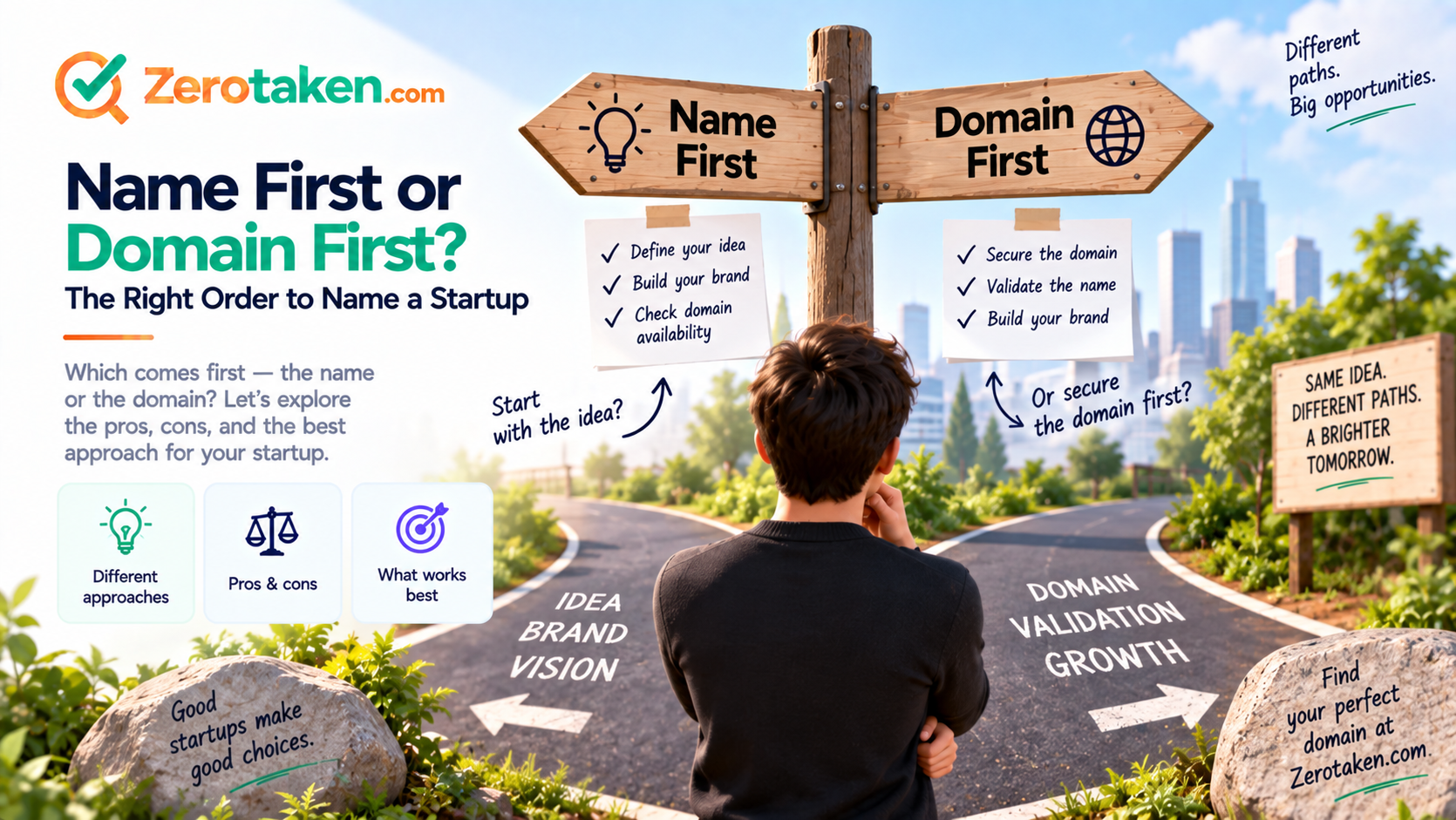
Why does the order you name and check availability in even matter?
Because a domain is the one part of your brand you don't fully control. You can invent any name you want, design any logo, write any tagline — but whether the matching domain is free is decided by whoever registered it before you showed up. Ignoring that until the end means you're doing your most creative, most emotionally-invested work inside a constraint you're pretending doesn't exist.
The cost of getting the order wrong isn't just money — it's attachment. A name you've said out loud for two weeks, put on a pitch deck, and told your co-founder about is psychologically expensive to abandon. So when the domain turns out to be gone, founders don't calmly move on; they overpay on the aftermarket, settle for an awkward extension, or bolt 'get' or 'try' onto the front and pretend that was the plan all along. Every one of those is a worse outcome than simply having known the domain was gone before the name became load-bearing.
Sequence it right and availability stops being a gate you slam into at the finish line. It becomes a filter that runs quietly in the background while you're still generating options — so the only names that survive to the 'do I love this?' stage are ones you can actually own.
What's wrong with naming first and hunting the domain later?
Naming first feels right because it's how brands are supposed to be born — from meaning, story, and taste, not from a database of what's left over. The problem is purely mechanical: the space of great names is enormous, and the space of great names whose .com is free at standard price is a tiny fraction of it. When you name first and check last, you're sampling from the big set and hoping you land in the small one. You usually don't.
The deeper trap is the emotional accounting. By the time you check, you've already 'spent' on the name — hours, conversations, a mental image of the brand. Loss aversion kicks in, and a $3,000 aftermarket domain suddenly sounds reasonable to avoid 'wasting' that investment. It isn't reasonable; it's the sunk-cost fallacy with a price tag. The two weeks are gone whether or not you buy the domain, and paying thousands to rescue a name you picked at random is a bad trade you'd never make with a clear head.
Name-first isn't wrong because taste is wrong — it's wrong because it defers the one hard constraint to the moment you're least able to think straight about it.
Is 'domain first' — letting availability pick your name — any better?
It has the opposite failure. If you open a bulk domain-search tool, dump in every available string, and pick whatever's short and free, you optimize for 'ownable' and forget that a name also has to mean something, sound like something, and survive being said out loud. That's how you end up with a technically-available domain that's an unpronounceable knot of consonants, or a random real word ('Badger,' 'Kettle') that has nothing to do with your product and confuses everyone who hears it.
Pure domain-first also tends to drag you toward the ugly compromises the format is famous for: the leftover names are leftover for a reason, so you drift into throwaway modifiers, awkward misspellings, and extensions nobody trusts. Availability is necessary, but it's a floor, not a goal. A name that's free and forgettable loses to a name that's free and good — and there are always more of the latter than a lazy search suggests.
So neither extreme works. 'Name first' ignores the constraint until it hurts; 'domain first' lets the constraint do the creative work it was never qualified to do. The answer is to run them together.
So what's the actual right sequence?
Interleave them. Treat availability as a live filter that runs alongside ideation, not a checkpoint at either end. Concretely: brainstorm in small batches, check each batch's domains immediately, and let what you learn about availability feed the next batch of ideas — before you've formed an attachment to any single name.
The rhythm looks like this. Generate eight to twelve candidates in the direction you're exploring. Check the exact domain for all of them in one sitting. Notice the pattern in what came back free — maybe your coined words are landing but your dictionary-word compounds are all taken — and steer the next batch toward whatever's actually available. Repeat two or three times. Within an hour you've got a shortlist where every name has already cleared the availability bar, and you get to do the 'which of these do I love?' decision among options you can all genuinely own.
This flips the emotional order in your favor. You never fall for a name you can't have, because you only ever fall for names that already passed the check. The constraint shapes the search early, when it's cheap, instead of demolishing your favorite at the end, when it's expensive.
How do you brainstorm names that are actually likely to be free?
None of this means abandoning meaning or taste. It means starting your brainstorm in the neighborhoods where free names still exist, instead of repeatedly proposing perfect dictionary words that were registered before you were in business — and then feeling crushed each time. Bias your ideation toward the categories that survive a 2026 availability check, so you're not just generating faster, you're generating in the parts of the space that aren't already picked clean.
A few directions consistently produce ownable .coms:
- Coined and invented words (Twilio, Vercel, Kajabi) — they were free precisely because they didn't exist yet; this is the single most reliable source of clean single-word .coms
- Two-word compounds of common, unmistakably-spelled words (Salesforce, DoorDash) — far more likely to be free than either word alone, and easier to trademark
- Modified real words: a small sound change, an added or dropped letter, a fused suffix that still reads as one word — used deliberately, not desperately
- Distinctive metaphors from outside your category — an evocative object or concept, chosen because it fits your brand's feeling, not because it's the literal keyword everyone else also tried
When is it fine to fall in love with the name before checking?
There's one honest exception: when you have a real budget for a domain and you're treating it as a deliberate acquisition, not a surprise. Well-funded companies do name first on purpose — they pick the perfect name, then go buy the aftermarket .com for five or six figures because owning exactly that string is worth it to them. That's a legitimate strategy. What makes it legitimate is that the spend is planned and priced in from the start, not a panic purchase to rescue an accident.
The test is simple: decide your domain budget before you name, not after. If you can comfortably say 'I'll pay up to $X for the right domain' and mean it, then yes, name first and treat the purchase as the plan. If your honest budget is 'the standard registration fee' — which describes almost every bootstrapped and early-stage founder — then you can't afford to name first, because your favorite name landing on a taken domain leaves you with no move that doesn't hurt.
Know which founder you are before you start. The interleaved sequence is for the second kind — the vast majority — who need the name and the standard-price domain to be the same decision.
How do you check a shortlist fast — without tipping off squatters?
Speed is what makes the interleaved approach actually work: if checking each batch is a slog of typing names into a registrar one at a time and dodging upsells, you'll stop doing it and slide back into name-first by default. You want to check a dozen names across a couple of extensions in one pass, read the results at a glance, and immediately generate the next batch — all inside a single sitting.
ZeroTaken is built for exactly this loop: describe the idea, get brandable candidates back, and see live .com/.io/.co availability side by side — so ideation and the availability check are the same motion instead of two separate chores. It also doesn't log your best ideas and hand them to a broker, which matters more than founders realize; some registrar search boxes are a genuinely bad place to type a name you haven't secured yet.
Whatever tool you use, the principle is the same: make the check cheap enough that you run it constantly. The founders who end up with a great, ownable name aren't the ones with better taste — they're the ones who checked availability twenty times while everyone else checked once, at the end, and flinched.
So which comes first — the name or the domain?
Neither, and that's the point. The right answer isn't name-then-domain or domain-then-name; it's name-and-domain, together, in tight loops, until a shortlist emerges where every survivor is a name you'd be happy with and a domain you can actually register. Then, and only then, you make the purely emotional call among options that have all already cleared the hard constraint.
Do it this way and the worst outcome of a naming session isn't a broken heart over a domain you can't have — it's simply a shortlist that's a little shorter than you hoped, which is a problem you solve with another batch, not another $40,000. Check early, check often, and let availability shape the search instead of ambushing it. Then register the winner today, and get back to building the thing the name is for.