
Is a Clever Pun a Good Domain Name? The Wordplay Test Before You Commit
A pun feels like a gift the moment you think of it. You grin, your co-founder groans, and you're already designing the logo. Then someone tries to type it from memory and lands on the wrong site. Wordplay is the highest-variance move in domain naming: when it works, the name is unforgettable; when it doesn't, you pay for it in every referral, podcast mention and email. This guide gives you a four-question test so you can tell which one you're holding before you pay for the registration.
Add ZeroTaken as a preferred source on Google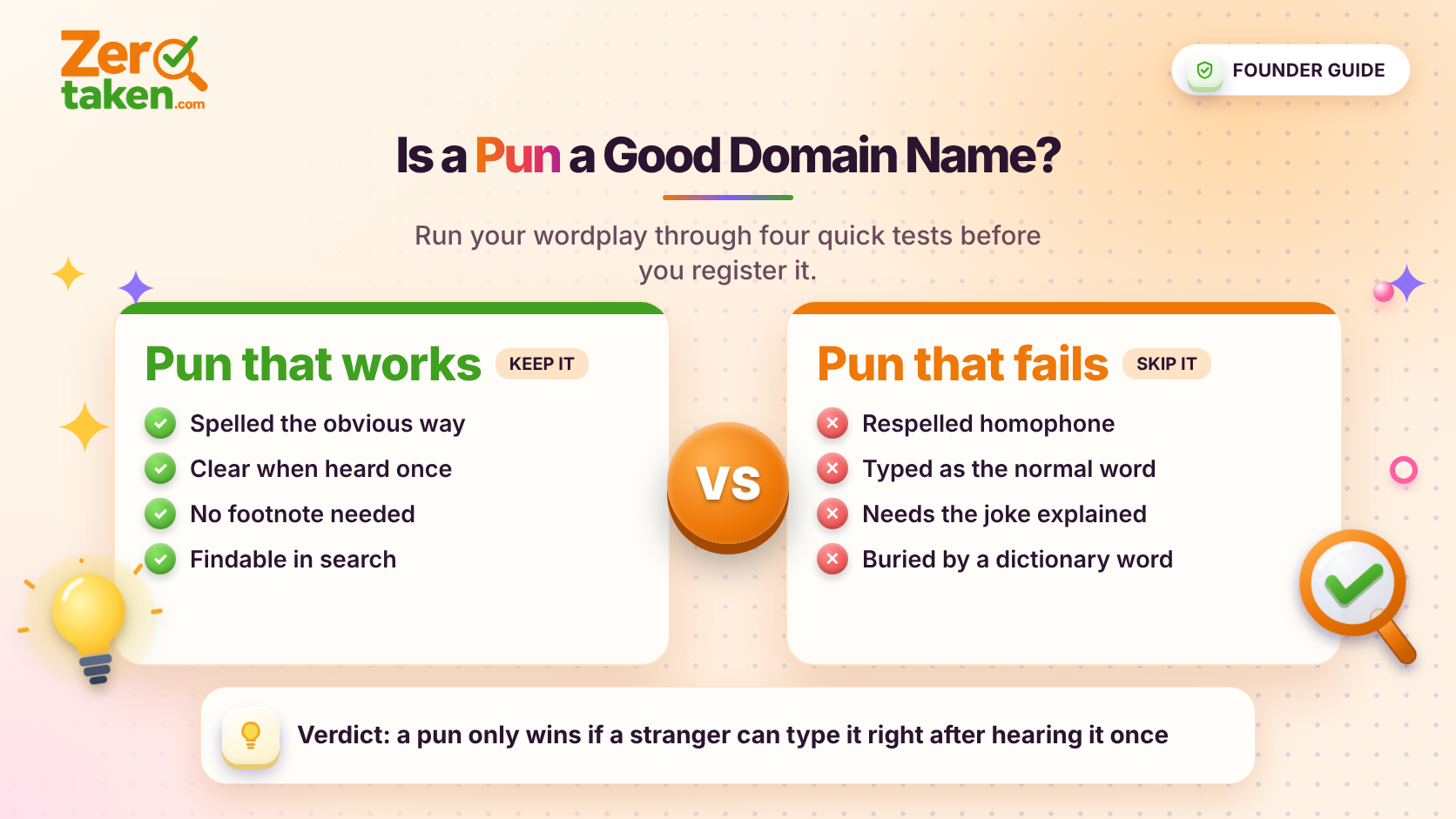
Why do pun domains feel so right and fail so often?
The pun is funny to you because you already know the joke. Your brain fills in the meaning automatically. A stranger who sees the name for the first time on a podcast, in a Slack message, or on a billboard has none of that context. They only get the sound, and the sound has to carry the whole joke.
That's the core problem: a domain name is a spoken-and-typed identifier first and a brand second. A pun adds a second layer of meaning on top of the first, and every extra layer is another place for the name to break. The question is never "is this clever?" It's "does this survive being heard once, remembered for a week, and typed from memory?"
What is the Four-Question Wordplay Test?
Run every pun candidate through these four questions. A name has to pass all four, not three out of four, because each one maps to a different way real people will reach you.
Be honest when you score it. Ask someone who hasn't heard your pitch, and don't explain the joke first.
- The hear-it test: say the name aloud to someone who hasn't seen it. Can they tell you how it's spelled without asking?
- The type-it test: ask them to type it from memory a day later. Do they land on your exact spelling, or on the obvious one?
- The explain-it test: does the pun still work if you can't explain it? If it needs a footnote, it's a private joke.
- The search-it test: if they Google just the name, do they find you, or a dictionary entry, a band, or the thing you punned on?
Which kinds of puns hold up, and which ones don't?
Not all wordplay is equal. The type of pun matters more than how clever it is.
Puns that keep the original spelling and add meaning through context are the safest. The word is spelled the way everyone expects, the joke lives in how it's applied, and nobody mistypes it. Puns that change the spelling to make the joke visible (a dropped vowel, a swapped letter, a homophone) look great in a logo and fail the type-it test, because the typist remembers the sound and writes the standard spelling.
Sound-alike puns on another word or phrase are the riskiest. They depend on the listener making the leap to the phrase you're riffing on, and they're also the ones most likely to read as a typo to someone skimming a list of links.
- Safest: a real word used in a new context, spelled normally. Passes hear, type and explain.
- Risky: a homophone or respelled word. Passes explain, usually fails type.
- Riskiest: a phrase-based pun that only works if you know the original phrase. Often fails hear and explain.
- Avoid: puns on a trademarked brand or slogan. That's a separate legal problem on top of the usability one.
What does a mistyped pun actually cost you?
Think about where a domain name travels: spoken on podcasts and in talks, pasted into slide decks, printed on business cards, typed from a screenshot. A pun that fails the type-it test leaks a slice of every one of those channels to whoever owns the obvious spelling, even if that's a parked page.
You can't measure the leak directly, but you can estimate it cheaply. Take your five most likely mistypes, check what lives at each, and ask whether you'd be comfortable if a customer landed there. If one of those spellings belongs to a competitor, a scam site, or an aggressive ad page, the pun is not cheap anymore.
Can you keep the pun and fix the typing problem?
Sometimes. If you love the pun but it fails the type-it test, you have three real options. You can register the obvious spelling as well and redirect it to your main domain, which costs a few dollars a year and closes the leak. You can lean on the spoken channel by making the pun the whole point of your tagline, so the sound reinforces the spelling. Or you can pick a different pun from the same family whose spelling is unambiguous.
What doesn't work is hoping people will learn the unusual spelling. They won't, and you can't train strangers. If you find yourself writing "that's spelled with a Z" in your onboarding emails, the name is costing you more than it's earning.
What about the search-it test?
This is the test most founders skip, and it's the one that decides whether your name is discoverable. Type just the name into a search engine, without your domain extension. If the first page is all dictionary definitions, a more established brand, or an unrelated hobby, you'll be fighting for your own name for years.
Wordplay on a common word is especially exposed here, because the common word dominates results. A pun built from a rarer or invented fragment is easier to own in search, as long as it still passes the hear-it and type-it tests. You're looking for a name that is distinctive in search and unambiguous in speech, and those two goals pull in opposite directions more often than you'd expect.
So should you use a pun for your domain or not?
Use a pun if it passes all four questions and you can say it once and have a stranger type it correctly. In practice that means a lightly playful name built on a normally spelled word, in a space where being memorable matters more than being literal, such as consumer apps, creator brands and food and hospitality.
Skip it if the pun needs explaining, depends on an altered spelling, or sits on a word that already owns the search results. Be especially wary if your buyers find you by word of mouth or by voice, because those are the exact channels where the type-it test fails.
When you have a shortlist, run each name through the four questions and check the exact spelling and the likely mistypes before you pay. ZeroTaken checks live availability so you can see whether the spelling you want is actually open before you commit to the joke.