
How Do You Come Up With a Domain Name When You're Out of Ideas?
You open a blank tab, type the perfect name, check the .com, and it's gone. So is the next one. And the one after that. Forty minutes later you're convinced every good name on the internet is taken and you're the least creative person alive. You're not — you're just doing two incompatible jobs at the same time. Generating names and checking availability are separate steps, and mashing them together kills every idea before it can breed a better one. This is the process that fixes that: how to reliably produce brandable candidates, filter them down, and only then find out what's free.
Add ZeroTaken as a preferred source on Google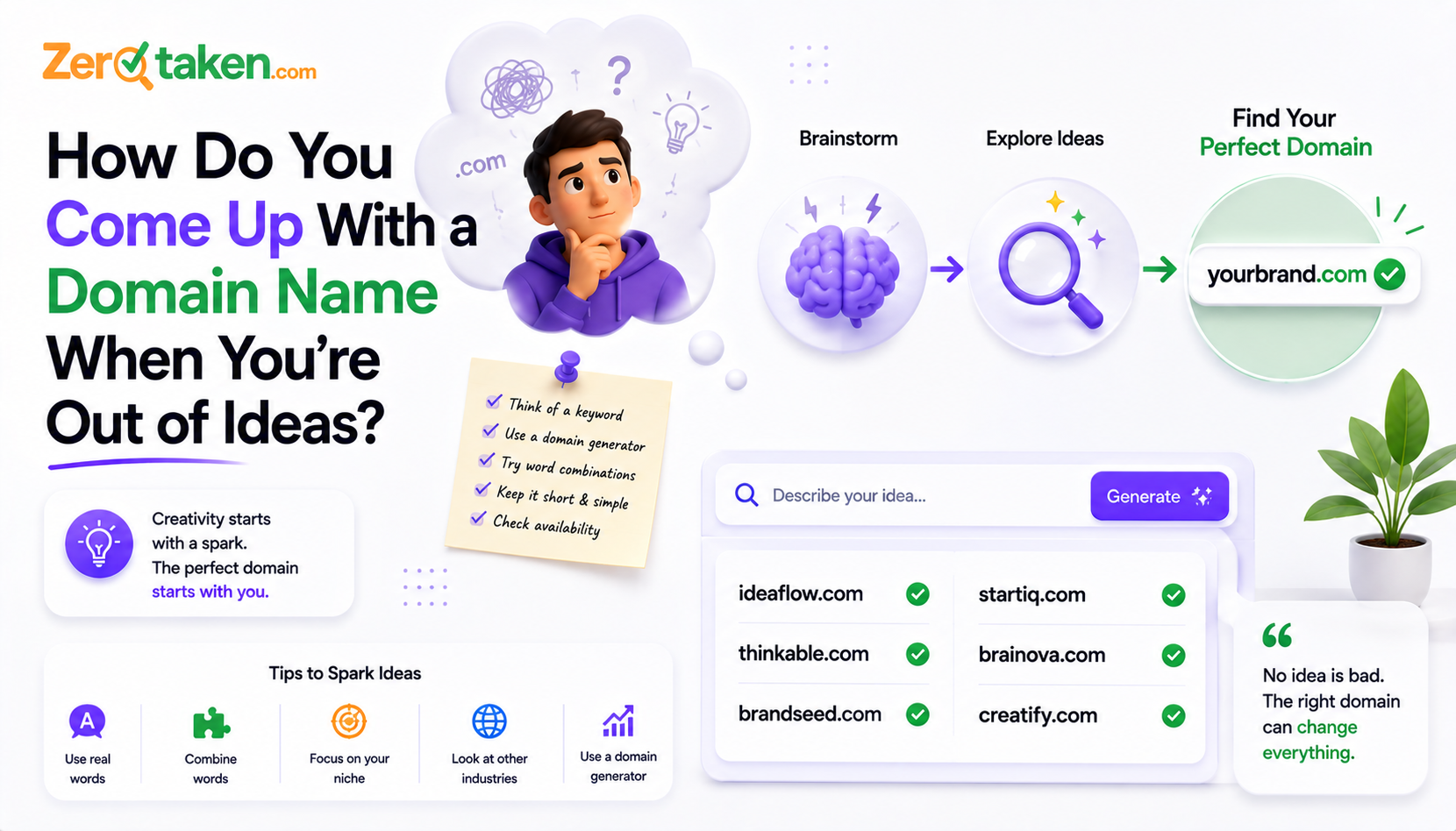
Why does every name you think of feel taken?
Because the names you think of first are the ones everyone thinks of first. Plain dictionary words and obvious two-word compounds — Cloud, Ledger, PayFast, SmartHome — were registered fifteen to twenty years ago by people who got there before you were born as a founder. Of course they're gone. That says nothing about your creativity and everything about the fact that the obvious layer of the namespace has been fully mined since roughly 2005.
The deeper problem is behavioral. When you check the .com the instant a name enters your head, a 'taken' result ends that thought completely — you never get to the ten variations that name could have spawned. You're pruning the tree before it grows a single branch. The fix is almost mechanical: brainstorm with availability turned off, generate far more candidates than you think you need, and judge them later. Good names don't live on the obvious layer. They live one deliberate step off it, and you only reach that step if you keep going after the first idea dies.
Should you describe what you do, or invent something new?
Before you generate a single name, pick a lane — because the three naming strategies pull in different directions and mixing them mid-brainstorm produces mush. There are really only three buckets. Descriptive names say exactly what you do (BookKeeper, InvoiceApp). Suggestive names hint at a feeling or benefit without spelling it out (Stripe, Bolt, Glide). Invented names are coined from scratch and mean nothing until you give them meaning (Twilio, Spotify, Kodak).
Here's the opinionated part. Descriptive names are the easiest to understand and the hardest to own — they're generic, unprotectable as trademarks, and almost universally already registered, which is exactly why your first ten ideas were descriptive and all taken. Invented names are fully ownable but expensive: you pay for that blank slate in years of marketing to teach people what the word means. For most founders the sweet spot is suggestive — a real or near-real word that carries the right mood, is short enough to own, and hasn't been claimed because it isn't the literal category term. Decide which bucket you're playing in first. Then every technique below gets sharper.
What actually generates good candidates?
This is the part people skip, and it's the only part that matters. Great names aren't summoned by staring harder — they're produced by running your idea through a set of transformations. Set a timer, open a plain text file, and run your core concept through every technique below without judging anything. Aim for eighty to a hundred raw candidates. Most will be bad. That's the point: you're generating volume so the filter in the next step has something to work with.
Each technique here is a repeatable pattern, not a one-off. The example brands show you the shape the pattern produces — steal the mechanism, not the word.
- Portmanteau — fuse two relevant words and trim the seam. Pinterest (pin + interest), Instagram (instant + telegram), Microsoft (microcomputer + software). Take your two most on-topic words and overlap them.
- Add a modifier — bolt a verb or tag onto a taken word to free it up: get-, try-, use-, join-, go-, or -hq, -app, -labs. 'Ledger' is gone; GetLedger, JoinLedger, or LedgerHQ often aren't.
- Suffix a noun into a brand — the -ify / -ly / -io trick turns a common word into something ownable: Shopify, Calendly, Twilio, Bitly. Works because the root stays recognizable but the whole is unique.
- Borrow Latin or Greek roots — meaning that isn't claimed in English: 'veritas' (truth), 'sonos' (sound), 'lumen' (light), 'novus' (new). Short, weighty, and usually wide open.
- Steal from nature, myth, and objects — concrete words unrelated to your category carry no baggage and are memorable: Apple, Amazon, Stripe, Monzo, Nike. Pick a word that shares a vibe with your product, not a definition.
- Compress or respell — drop a vowel or double a letter to reclaim a taken word: Tumblr, Flickr, Dribbble, Lyft. Use sparingly; every respelling is a small tax on spelling it out loud.
- Try compounds you haven't tried — verb + noun and adjective + noun combinations you dismissed too fast: Salesforce, Mailchimp, Firebase, Nextdoor. The obvious compound is taken; the third-most-obvious one frequently isn't.
- Translate the concept — a familiar idea in another language: 'rapido' (fast), 'zenith' (peak), 'kaizen' (improvement). Check that it doesn't mean something unfortunate to a native speaker before you commit.
How do you get from a hundred names to a shortlist of five?
Now — and only now — you switch from generating to judging. Run every candidate through these filters and cut hard. A hundred names should collapse to fifteen or twenty survivors fast, because most of what you generated was deliberately disposable.
The filters are simple but non-negotiable. Say each name out loud and imagine telling it to someone in a noisy room — if they can't spell it back, it's out (this is the classic 'radio test'). Kill anything you have to spell with a caveat: 'Flickr, with no e' leaks traffic to a competitor forever. Run the letters together with no capitals and read the result, because 'ExpertsExchange' becomes something you don't want on a billboard. Prefer short, but never trade instant spellability for one fewer syllable. And do a thirty-second trademark gut-check: search the name plus your category, and if an established company already owns it, drop it now rather than after you've printed business cards.
When should you actually check availability?
At the very end, in one batch — never during the brainstorm. Take your shortlist of fifteen or twenty and check them all at once across the extensions that fit your audience: .com first, then .io, .co, or .ai depending on your space. Checking in bulk keeps you objective. You're comparing what's actually available instead of falling in love with one name and then being crushed when it's gone.
This is exactly the batch step ZeroTaken is built for: paste or generate a whole shortlist and see what's genuinely open across every extension in a single pass, with real registry checks rather than a registrar's upsell page. The sequencing is the whole game. Founders who fall in love first and check second are the ones who end up wiring five thousand dollars to an aftermarket broker for a .com they never actually needed — because they'd already emotionally committed before they knew the alternatives were free.
What if the entire shortlist comes back taken?
Don't restart from a blank page — twist what you already have. Nine times out of ten you're one small transformation away from an open name, not one brainstorm away. Add a modifier to a survivor (get-, try-, -app, -hq). Move to an alternative TLD your audience already trusts. Respell or compress a favorite. Or splice two shortlist survivors into a new portmanteau. Only look at the aftermarket if one specific name is worth real money to your business, and only consider rebranding the concept if literally nothing survives — which almost never happens once you've generated a hundred candidates instead of ten.
That's the whole loop: separate generating from judging, run the transformations, filter without mercy, and check in a batch at the end. Do it in that order and the blank tab stops being intimidating. The good names were never gone — they were just one deliberate step past the first idea you gave up on.