
Does Your Open-Source Project Need Its Own Domain? GitHub Pages vs. a Real Domain
Most open-source projects start life at github.com/yourname/yourproject, and most of them stay there until something goes wrong: the maintainer moves the repo to an org, a fork overtakes the original in search, or a popular blog post links to a docs URL that no longer exists. A domain is the cheapest insurance an open-source project can buy, and the best time to buy it is before anyone links to you. This guide covers when a project has earned a domain, how to choose one, and how to set it up so a future move never breaks a single link.
Add ZeroTaken as a preferred source on Google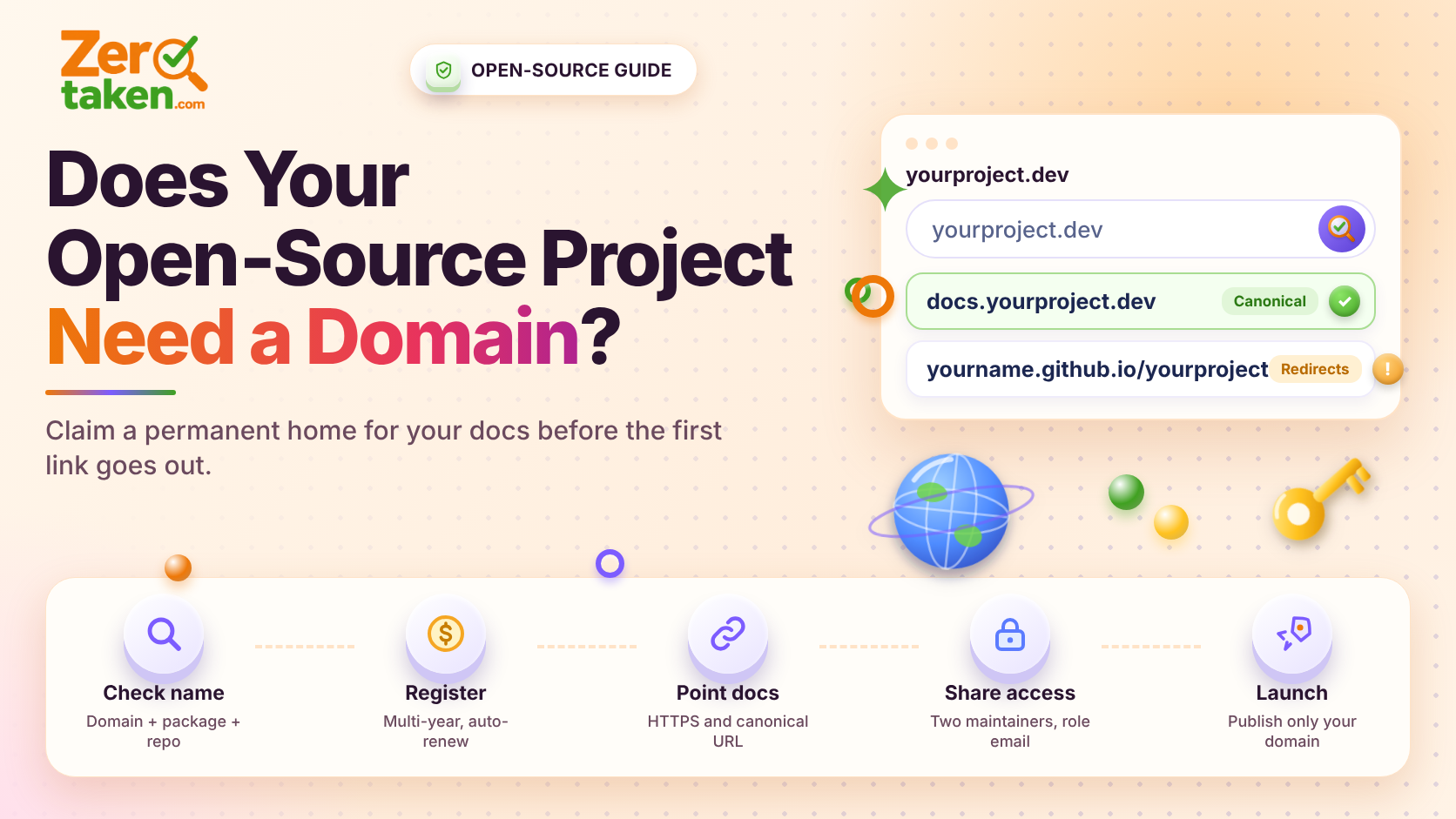
Does a small open-source project really need its own domain?
Not on day one. If the repo has three stars and one contributor, a README is your landing page and github.io is fine. Spending a weekend on a domain before the code works is procrastination wearing a branding costume.
The threshold is lower than most maintainers think, though. The moment you write documentation that other people will link to, you are creating URLs you will have to keep alive for years. Those URLs belong on a domain you control, not on a hosting address that is tied to one GitHub username or one platform's policies.
- Buy a domain when you publish docs, a blog post or a package that points to a URL
- Buy it before you submit to Hacker News, Product Hunt or a newsletter, not after
- Skip it if the project is an experiment you would abandon without regret
What can go wrong if you stay on github.io forever?
A github.io address ties your docs to a username or org name. Rename the account, transfer the repo to a foundation or a company, and every deep link in blog posts, Stack Overflow answers and package READMEs either breaks or relies on redirects you do not control.
It also hands your search ranking to the platform. Links to yourname.github.io/project build authority for a subdomain you can never take with you. A project that outgrows its hosting, say by moving docs to a static site host or a docs platform, starts its SEO from zero.
- Account renames and org transfers break inbound links
- You cannot move your link authority to a new host
- Email at your project's address is impossible, which matters for security reports and sponsorship
- Corporate users often cannot trust or allow-list a personal subdomain
Which extension should an open-source project use: .com, .dev, .org or .io?
Pick the extension that matches how your community already thinks of you. For most projects that is .dev or .org, and .com only if the bare name is genuinely cheap and clean.
The .dev extension is the natural fit for libraries, CLIs and frameworks: developers recognise it instantly, and it enforces HTTPS by default. The .org extension signals a community-run or foundation-backed project, which is a real trust signal if you want companies to sponsor or adopt it. The .io extension is common for developer tools, but it is a country-code extension with a different pricing and renewal profile, so check the real renewal price before you commit.
What not to do: pick a trendy extension just because the .com is taken, then discover that your docs, your package name and your Twitter handle all spell the name differently.
- .dev: best default for libraries, CLIs, frameworks and developer docs
- .org: best if you want a foundation, sponsors or a community-owned feel
- .com: worth it if you plan a company or hosted product around the project
- .io: fine and familiar, but verify the renewal price and be consistent everywhere
Should the domain match the package name and the repo name?
Yes, as closely as you can manage. Developers find projects by typing a name into npm, PyPI, crates.io or a terminal, so the package name, the repo name and the domain should be the same string wherever the platform allows it.
If the exact package name is taken on your registry, resolve that conflict first. Renaming a package later is painful, and a domain that does not match the install command forces every new user to translate between two names. Check all three at once before you commit to a name, not one after the other.
A quick test: say your install command out loud, then say the docs URL. If a listener could not type either from hearing it once, the name is carrying hidden friction.
How do you set the domain up without breaking existing links?
Treat the domain as the permanent home and everything else as a redirect. Point the custom domain at your docs host, keep the old github.io address redirecting to it, and make sure the canonical URL in every page's metadata is on your own domain.
Then make the domain the only address you ever publish. Put it in the repo description, the package metadata, the README badge row and your social profiles. Search engines and package registries will start to treat it as the project's official site, and a fork can no longer claim that spot.
- Add the custom domain to your docs host and enforce HTTPS
- Set a canonical URL on your domain on every docs page
- Fill in the homepage field in package.json, pyproject.toml or Cargo.toml
- Register the domain for multiple years and turn on auto-renew
- Keep the registration in a shared org account, not one maintainer's personal email
Who should own the domain if the project has several maintainers?
Never one person's personal account. Domains are the classic single point of failure in open source: a maintainer burns out, loses access to an old email address or simply forgets to renew, and the project's docs vanish or get bought by a squatter.
Register the domain under a role-based email that at least two maintainers can reach, give a second person recovery access, and write the registrar name and renewal date into your governance or maintainers file. If the project ever joins a foundation, transferring a domain that has clean ownership records takes an afternoon. Untangling one that lives in a former contributor's inbox can take months.
How do you check a name before you commit?
Check the domain, the package registry name, the GitHub org or repo name and the social handles in one sitting. Finding out later that two of the four are taken is how projects end up with a mismatched mess of names.
ZeroTaken can check a name across extensions in seconds, so you can see whether your preferred .dev, .org or .com is free before you write the first line of documentation. Do that first, then claim the package name, then register the domain on the same day so nobody can squat on one half of the set.
So what is the verdict?
Buy the domain when you publish your first docs page or package, not when you get your first thousand stars. Choose .dev or .org unless you have a real reason for .com, match the name to your package, keep the registration in a shared account, and redirect everything else to it. It costs less per year than a month of most developer subscriptions, and it is the one asset that lets the project move hosts, owners and platforms without losing its address.