
Does Your Domain Name Have to Match Your Business Name?
You've settled on a business name you love. You open a domain search, type it in, and the exact-match .com comes back gone — owned, parked, or wearing a five-figure price tag. Now you're at the fork every founder hits: bend the name to fit an available domain, or keep the name and accept a domain that doesn't match it letter for letter. It feels high-stakes because your domain is the address every customer, investor, and press mention will point at for years. So does the domain actually have to be your business name, character for character? The short answer is no — but the gap between them follows rules, and getting them wrong is where founders quietly bleed traffic and trust. Here's how to think about it.
Add ZeroTaken as a preferred source on Google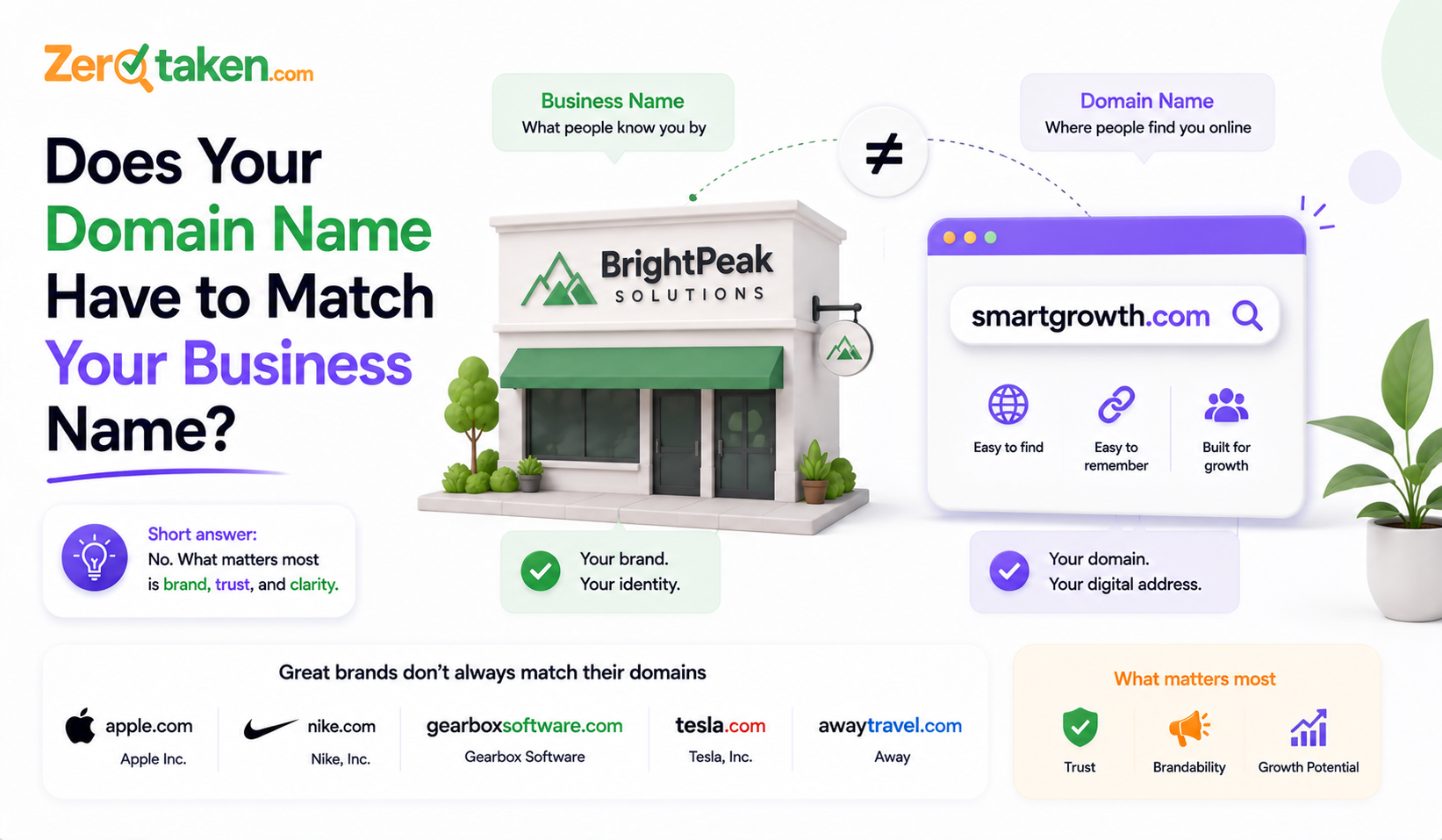
Does your domain really have to match your company name?
No — because they are two different assets doing two different jobs. Your business name is the thing people say, remember, and repeat: it lives in conversations, podcasts, and referrals. Your domain is the address they type or click to actually reach you. The two usually should be close, but 'close' is a range, not a demand for exact identity. Plenty of companies you respect run a domain that isn't a perfect character-for-character copy of their name, and you've never once held it against them.
The real requirement isn't 'identical' — it's 'unambiguous.' If a person hears your brand name once and can find you without guessing how it's spelled or which extra word you bolted on, your domain is doing its job. The moment they have to wonder — was it the name plus 'app,' or 'get,' or was it the .io? — you've created a tax you'll pay on every single word-of-mouth referral. Exact-match is the cleanest way to eliminate that guessing, but it is not the only way.
What does it actually cost you when they don't match?
The costs are real but specific, and they scale with how strange the gap is. First, type-in traffic: some slice of your audience will type your bare name plus .com out of muscle memory, and whoever owns that exact match — a competitor, a parking page, a broker — quietly collects it. Second, word-of-mouth leakage: every added word or unusual ending is one more thing a person can forget, reorder, or spell wrong when they're recommending you to a friend from memory. Third, paid search: you can end up bidding on your own brand terms while a squatter sits on the literal .com and skims the clicks.
There's also a trust cost, but only when the mismatch looks like a workaround. A clean alternate extension reads as a deliberate modern choice. A hyphen, a random unrelated word, or a misspelling a non-technical audience can't reproduce reads as 'couldn't get the real one.' The encouraging part: none of this is fatal when the gap is small and consistent. A tidy, predictable difference costs you almost nothing. It's the weird, guess-inducing gaps that bleed.
How big can the gap get before it actually hurts?
Think of it as a spectrum from frictionless to dangerous. At the safe end is the exact match — zero guessing, nothing to explain. One step out is the exact word on a different extension: [yourname].io, .co, or .ai keeps the spoken name completely intact, which is why it's often a stronger move than adding a word. Next is a small, predictable prefix or suffix — get-, try-, use-, or -hq, -app — survivable and extremely common, but every extra syllable is something a referrer can drop.
Further out sits the deliberate misspelling, and it only works if the misspelling becomes the brand and you commit to it everywhere. Flickr dropped the 'e' because flicker.com was gone; Dribbble tripled the 'b.' Both made the odd spelling the identity — half-commit and you just hand traffic to the correctly-spelled version someone typed by instinct.
Then there's the temporary mismatch you plan to outgrow, which is the safest kind of all. Notion ran on notion.so for years, Discord operated as discordapp.com, and Zoom launched on zoom.us — each eventually consolidated onto the clean exact match once it could. A mismatch is far easier to live with when it's a runway rather than a permanent address. The one spot to avoid is the far end: a totally unrelated domain for a brand-new company means you're now marketing two things at once, and that almost never pays off.
Which should bend — the name or the domain?
If you're forced to compromise on one, protect the name and let the domain flex. The name is the asset that compounds — it's in every conversation, every intro, every 'you should check out ___.' The domain is a routing detail you can quietly upgrade later, exactly as Notion and Discord and Zoom did once the exact match came free. So when you have a genuinely great name and only a 'good enough' domain, keep the name and take the domain that's closest and cleanest to say out loud.
There's one hard exception. If the only available domain forces a spelling nobody can reproduce from hearing your name, the domain problem has become a name problem — and the fix is to change the name, not to ship a domain people can't find. A brand you can't spell out loud is broken no matter what domain sits behind it. Say your finalist names and their domains aloud to someone who's never seen them written down; the one they can type back correctly is the one that's actually working.
Ready to see which version of your name is actually free?
The fastest way to end this debate is to stop theorizing and check. Type your business name and its close cousins — the exact match, the alternate endings, the alternate extensions — and see what's genuinely open before you commit to a single business card. ZeroTaken checks real availability across .com, .io, .co and more in one search, so you can compare the whole family of options side by side instead of guessing which compromise you'll be stuck with.
What are your options when the exact match is taken?
You have more good moves than the panic in the moment suggests. Ranked roughly from least to most disruptive to your name, here are the ones worth trying before you tear up a name you love — and the trade-off each one carries:
- Same word, different extension — [name].io, .co, or .ai. Keeps the spoken name whole; usually the strongest option after an exact .com.
- Same word, predictable wrapper — get[name], try[name], use[name], or [name]hq / [name]app. Survivable, but every added word is something a referrer can forget.
- A tight two-word compound that still reads as one idea — [name]labs, [name]pay — as long as nobody would mistake it for two separate things.
- Buy the exact match outright — worth it when the name is core and the price is sane, but never overpay in the first month of an unproven idea.
- Change one letter — only if the misspelling becomes the brand and you commit to it on every surface, forever.
- Change the name — the right call, not a defeat, when every available domain forces people to guess how to spell it.
So — does your domain have to match your business name?
No. It has to be unambiguous, easy to say, and easy to spell from hearing it once. Exact match is the cleanest way to clear that bar, but a well-chosen alternate extension or a predictable wrapper clears it too. The real failures aren't mismatches — they're mismatches that make people guess, because guessing is where your traffic and your referrals leak out.
So keep the name you can defend in conversation, take the closest clean domain you can get today, and upgrade to the exact match later if it ever matters. Founders who hold out for a letter-perfect domain before launch usually just delay launching. The ones who win pick a name people remember and a domain people can find — then get back to building.