
Do You Need Web Hosting to Own a Domain? Domain vs. Hosting, Explained
You found the name. You bought the domain. Now a checkout page is trying to add 'web hosting' for $9.99 a month, an 'email plan' for $6, and a 'website builder' for $16 — and you genuinely can't tell which of these you actually need to have a live website versus which are upsells riding on your confusion. Almost every first-time founder buys at least one thing here they don't need, and misses one thing they do. The root of it is that 'domain,' 'hosting,' and 'website builder' get used interchangeably when they are three completely separate purchases that do three completely separate jobs. This guide untangles them for good: what each one actually is, what you can run with a domain and no hosting at all, when you truly need hosting, and why buying the domain and the hosting from the same company is a quiet trap.
Add ZeroTaken as a preferred source on Google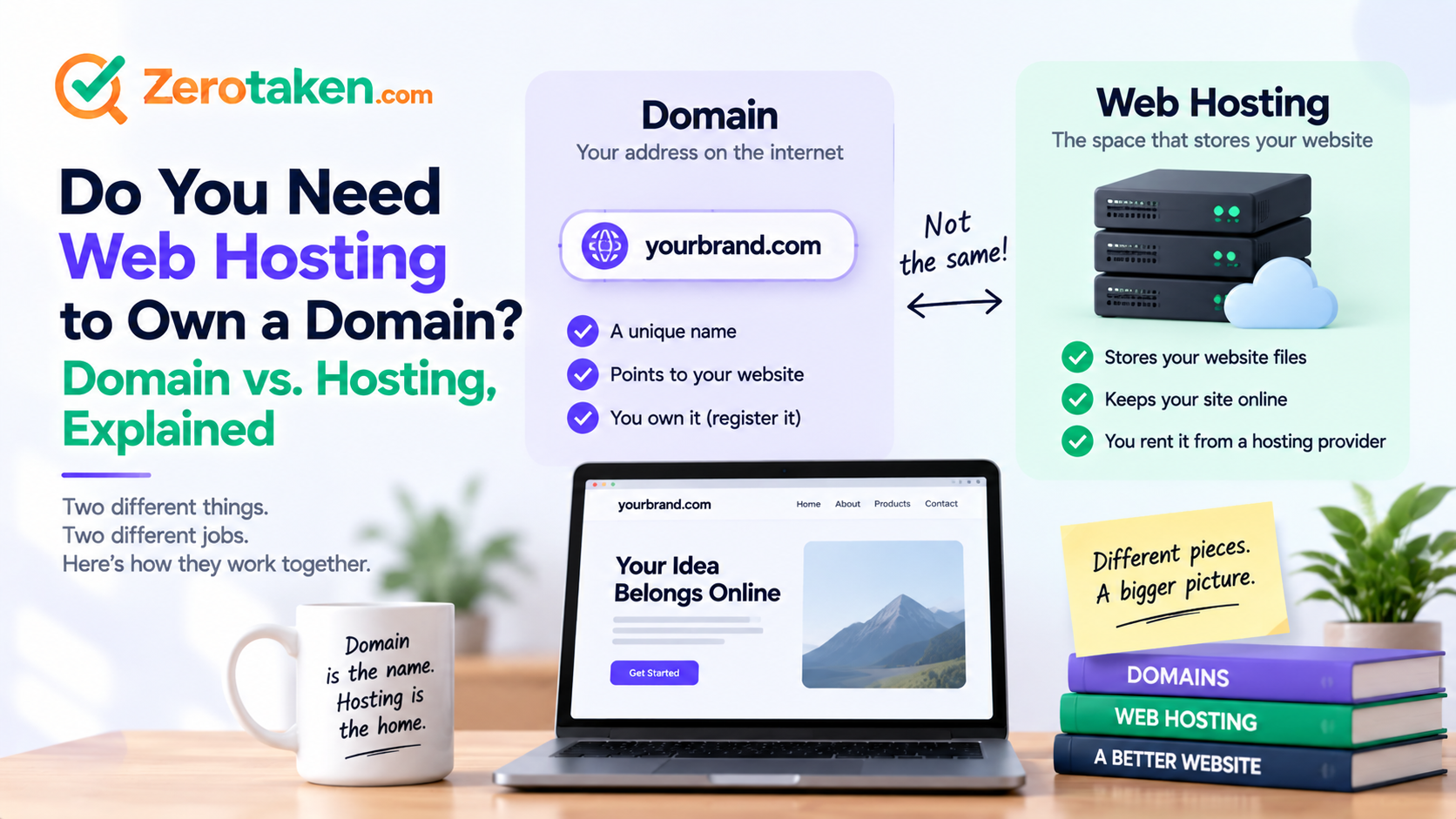
What's the difference between a domain, hosting, and a website builder?
Think of a physical business. The domain is your street address — 'yourbrand.com' — the thing people type or say to find you. Hosting is the land and building the address points to: the always-on computer (a server) that actually stores your website's files and hands them to visitors. A website builder is the construction crew and the furniture: the software you use to design the pages that then get stored on that server. Three different products, from three different kinds of vendor, that happen to get sold on the same checkout page.
The reason the confusion is so common is that these three are technically independent but commercially bundled. You can own a domain with no hosting. You can have hosting with no domain (it just gets an ugly numeric address). You can design a site in a builder that hosts it for you, or one that exports files you host somewhere else. Registrars, hosts, and builders all want to sell you the other two, so they blur the lines on purpose. Once you can name which job each product does, the upsells stop being confusing and start being optional.
Can you own a domain without paying for hosting?
Yes — completely, and for years if you want. Registering a domain and paying for hosting are two separate transactions with two separate vendors and two separate bills. A .com costs roughly $10–15 a year to register, full stop. That fee reserves the name in your control and nothing else; it does not require, include, or expire without hosting. Plenty of smart founders own a domain for six months or more before a single line of their real site exists.
This matters because the highest-priority move when you land on a good name is to secure the name, not to build the site. Names get taken; a half-built homepage can wait. Registering the domain the day you decide on it — with no hosting, no builder, no plan for the site yet — is a perfectly normal, deliberately cheap holding pattern. Anyone who tells you that you must buy hosting 'to activate' the domain is selling, not explaining.
What can you actually do with a domain and no hosting?
More than most people expect. A domain comes with DNS — the settings that tell the internet where 'yourbrand.com' should point — and you can put those settings to work without renting a server at all. The practical list of things a hosting-free domain can already do is longer than the list of things it can't:
- Professional email — set up name@yourbrand.com with free email forwarding (Cloudflare Email Routing and others) or a mailbox plan, no website required
- A redirect — point yourbrand.com straight at your existing landing page, Notion doc, Linktree, Instagram, or Substack
- A free coming-soon or launch page — services like Carrd, GitHub Pages, Cloudflare Pages, Netlify, and Vercel host a simple static page for $0 and let you attach your domain
- Reserve the name — hold it as a defensive or future asset while you build elsewhere, paying only the yearly registration
- Verify ownership — prove control of the domain to Google, a mail provider, or a payment processor via a DNS record
So when do you actually need hosting?
You need hosting the moment you have real files or a real application that has to live somewhere and be served to visitors on demand. A multi-page marketing site, a web app with a login, a store with a database, a blog with a CMS — all of that is 'a site,' and a site needs a server to sit on. That server is hosting. The question is never whether you need hosting for a genuine website; you do. The question is what kind, and whether you're overpaying for it.
Here's the part the checkout page won't tell you: for a huge share of early projects, hosting is free or nearly so. A static or 'JAMstack' site — most landing pages, docs sites, and portfolios — runs indefinitely on the free tiers of Cloudflare Pages, Netlify, Vercel, or GitHub Pages, and you point your domain at it in about two minutes. You step up to paid hosting (a few dollars a month for shared hosting, more for managed platforms) when you have a real backend, a database, server-side code, or serious traffic. Buy hosting when the site demands it — not because a domain purchase made you feel like you had to.
Should you buy your domain and hosting from the same company?
Usually not — and this is the one opinionated stance worth holding firmly. Keeping your domain at a dedicated, low-cost registrar and your hosting wherever it makes technical sense is the flexible, portable setup. Your domain is the one asset you never want to lose control of or find yourself unable to move. When it's bundled inside a hosting or website-builder account, moving hosts can turn into a hostage negotiation over the name itself, and 'free domain with hosting' offers routinely renew at inflated prices or make the domain awkward to transfer out.
The clean pattern is decoupled: the domain lives at a registrar whose only job is registering domains, and it points — via DNS — at whatever host or builder you're using this year. Change hosts, redesign, migrate platforms, and the domain never moves; you just repoint a record. Bundling everything with one vendor optimizes for one afternoon of convenience and quietly costs you leverage for years.
- Keep the domain at a dedicated registrar — it's the asset you must always be able to move
- Be wary of 'free domain for the first year' — check the renewal price and the transfer terms
- Remember the 60-day lock: after registering or transferring, ICANN blocks a transfer to another registrar for 60 days
- Point the domain at your host with DNS records — you never have to move the domain to change hosts
How do you lock down the name before you sort out the rest?
The sequence that saves founders the most pain is boring: settle the name and register the domain first, then take your time with hosting and the build. Hosting decisions are reversible in an afternoon; losing your first-choice name to someone else is not. Before you commit, though, check that the exact name is genuinely free across the extensions you care about — the .com being gone while the .co sits open changes the whole plan, and you want to know that before you fall in love with a name.
ZeroTaken checks a name across .com, .io, .co, and more in a single search and never logs your queries, so you can pressure-test your shortlist without leaking your best idea to an aftermarket bot. Lock down the winner, park it with a free redirect or coming-soon page, and only then start shopping for hosting — with a clear head instead of a checkout page rushing you.
What about all-in-one builders like Wix, Squarespace, or Framer?
All-in-one website builders roll the builder and the hosting into one subscription — you design in their editor and they serve the result, so you never think about a server. For a non-technical founder who wants a good-looking site live this weekend, that convenience is genuinely worth paying for, and there's no shame in it. The trade-off is lock-in: your site is built in their system and generally can't be lifted out and hosted elsewhere without rebuilding it.
The specific thing to watch is who holds your domain. Most builders happily register the domain for you — sometimes free for the first year — and then it lives inside their account. That's the setup you want to avoid. Either register the domain separately at a real registrar and just connect it to the builder (every serious builder supports this in their settings), or, if you did let them register it, know your rights: it's still your domain, you can unlock it and transfer it out after the 60-day ICANN window, and you should confirm that before you're locked into a renewal you didn't intend.
So what do you actually need to get online?
Strip away the upsells and the real shopping list is short. You always need a domain — that's non-negotiable and cheap. You need hosting only when you have an actual site or app to serve, and for early landing pages and static sites that hosting is very often free. You need a website builder only if you want help designing the pages and don't want to touch code — and if you use one, keep your domain registered separately so you're never trapped. Email on your own domain is a bonus you can add at any point, with or without a website.
The mistake isn't buying too little; it's buying a bundle you didn't understand and calling it a website. Register the name first because names run out. Add hosting when a real site needs a home, and not a day sooner. Keep the domain — your one irreplaceable asset — under your own control at a registrar, pointing wherever you like. Do that, and you'll never again stare at a checkout page wondering which of three things you're actually supposed to buy.