
.com vs .net: Should You Ever Choose .net in 2026?
You searched for your brand, the .com came back taken, and right below it sat the .net — same word, standard price, available right now. Before you grab it, you want the thing nobody says out loud: is .net a legitimate choice in 2026, or a quiet signal that you couldn't get the real one? This guide gives you a straight answer — what actually separates the two extensions, whether Google or your customers care, the handful of cases where .net genuinely wins, and the one risk that sinks most .net brands.
Add ZeroTaken as a preferred source on Google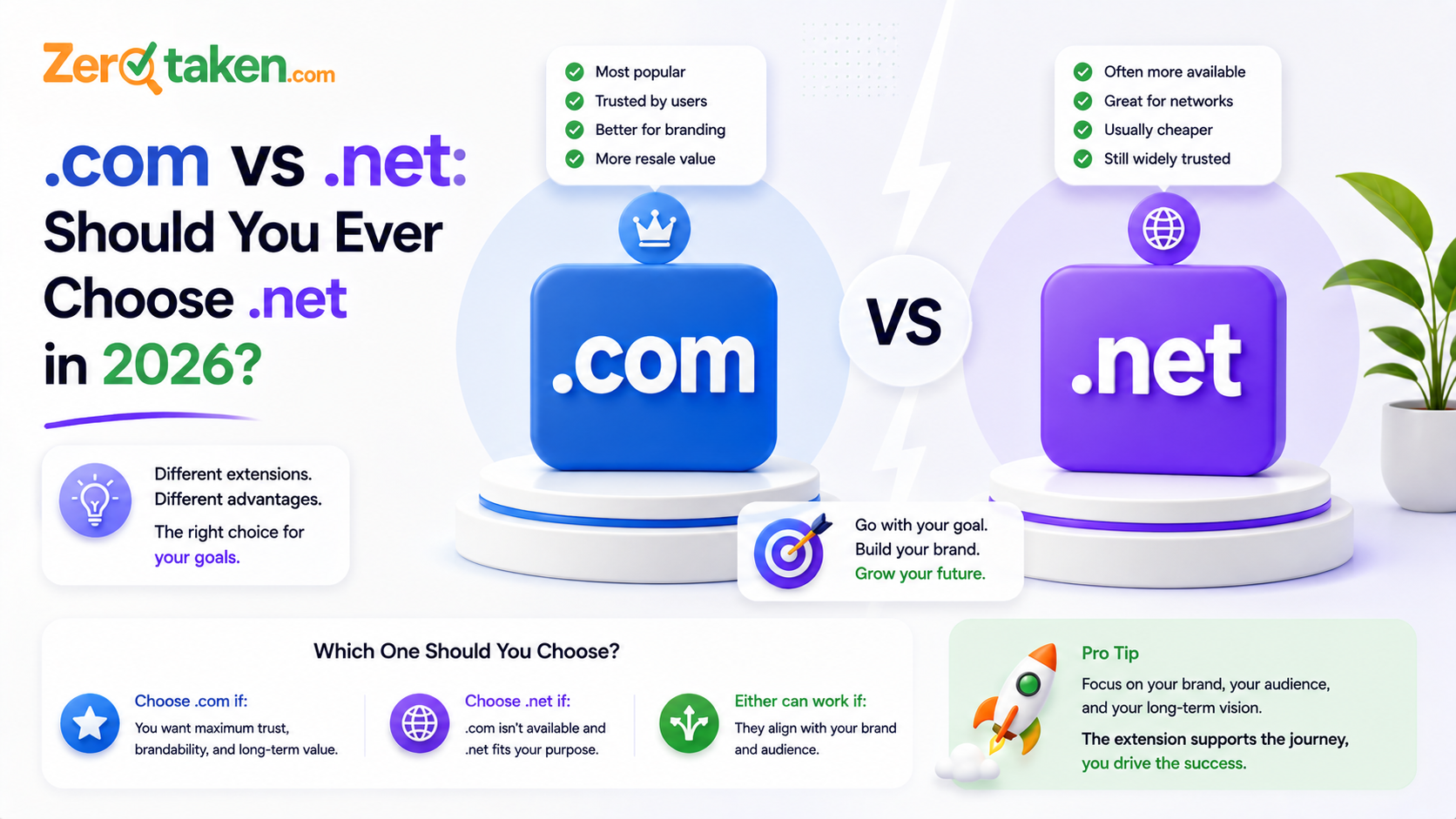
What actually separates .com from .net?
.com and .net were both born in 1985, part of the original handful of top-level domains. The distinction was purpose: .com for commercial entities, .net for the companies that ran the network itself — ISPs, infrastructure providers, the plumbing of the early internet. That intent is long dead. Both are now open, generic top-level domains (gTLDs) that anyone can register for anything, with no restrictions and no country attached.
What survives is perception, and it is lopsided. .com has become the default namespace of the entire web — over 160 million registrations, and more importantly the extension every non-technical person assumes a real business uses. .net has roughly 13 million registrations and no clear modern identity. It isn't wrong; it's just unmarked. When someone hears your name and reaches for a browser, their fingers type ".com" on autopilot. That single reflex is the whole ballgame, and we'll come back to it.
Is .net worse for SEO than .com?
No. Google treats .net exactly like .com — both are generic gTLDs with no geo-targeting and no ranking penalty attached to the letters after the dot. A .net site can rank on page one against .com competitors on identical footing. Relevance, backlinks, site speed, and content depth decide your position; the extension does not.
The honest caveat is about humans, not algorithms. In a results page or a shared link, a mainstream audience reads .com as marginally more "official," which can nudge click-through on consumer queries. That effect is small and shrinking. The bigger SEO-adjacent problem with .net isn't ranking at all — it's that if a competitor owns your .com, a share of the people searching for you will land on them instead. That's a traffic leak, not a penalty, but it hits the same bottom line.
Does .net actually cost less than .com?
Barely, and not enough to matter. Both extensions register and renew in the same $10–15 per year range at mainstream registrars. .net is occasionally a dollar or two cheaper on a first-year promo, but it renews at parity. So unlike the .io or .ai decision — where you're weighing a genuine 3x–5x price gap — there is no money argument for .net.
That's actually clarifying. If the .com and the .net of your name are both available at standard price, cost gives you zero reason to pick the .net. The only real trade-off left is perception and typo-traffic, which means the decision comes down to who your audience is and whether you can also hold the .com.
When is .net actually the right choice?
Most of the time it isn't — but dismissing .net entirely is as lazy as defaulting to it. Choose .net deliberately when one of these is genuinely true:
- Your audience is technical and the word fits the medium. Developer tools, self-hosted software, open-source projects, and networking or infrastructure products can wear .net without a second look — the extension's original "network" association still reads as on-brand to that crowd.
- You already own the matching .com and are pointing it at the .net. If you control both and redirect one to the other, the type-in leak disappears and you can lead with whichever you prefer.
- The name is genuinely great on .net and the .com is a five-figure aftermarket listing. A memorable, brandable .net you own outright beats a hyphenated, misspelled, or bolted-on .com you settled for. Owning your exact word matters more than the three letters after it.
- You're building a community, forum, or platform where "net" reads as intentional — networks of people, not just packets. Some brands lean into it, and it works.
What's the real risk of building a brand on .net?
Type-in leakage, and it compounds. Every time you say your name on a podcast, print it on a card, or someone recommends you out loud, a predictable chunk of that audience types yourname.com — because that's muscle memory, not a decision. If you don't own the .com, you're handing those visitors to whoever does. If that .com is parked with ads, or worse, owned by a competitor, you're actively funneling your own word-of-mouth to someone else.
It shows up in the small moments too. Reading your email address aloud — "that's at yourname-dot-net" — invites a "don't you mean .com?" every single time, and support tickets pile up from customers who guessed wrong. None of this is fatal, but it's a persistent tax you pay forever. The way to neutralize it is simple and non-negotiable: if you build on .net, buy the .com too the moment you can.
Should you buy the .com if you launch on .net?
If it's available at standard price, yes — treat it as part of the cost of the name, not an optional extra. Register it, 301-redirect it to your .net (a five-minute forward at your registrar), and you've plugged the leak while keeping your .net as the brand. Fifteen dollars a year is cheap insurance against sending real traffic to a stranger.
If the .com is already taken, do the honest math before you commit to the .net. Look at what's actually sitting on it today — a parked page, an unrelated business, a broker asking five figures, or an active competitor. If it's a broker and the name is worth it, a mid-four-figure purchase to own both can be money well spent. If it's a competitor in your space, seriously reconsider the whole name; you'll spend years fighting brand confusion you chose on purpose. The time to check who owns the .com is before you fall for the .net, not after.
So .com or .net — what should you actually pick?
Default to .com. For the overwhelming majority of brands — consumer apps, agencies, SaaS, e-commerce, anything a non-technical person will type — the .com is worth reaching for first, whether that means a slightly longer name, a different word, or a modest aftermarket purchase. It's the extension that gets typed by default, and defaults win.
Choose .net only on purpose: a technical audience where it reads as native, or a name good enough that you'll also secure the .com. And whichever way you lean, check both extensions across your shortlist before you commit — running your candidates through ZeroTaken shows the .com and .net status side by side, so you find out who owns what before you're attached to a name. That five minutes is the difference between a clean launch and a brand you're quietly apologizing for.
The rule in one line: pick .com unless you have a specific reason not to — and if you pick .net anyway, own the .com too.