
Can Anyone Find You by Name? The Google Test to Run Before You Register a Domain
Most founders vet a domain name for availability, length and spelling. Almost none vet it for findability. Then launch week arrives, someone hears your name at a conference, types it into Google — and gets a dictionary definition, a band, a hiking brand and a competitor's blog post. Your own site is on page three. A name you cannot rank for is a tax you pay on every referral, podcast mention and word-of-mouth recommendation, forever. The good news: you can measure this before you spend a cent, and the test takes ten minutes.
Add ZeroTaken as a preferred source on Google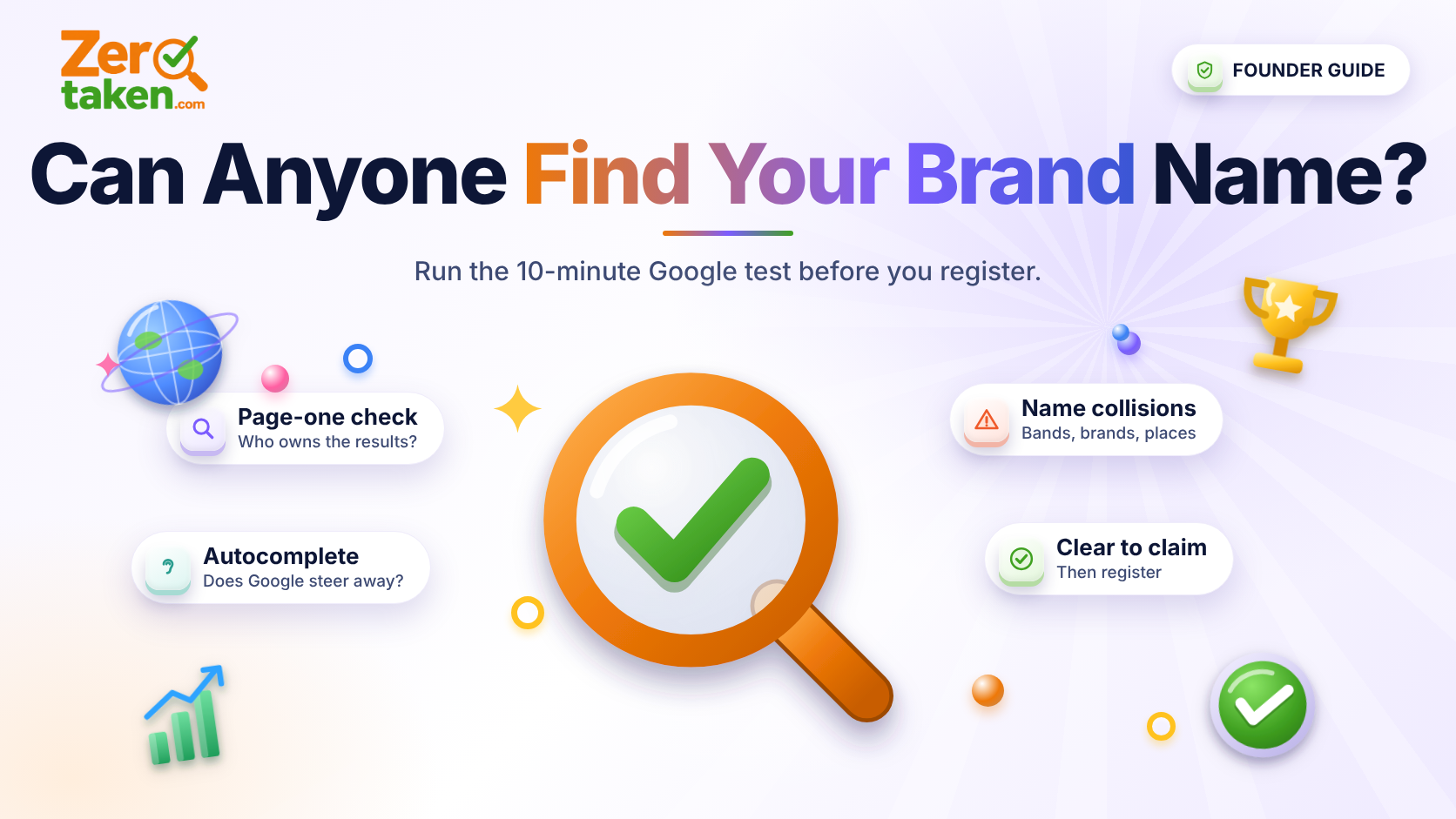
Why does searchability matter more than the domain itself?
Think about how people actually reach a young brand. Very few type the URL cold. They hear the name — on a call, in a podcast, from a friend — and then they search it. That search is your single most valuable traffic source, because the visitor already wants you. If the results page sends them somewhere else, the referral is lost, and you will never see it in your analytics.
This is the part of naming that availability checkers cannot see. A domain being free tells you nobody registered it. It says nothing about whether the word is already owned in search results by a movie, a medication, a city or a Fortune 500 company.
What is the 10-minute Google test?
Open a private window so your history does not skew results, and search the bare name — no extension, no quotes first, then with quotes. Then run these five checks:
- Page-one ownership: how many of the first ten results are about something unrelated to your idea? More than three is a red flag; more than six means you will fight for years.
- The 'brand + category' query: search 'yourname + your product type' (for example, 'yourname invoicing software'). If the results are junk, even a strong product struggles to be discovered through that phrase.
- Autocomplete: type the name and look at the suggestions. If Google completes it to something else entirely, searchers are being steered away from you.
- Image and news tabs: a name tied to a scandal, a lawsuit or a tragedy will carry that association into every search.
- Exact-match competitors: if a company in your category already owns the name or a one-letter variant, stop. Searchers will not tell you apart.
Which kinds of names fail this test most often?
Common dictionary words fail hardest. 'Apple', 'Slack' and 'Square' only work for companies with enormous budgets; a new startup using a plain word competes with every page that uses that word in its normal sense. The shorter and more common the word, the worse the problem.
Names with a built-in collision are the second trap: a word that is also a famous person, a place, a band or a disease. And the third is the near-miss: a name one letter off from an established brand, which Google will often 'correct' for the searcher, quietly sending them to the bigger company.
Invented or lightly modified words — two syllables, unusual enough to be unique, easy enough to type — consistently do best. You are not looking for a word with zero meaning; you are looking for one where no other meaning dominates the results page.
Does a common-word name ever make sense?
Yes, in two situations: you have a distribution channel that does not depend on search (a sales team, a built-in install base, a marketplace listing), or you are willing to pay for the name's ambiguity with a qualifier. Plenty of founders go with 'Name + category' — 'Name Payments', 'Name Analytics' — and own that two-word phrase while the bare word stays contested.
What does not work is hoping SEO will sort it out later. Ranking for a name that Google associates with something else takes content, links and years. If your plan to win the name is 'we will outrank them eventually', pick a different name.
How do you check this next to availability?
Run the two checks in order. First screen your shortlist for availability so you do not fall in love with a taken domain — a quick pass in the ZeroTaken search tool handles that across extensions. Only then run the Google test on the survivors. Doing it in this order saves you from spending ten minutes researching names you cannot register anyway.
Keep a simple scorecard for each finalist: how many page-one results are unrelated, whether autocomplete helps or hurts, and whether a competitor owns the neighborhood. A name that scores clean on all three is worth more than one that is merely clever.
What if your favorite name fails?
Do not abandon it blindly — adjust it. Adding a distinctive suffix or prefix, changing a spelling in a way that stays typeable, or combining it with a second word often turns a crowded term into an ownable one. Re-run the test on every variation; a small change can move you from a results page you cannot win to one you will own within weeks.
And if the name still fails, let it go. The cost of switching names after launch dwarfs the ten minutes you spend now. A name is only an asset if people can find it.
What is the short version?
Search your name before you register it. If the first page belongs to someone else, you are renting visibility from their brand. Pick a name where the results page is empty or yours to take — and where searching the bare name leads people straight to you.