
That $1 Domain Isn't Cheap: The Real Cost of Owning a Domain
You found the name, the checkout said $0.99, and it felt like a steal. Then next year the same domain quietly renews at $42 — and you find out the .ai you were eyeing is billed two years at a time, that the clean one-word .com is flagged "premium" at $180 every single year, and that the WHOIS privacy you assumed was free is a line item. A domain is one of the few things a founder buys where the advertised price and the price you actually pay to keep it can differ by 40x. This guide strips the sticker off: why the first year is a loss leader, which extensions are expensive to hold, the fees that appear after checkout, and how to see your true cost before you commit — not after.
ZeroTaken'ı Google'da tercih edilen kaynak olarak ekle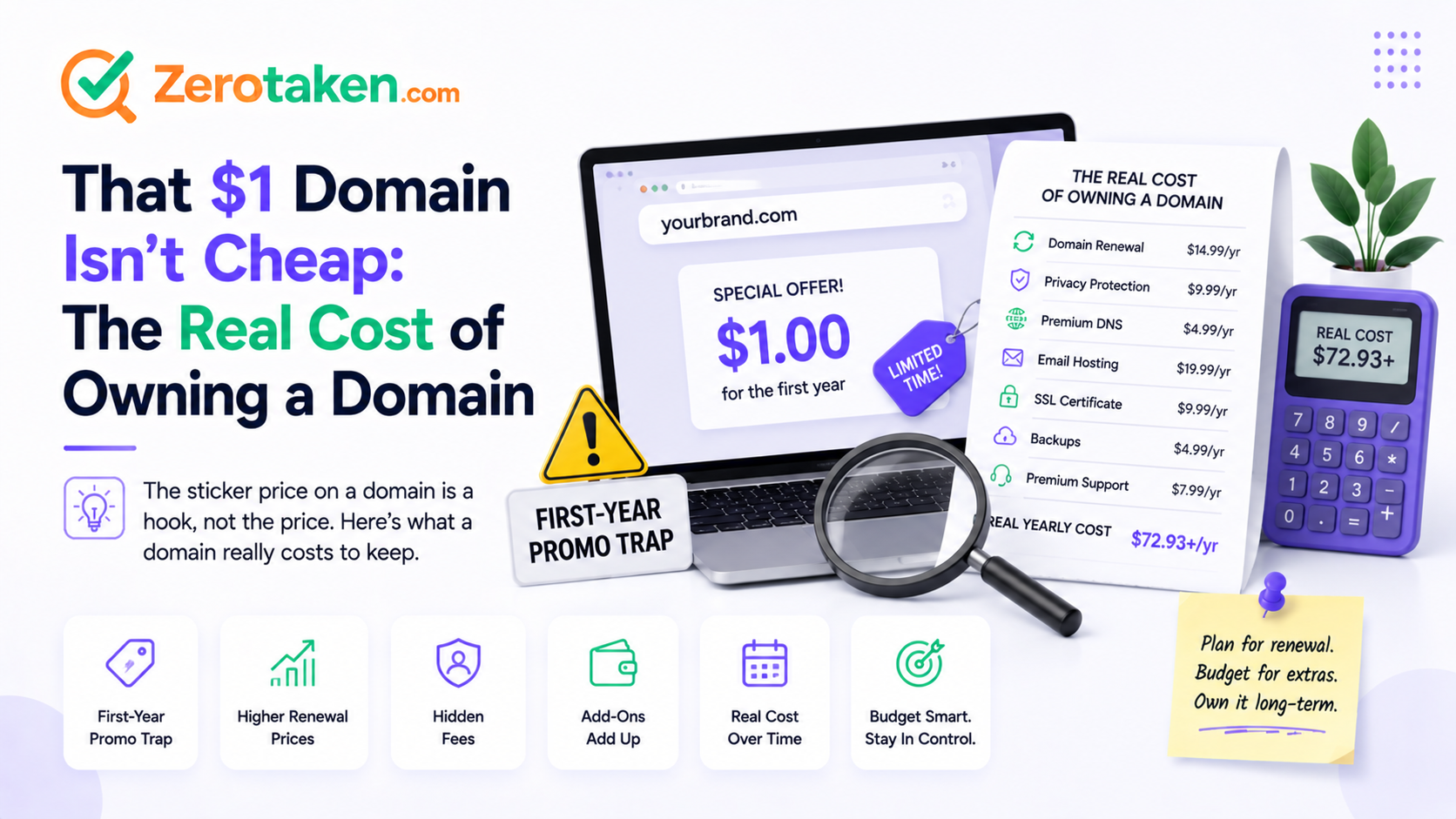
Why is the first year so cheap and the second year so expensive?
Because the first year is a customer-acquisition cost, not a real price. Registrars know that once your domain is set up — DNS pointed, email running, business cards printed — you almost never move it, so they sell the first year at or below cost to win you, then make their margin on every renewal after. A .xyz or .co dangled at $1 to $5 in year one routinely renews at $12 to $35. The teaser number is bait; the renewal number is the one you'll pay four, five, ten times over.
The fix is a one-second habit: never read the sticker price, read the renewal price. Every reputable registrar shows it, usually in small grey text right under the promo. If you can't find a renewal price before you pay, that's the answer — assume it's high. And do the math over your real horizon: you're not buying a domain for a year, you're buying it for as long as the company lives, so a $3 domain that renews at $30 is a $30 domain with a coupon.
What is a 'premium' domain that isn't even on the aftermarket?
Most founders think 'premium domain' means a name someone already owns and resells for four figures. There's a second, sneakier kind: registry premiums. The registry that runs an extension can flag any unregistered name it thinks is valuable — a short word, a common term, a hot keyword — and set a permanently elevated price on it. Nobody owns it yet. You can register it right now. But instead of $12 a year it might be $180 a year, forever, and that premium price applies to every renewal, not just the first.
This bites hardest on the trendy extensions. The reason a great one-word .io or .ai appears 'available' when your usual .com is long gone is often that the registry has quietly priced it as a premium — so the name is free to grab but expensive to hold. Before you celebrate finding an open one-word name on a newer TLD, check the exact annual figure. A domain you can afford to buy but not to renew is a trap with a countdown timer on it.
Which domain extensions actually cost the most to keep?
The extension you pick sets your baseline for the entire life of the brand, and the spread is enormous. Here's the honest lay of the land for standard (non-registry-premium) names as of 2026 — always confirm exact numbers at checkout, since registrars price differently and promos move constantly:
- .com — the cheapest to own long term and the most stable: roughly $10–15/year at both registration and renewal, with no surprises.
- .ai — the expensive darling: sold in mandatory two-year blocks, so you pay for two years up front, and the all-in annual cost typically lands well north of any .com — budget for it before you fall in love.
- .io — a developer favorite that isn't cheap to hold: commonly $30–60/year at renewal, often behind a much lower first-year promo.
- .co — usually $25–35/year, frequently promoted under $10 for year one, then full price after.
- .app / .dev — reasonable (often $12–20/year) but they require HTTPS to load at all, so factor in an SSL certificate (free via most hosts, but not optional).
- .xyz and other budget gTLDs — cheap sticker, cheap-ish renewal (~$10–15), but watch for registry-premium names hiding inside the extension.
What hidden fees show up after you click 'register'?
The domain line item is rarely the whole bill. The classic upsell is WHOIS privacy — the service that hides your name, address, and phone from the public registration record. It should cost nothing; registrars like Cloudflare and Namecheap include it free, and it's a basic protection against spam and doxxing. If a registrar tries to charge you $5–10 a year for it, that's a signal to register somewhere else, not to pay the toll.
Then there's the pile of things checkout tries to bundle: 'website builders,' 'professional email,' SSL certificates you can get free elsewhere, and premium DNS you don't need on day one. There's also a tiny, legitimate ICANN fee (about $0.18 per domain-year on most gTLDs) that's real and unavoidable — but it's cents, not the thing to worry about. The thing to worry about is the $60 of optional extras pre-ticked in your cart. Uncheck everything, buy the domain, and add real services later only when you actually need them.
What does it cost if you let a domain expire — and can you get it back?
This is the fee nobody plans for, and it's the biggest one. When a domain lapses it doesn't vanish instantly. First comes a grace period (typically up to ~30 days) where you can still renew at the normal price. Miss that and it enters redemption — the name is deactivated and only you can recover it, but now the registrar charges a restore fee on top of the renewal, commonly $80–150 and sometimes more. Same domain, same you, ten times the price, purely for being late.
Blow past redemption and the domain drops back to the public, where backorder services and drop-catchers are waiting to grab anything with traffic or a brand attached — after which your only path back is buying it from whoever caught it, at aftermarket prices. The cheapest insurance against all of this is free: turn on auto-renew, keep a card on file that isn't expired, and make sure the registrar's reminder emails go to an address a human actually reads. Losing a domain almost never happens because someone couldn't pay $15 — it happens because a reminder hit a dead inbox.
How do you find your true cost before you commit?
Total cost of ownership on a domain is knowable in about two minutes if you ask the right questions before you pay. Run this checklist on any name you're serious about, and compare the real numbers across the extensions you're weighing — not the promo prices:
- What's the renewal price (not the first-year price)? Multiply it by 5 to see what five years of owning this name really costs.
- Is this specific name flagged as a registry premium? An open one-word name on a trendy TLD often is.
- Is the extension billed in multi-year blocks (like .ai)? If so, know the upfront number.
- Is WHOIS privacy included free? If not, pick a registrar that includes it.
- Are there pre-ticked add-ons in the cart? Uncheck everything you didn't come for.
- Does auto-renew work and is a valid card on file? This is what actually protects the asset.
How do you compare the true cost of a name across extensions?
The trap most founders fall into is checking one extension, seeing a scary price or a 'taken,' and settling — without knowing that the same idea might be cheap and clean one column over. Availability and long-term cost move together: the reason a name is still open on a pricey TLD is often the reason it's expensive to keep. Seeing them side by side is what turns a snap decision into an informed one.
ZeroTaken checks your name across .com, .io, .ai, .co and more in a single search, so you can spot which extension is genuinely free versus flagged premium before a checkout page ever gets to spin the price on you — and it never logs your queries, so testing your best name doesn't leak it to an aftermarket bot. Line up the real options first; decide with the numbers in front of you.
So what does a domain really cost?
For a standard .com, honestly not much — plan on $10–15 a year, forever, and stop worrying about it. The cost blows up in three predictable places: a trendy extension with a high or premium renewal, a pile of upsells you didn't need, and a lapse that drags you into an $80-plus restore fee. All three are avoidable, and all three come down to the same discipline: look at the renewal price and the fine print before you pay, not after your card is charged.
The rule that keeps you out of trouble is simple. Buy the name you can afford to keep for a decade, not just to grab for a year — because the whole value of a domain is in never having to change it. A cheap sticker price on a name you'll rename away from in eighteen months is the most expensive domain of all.