
.shop vs .store vs .com: Which Domain Should Your Online Store Use?
You've got a product, a Shopify trial open in another tab, and a name you like — but the .com is gone or costs five figures. So you're staring at .shop and .store, wondering whether a keyword extension makes you look modern or makes you look like you couldn't afford the real thing. This is a genuinely close call for ecommerce, closer than it is for most startups, and the honest answer isn't 'always buy .com.' Here's exactly when each extension wins, and how to decide in the next ten minutes instead of the next ten days.
ZeroTaken'ı Google'da tercih edilen kaynak olarak ekle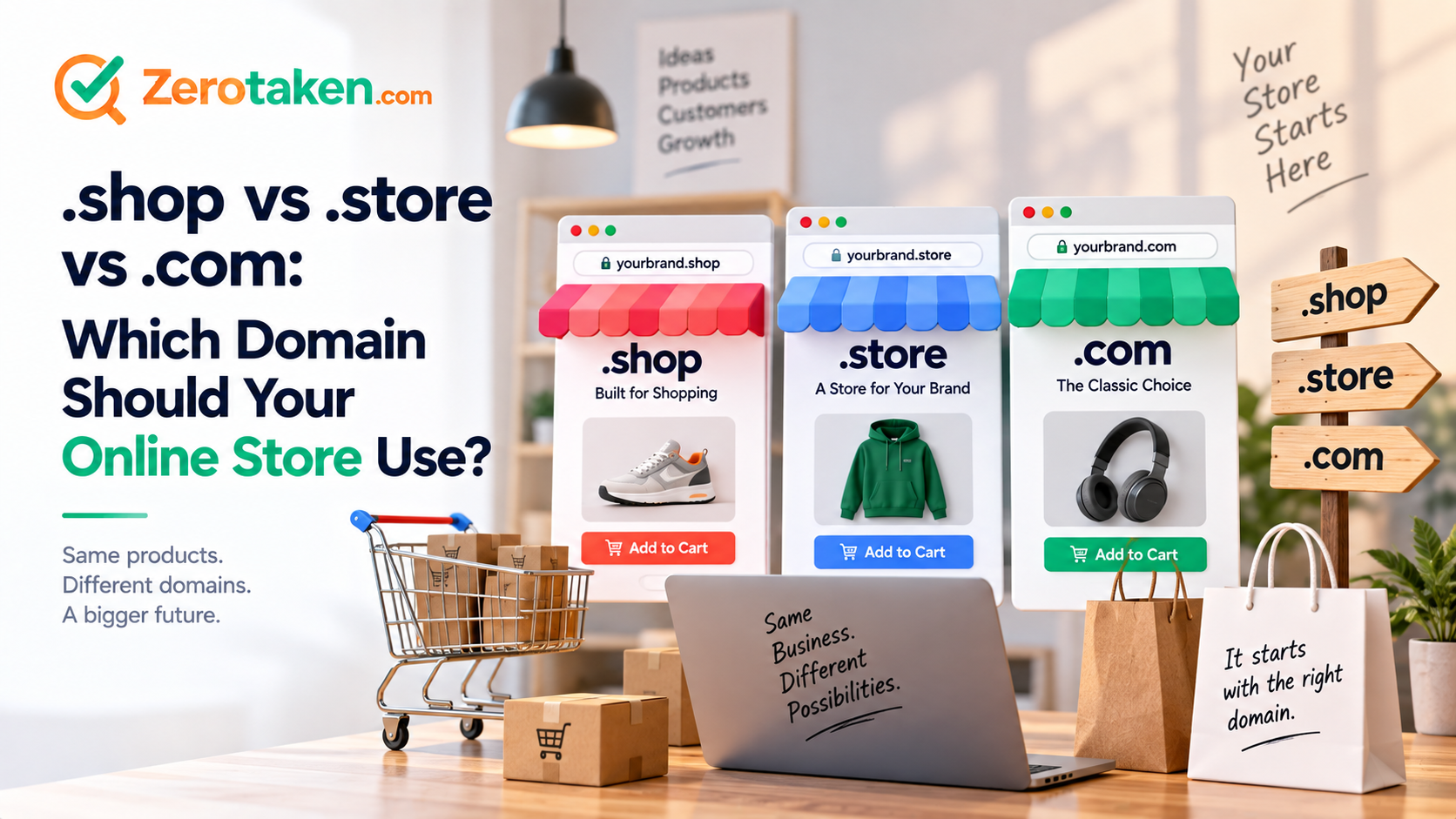
Does the extension even matter for an online store?
It matters less than founders fear and more than the '.shop is fine, ship it' crowd admits. For a store, the extension does two jobs: it tells a stranger what you sell before they've read a word, and it decides how many people mistype your address into a competitor's site. A great .shop or .store can nail the first job. Only .com reliably nails the second.
The trap is treating this as a branding debate when it's really a leakage problem. If your name is 'Lumen' and you buy lumen.store, a meaningful slice of people who hear your name will type lumen.com out of pure muscle memory — and if someone else owns that, you just handed them a warm lead. That's the real cost of a non-.com, and it's the number you should be weighing, not vibes.
What's the actual difference between .shop and .store?
Functionally, nothing — both are new generic top-level domains launched in 2016, both work identically in browsers, email, and checkout, and neither carries any technical advantage over the other or over .com. The difference is entirely linguistic, and it's worth thirty seconds of thought.
'.shop' reads as a verb and an invitation — 'come shop' — which flatters small, focused, direct-to-consumer brands: one product line, a clear vibe, a name that wants energy. '.store' reads as a noun and a place — bigger, more general, more 'we carry a lot of things.' If you sell one beautifully-made thing, .shop usually feels tighter. If you're a marketplace or a broad catalog, .store often fits better. Say your full domain out loud twice; the one that sounds like a sentence a customer would actually say is the right one.
- Pick .shop for focused, single-category, DTC brands where the name wants momentum.
- Pick .store for broad catalogs, marketplaces, or 'flagship' positioning.
- Ignore the price gap between the two — it's noise next to the branding fit.
When is .com still the right call?
Most of the time, if you can get a clean one. .com is the only extension the entire buying public treats as the default — people type it without thinking, autocomplete assumes it, and older or less-online customers genuinely don't register that anything else exists. For a store, where every mistyped visit is a lost sale, that default behavior is worth paying for.
So the rule is simple: if a strong, short, spellable .com exists for a name you'd be happy with, take it and stop agonizing. Don't buy yourbrand.shop to feel clever when yourbrand.com is sitting there for fifteen dollars. The clever move and the safe move are the same move here.
When does .shop or .store actually beat .com?
When the only .com you can get is a compromise — a hyphenated version, a random extra word, a misspelling, or the 'get' / 'try' / 'buy' prefix that quietly announces you're the second choice. A crisp, one-word yourbrand.shop beats a mangled yourbrandonline.com or get-yourbrand.com almost every time, because the compromise .com carries the same recall problems as a non-.com and looks worse doing it.
It also wins when the keyword is doing real work. A name like 'Rune' is abstract; rune.shop tells people it's a place to buy something. That built-in context can be worth more to a brand-new store than the marginal recall edge of a weaker .com. The deciding question is never '.shop or .com?' in the abstract — it's 'this specific .shop, or the specific .com I can actually afford?'
Do .shop and .store hurt trust at checkout?
A little, and it's worth being honest about it. There's a recognition gap: a slice of shoppers still reflexively trust a .com more, and a smaller slice will hesitate at an unfamiliar extension on a page where they're about to type a card number. You can't fully close that gap, but you can make it irrelevant.
Trust at checkout is built by the things around the domain far more than the domain itself — a valid HTTPS padlock, real reviews, recognizable payment logos, a visible returns policy, and a site that simply looks cared-for. A polished store on a .shop out-converts a sketchy store on a .com every day. Spend your worry there, not on the four letters after the dot.
Do these extensions affect SEO or Google Shopping?
No, and don't let anyone sell you otherwise. Google has stated plainly and repeatedly that new extensions like .shop and .store get no inherent ranking boost and no penalty — they're treated the same as .com. Your rankings come from content, links, site speed, and product data, not from the letters in your TLD. Google Shopping and Merchant Center don't care about your extension either, as long as your domain is verified and your feed is clean.
The one real, indirect SEO factor is click-through: if a chunk of searchers instinctively trust .com results more, an unfamiliar extension can shave a little off your click rate in the results page. That's a branding effect, not a ranking one, and a strong, relevant brand name closes it fast.
What about the money — are .shop and .store cheaper?
Usually the opposite, and this is where stores get burned. Keyword extensions love a first-year promo — a few dollars to get you in the door — but their standard renewal prices are typically well above .com's, sometimes several times higher year after year. .com renewals are boring and cheap for a reason: brutal competition. Newer extensions have less of it.
Before you buy anything, look up the renewal price, not the sticker price, and multiply it by the years you actually expect to run the store. A domain is one of the few costs you'll pay every single year for the life of the business, so a fifteen-dollar difference is real money over a decade. Cheap year one, expensive forever is a common shape here — check it before you commit.
So which one should you actually buy?
Work down this list and stop at the first 'yes.' Is a clean, short, spellable .com available for a name you like? Buy it — done. No? Is the best available .com a compromise (hyphens, extra words, a 'get/try' prefix)? Then a crisp one-word .shop or .store beats it — pick the one that reads right for your catalog. Still torn between .shop and .store? Say the whole domain out loud; buy the one that sounds like something a customer would say, and grab the other extension for a few dollars so a copycat can't sit on it.
Whatever you land on, decide it today. The perfect-domain paralysis costs stores more than any extension ever will — every week you spend deliberating is a week you're not selling. Run your shortlist through a checker like ZeroTaken to see what's genuinely free across .com, .shop, and .store in one pass, pick the first one that clears the list above, and go build the store.