
Is a Free yourapp.vercel.app Address Good Enough? When to Buy a Real Domain
Every modern host gives you a free address the moment you deploy: yourapp.vercel.app, yourapp.netlify.app, yourname.github.io. It works, it has HTTPS, and it costs nothing, so a lot of founders ship on it and put the domain decision off. That is a perfectly good call for about two weeks. After that, the free address quietly becomes the most expensive thing in your stack, because everything you build on top of it (links, logins, email, search listings) belongs to the platform's domain, not to you. This guide draws the line: what a platform subdomain is genuinely fine for, the five moments you should switch, and how to move without losing anything.
ZeroTaken'ı Google'da tercih edilen kaynak olarak ekle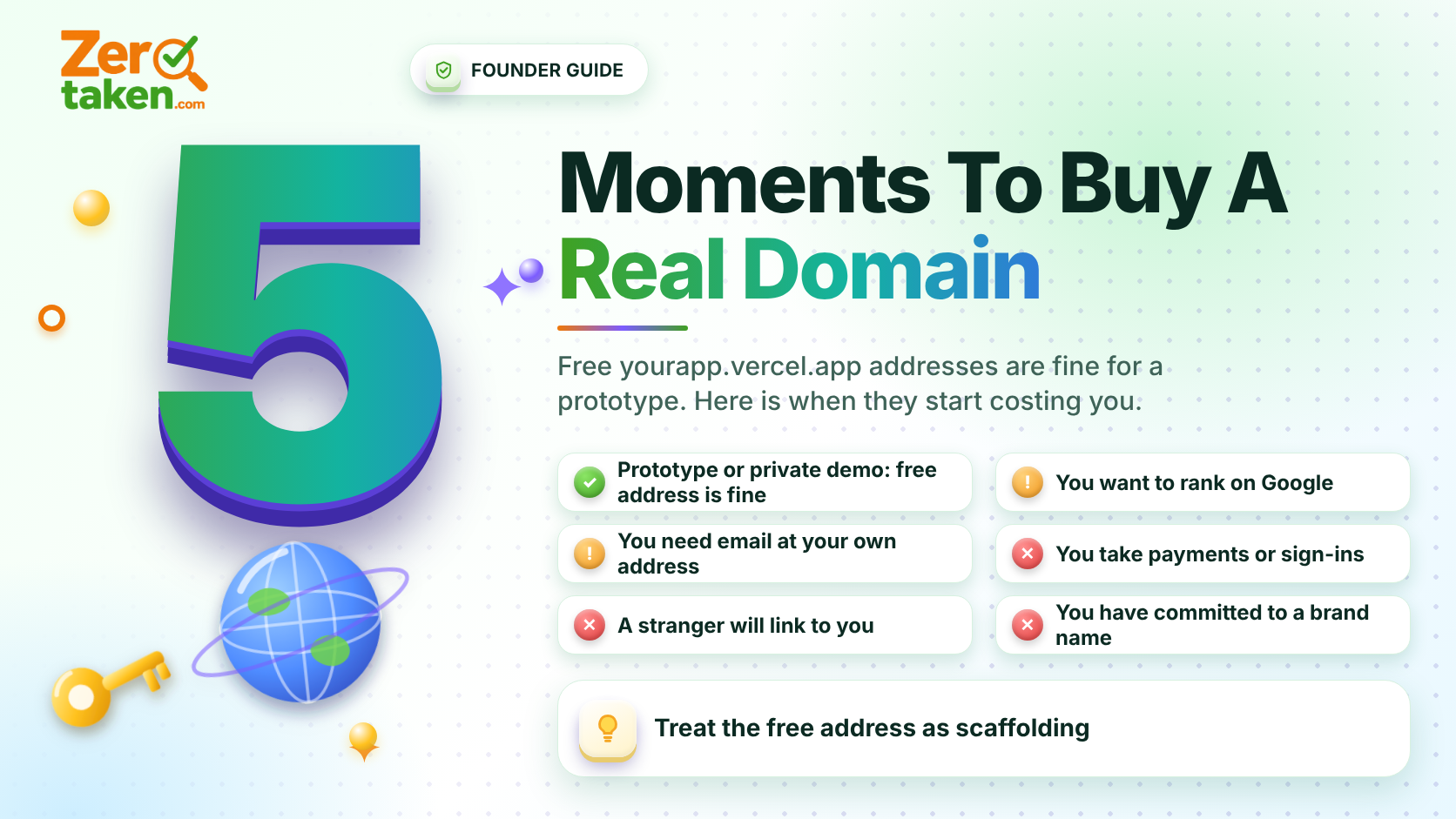
What are you actually getting with a free platform subdomain?
A free address like yourapp.vercel.app is a subdomain of a domain the host owns. You get a name under their roof, not a name of your own. The host controls the DNS for the parent domain, decides which names are allowed, and can rename, suspend or reclaim a project's address under its terms of service. You never hold the registration, so you can never transfer it, sell it or point it somewhere else.
That is not a criticism of these platforms. It is the deal, and for prototypes it is a good one: instant setup, automatic HTTPS, no registrar account, no DNS to configure. The mistake is treating a temporary address as if it were a brand asset.
When is the free address genuinely good enough?
Stay on the platform subdomain while the URL is something only you and a handful of friendly people will ever see. Be strict about that test. If a stranger could type it, search for it, or be sent it by someone who is not on your team, you have already outgrown it.
Free addresses are the right tool for:
- A weekend prototype or hackathon project you may abandon in a month.
- A staging or preview environment (these should stay on platform URLs even after launch).
- A private demo for a design partner, behind a login, that you will replace before any public launch.
- A portfolio piece or learning project where the point is the code, not the brand.
- Validating an idea before you have spent any money or named anything.
What are the five moments you should buy a real domain?
Each of these is a concrete trigger, not a vibe. When you hit the first one, stop deferring.
1. You want to be found on Google. A page that has accumulated links and history on yourapp.vercel.app has built that equity on an address you cannot take with you. If you later change hosts, you are starting the SEO clock over unless you can redirect, and you cannot redirect an address that disappears with your project.
2. You need email at your own address. You cannot publish MX records for a subdomain you do not control, so hello@yourapp.vercel.app is impossible. Anything that requires a sender you own (transactional email, a support inbox, SPF, DKIM and DMARC) needs a domain you control. Sending from a free Gmail address while asking customers to trust you is a credibility tax.
3. You are asking for money or sign-ins. Payment processors and OAuth providers look at your site before approving you. Google's OAuth verification, for example, expects the domains on your consent screen to be ones you own, and shared platform domains do not qualify. A checkout page on someone else's subdomain also reads as a hobby project to a cautious buyer.
4. Someone else is about to link to you. A launch post, a press mention, a newsletter feature, a customer putting you in their docs. Those links are permanent and you cannot update them. Every one that points at a free address is a link you will later have to chase.
5. You have chosen a name. The moment you commit to a brand, the matching domain is part of the commitment. Not owning it only gets more expensive, because someone else can register it while you wait.
Why does it cost more to wait than the domain costs to buy?
A standard .com typically runs somewhere around $10 to $15 a year at most registrars at the time of writing. Compare that with what waiting really costs.
Migration cost grows with every day you are live. Every hard-coded URL in your app, every webhook endpoint registered with a third party, every OAuth redirect URI, every QR code and every link in a signature has to be found and changed. Cookies are scoped to the host, so users on the old address are logged out when you move. Search engines treat a change of address as a fresh start unless you can redirect from the old one.
The domain itself is the part that does not wait for you. Shared platforms hand out the exact same words that founders want as brand names, and the matching registration can be taken any day. If the name you are building on is already gone, you would rather learn that before you have spent a month on branding. [CTA_BANNER]
Does the free subdomain hurt trust or SEO?
On SEO, the honest answer is that a subdomain of a large platform can rank, and plenty of small pages do. The problem is not a penalty, it is portability. Authority you earn there is tied to an address that is not yours, and a shared parent domain is also where a lot of spam and throwaway sites live, which does your reputation no favors when someone is deciding in two seconds whether your site is real.
On trust, the signal is simple. Browsers show the address, and people read it. A custom domain says a business exists and intends to be around next year. A platform address says a project exists today. For anything where the visitor has to enter a card number, an email address or a password, that gap is the difference between a click and a bounce.
How do you move from a platform subdomain to your own domain without breaking things?
The move is easy if you do it deliberately and early, and painful if you let it drift. Follow this order:
- Register the domain first and add it to the host as a custom domain. Every major platform supports this and issues HTTPS automatically.
- Keep the old platform address live and set it to redirect permanently (a 301) to the new domain, using the platform's own redirect setting, so existing links keep working.
- Update everything that stores a URL: OAuth redirect URIs, webhook endpoints, payment dashboard settings, your sitemap, canonical tags and social profile links.
- Tell Google Search Console about the new property and submit the new sitemap.
- Set up email DNS (MX, SPF, DKIM, DMARC) before you send the first message from the new domain.
- Do a final sweep of old links in your README, docs, launch posts and email signatures.
What is the simple rule for deciding?
Use the free address until the first of these happens: you commit to a name, a stranger will see the link, or you need email, payments or sign-in. The earliest of those is almost always before launch. If you want to avoid a rename later, check the name you are about to build around first. A quick search on ZeroTaken shows whether the .com and the other extensions you would accept are taken, before you spend a week designing a logo for a name you cannot own.
Treat the platform address as scaffolding. It is there to hold the building up while you build, and it comes down before anyone moves in.