
B2B or B2C? Why Your Customer Should Decide Your Domain Name
Most domain advice is written as if every startup sells to the same person. It doesn't. A teenager downloading a habit-tracker and a procurement manager approving a $40k security tool judge a domain in completely different ways: one wants it fast, short and fun to say; the other wants proof you will still exist next year. If you pick your name using generic rules, you will optimise for the wrong buyer. This guide breaks down what actually changes between B2B and B2C, so you can decide with your customer in mind instead of your own taste.
ZeroTaken'ı Google'da tercih edilen kaynak olarak ekle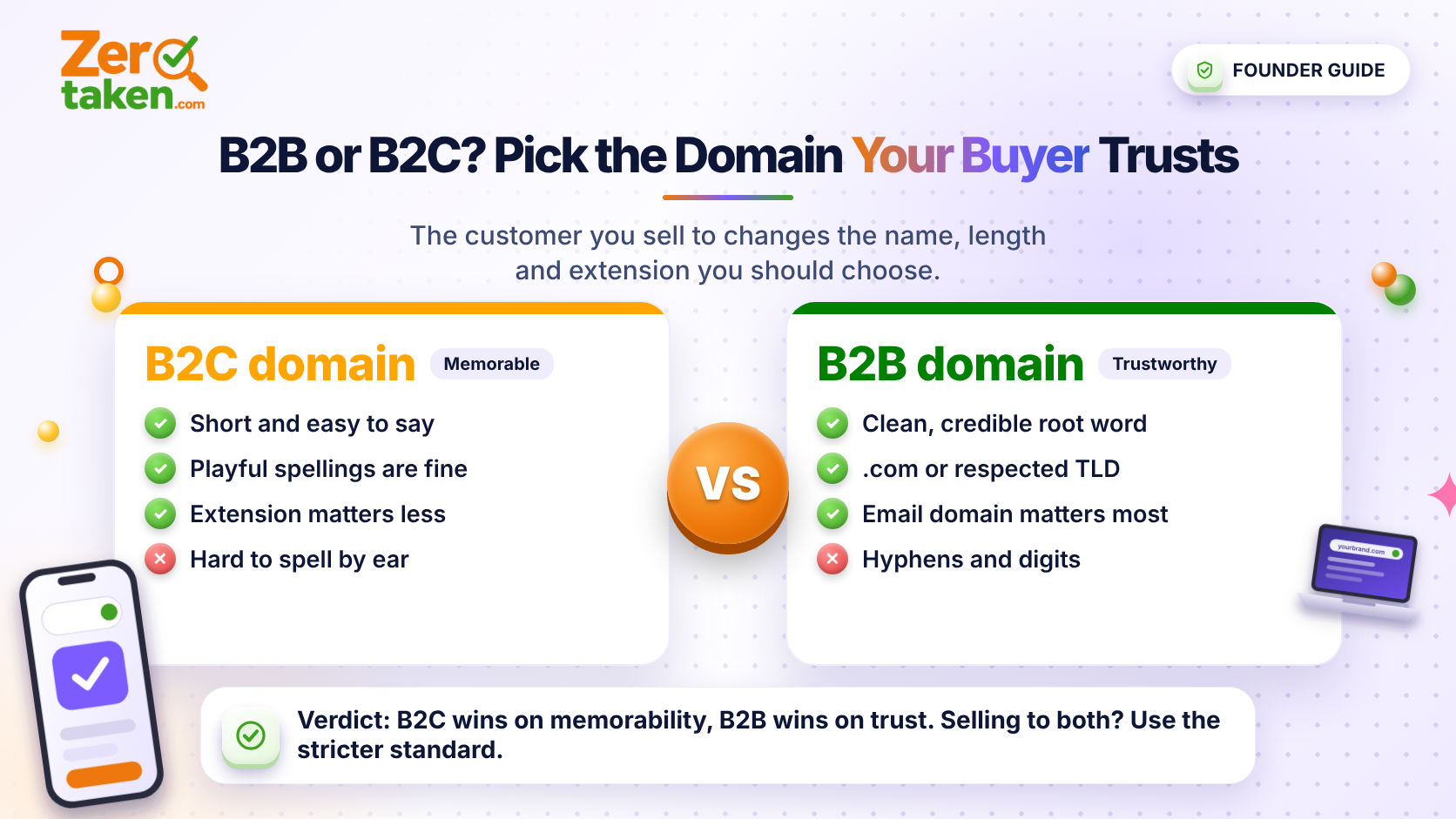
Why does the type of customer change the right domain?
A domain does three jobs: it is typed or tapped, it is read in an email or search result, and it is judged for trust. Consumers lean on the first job. Business buyers lean on the third.
A consumer usually finds you through an app store, a social post or a friend, then types or taps once. Speed and memorability win. A business buyer finds you through a colleague, a search result or a sales email, then checks you out: they read the domain in the address bar, look at the email addresses that contact them, and sometimes forward the link to a finance or security team. Every one of those steps is a small credibility test.
So the rule is simple: B2C domains are built to be remembered, B2B domains are built to be believed. Most of the decisions below follow from that.
How short and playful can a B2C domain be?
Very. Consumers forgive invented words, quirky spellings and a name that means nothing until the product explains it. What they do not forgive is friction: a name they cannot spell after hearing it once, or one they mistype into a competitor's page.
That means the strongest B2C names are short, phonetic and easy to say out loud. Run the radio test: say it to someone and see if they type it correctly. If you rely on word of mouth, TikTok or podcasts, this matters more than any extension choice.
Playful also means you can take more risk with the extension, because buyers rarely examine the part after the dot. A consumer who already loves the app will find it however it is spelled.
- Aim for one to two syllables, or a compound that reads as one word
- Prefer spellings people guess correctly over clever spellings
- Check the name is available as an app-store and social handle, not just a domain
- Make sure the name survives being heard, not only read
What does a B2B buyer actually look for in a domain?
Stability and seriousness. A business buyer is taking a risk on your company, and the domain is the cheapest signal available to them. They are not asking whether it is clever; they are asking whether it looks like a company that will answer a support ticket in three years.
That doesn't mean boring. It means legible: a clear root word or invented name, no hyphens, no digits, no stacked extra words like get, try or app unless they are part of the brand. Any of those can make a vendor look like a landing page rather than a company.
It also means your email domain matters more than your website. B2B deals live in the inbox. A sales email from a weird or unfamiliar domain is more likely to be treated as phishing, and enterprise filters are harsh on new, unusual domains.
- Pick a name you can put on a contract and a conference badge without cringing
- Avoid hyphens, numbers and look-alike spellings; they read as risk
- Treat the email domain as the real product surface for sales
- Plan for the .com, or have a clear reason (and a redirect plan) if you don't
Does the extension matter more for B2B than B2C?
Usually yes, but not as much as people claim. In B2B, a .com still signals established, and a buyer who guesses your address will type .com first. A non-.com name isn't disqualifying, particularly in tech where .io and .ai are common, but you are accepting a small amount of lost traffic from people who guess wrong.
In B2C, the extension matters mostly when people type the name by hand. If your growth comes from links, app stores and social, the extension is nearly invisible. If it comes from word of mouth, a non-.com name leaks visitors to whoever owns the .com.
The practical rule: if you sell to businesses and have a choice, take the .com even if it means a slightly longer or more distinctive name. If you sell to consumers through links and apps, a good name on a respected alternative extension beats a mediocre .com every time.
Should the domain describe what you sell?
Descriptive names help when the buyer is searching for a category, which is more common in B2B. A name that hints at the job, like a root word tied to invoicing, scheduling or security, helps a stranger understand the pitch from a search result.
Consumer products run the other way. People rarely search the category and then pick the first brand they see; they follow a recommendation. So the name should be distinctive first, descriptive second, and the product should do the explaining.
A good middle path for both: choose a distinctive brand name and let the tagline, page title and category words in the content carry the description. You get memorability and relevance without locking the name to a feature you may drop in a year.
- B2B: a hint at the category is a bonus, an exact-match phrase is a trap
- B2C: distinctiveness beats description almost every time
- Either way, avoid names that describe a feature you may pivot away from
What if you sell to both businesses and consumers?
Pick the stricter standard. If any real revenue comes from business buyers, the domain has to survive their scrutiny, because a consumer-friendly name that passes the B2B test is easy, while a B2B-friendly name stretched to feel fun is much harder.
In practice that means a clean, pronounceable brand on a .com or a respected alternative, with no hyphens or digits. Then use subdomains or paths for audience-specific pages rather than buying a separate brand domain for each side.
Before you commit, search a handful of candidates in ZeroTaken and compare them against the checklist above. If a name fails the buyer test you care about, move on early; renaming after you have customers is far more expensive than choosing again today.
How do you run a quick buyer test before you register?
Write down your single most important buyer, then test the name against them in five minutes, not five days. The point is to catch the obvious mismatch before money and brand equity are tied to it.
Show the domain to three people who match that buyer, without context. Ask what the company does, whether they would trust an invoice from it, and how they would spell it after hearing it once. If two of three stumble, change the name.
- Read it aloud: can a stranger spell it?
- Imagine it in a sales email signature: does it look credible?
- Imagine it in a TikTok caption: is it short enough to remember?
- Check the .com, the main alternative extension and the social handles
- Confirm there is no obvious trademark conflict in your category