
Single-Word vs Compound Domain Names: Which Wins in 2026?
Every founder hits this fork. You want a name like Stripe or Notion — one clean word that sounds like a brand and nothing else — but the good single words are gone or priced like a house deposit. So you start bolting words together: your niche plus a verb, an adjective plus a noun, and suddenly you are staring at Mailchimp, DoorDash, and Squarespace, wondering if a compound name reads as 'couldn't afford the real thing.' It doesn't have to. This guide cuts through the aesthetics with specifics: whether single-word .coms are even gettable anymore, where compound names quietly win, the one place they lose customers, and a rule for picking the right shape for your brand.
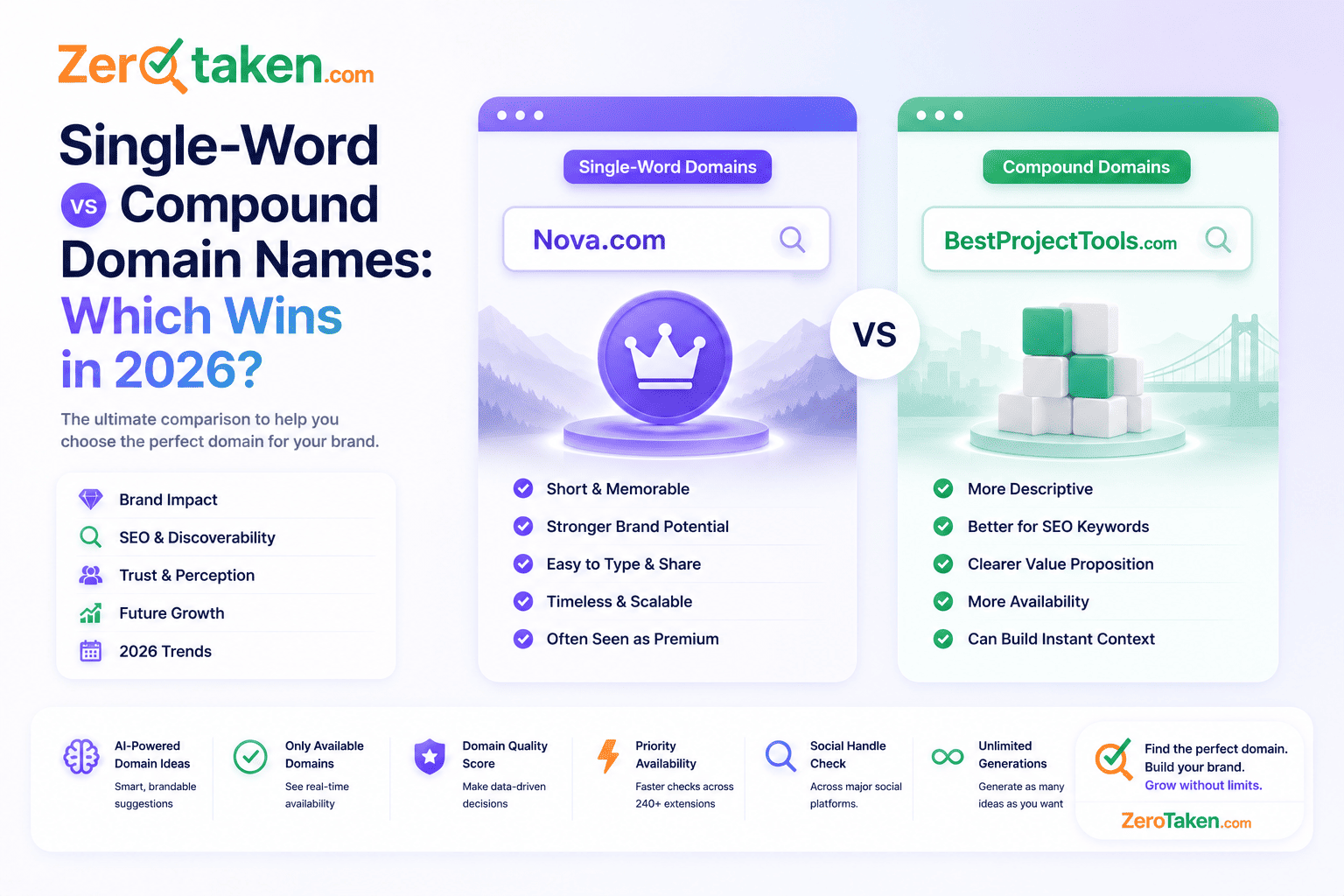
What actually counts as a single-word vs a compound domain?
A single-word domain is exactly one lexical unit — a real dictionary word (apple.com, stripe.com), a coined or invented word (vercel.com, twilio.com, kajabi.com), or a deliberate misspelling that still reads as one word (lyft.com, fiverr.com). Your eye and ear process it as a single token, which is the whole point: nothing to parse, nothing to break apart.
A compound domain is two or more words fused into one string — usually a modifier plus a noun (mailchimp.com, doordash.com) or a portmanteau that stitches two words into a new one (calendly.com, pinterest.com). The distinction that matters isn't the word count on a whiteboard; it's how many pieces a stranger's brain has to assemble when they hear the name once and try to type it later. That parsing cost, not elegance, is what this whole decision turns on.
Can you even still get a single-word .com in 2026?
Not the way you're imagining it. Every common English dictionary word was registered years ago, and the desirable ones — short, positive, pronounceable — now trade on the aftermarket from five figures into the millions. If your plan is to hand-pick a real word like 'orbit' or 'summit' and grab the matching .com at standard registration price, that plan is already dead. Somebody owns it, and they know what it's worth to you.
The single-word names founders actually land in 2026 are almost never dictionary words — they're coined ones. Stripe is a real word, but Twilio, Vercel, Kajabi, and Brex are invented, and that's precisely why their .coms were available at normal prices. The realistic path to a single-word domain isn't shopping the dictionary; it's manufacturing a short, brandable word that doesn't exist yet. That's a creative constraint, not a dead end — and it's the reason so many modern startups sound like they do.
So the honest framing is this: 'single-word' in 2026 almost always means 'coined single word.' If you're unwilling to invent one, you are effectively choosing between an expensive aftermarket dictionary word and a compound name — and for most bootstrapped or early-stage teams, that means the compound name.
Are compound domain names a compromise or a genuine strength?
Compound names carry a stigma they mostly don't deserve. Some of the most valuable software companies in the world run on two words welded together — Salesforce, HubSpot, Squarespace, DoorDash, Substack, Firebase — and none of them read as second-rate. The stigma comes from lazy compounds (get-, -ify, -hub, -ly stapled onto a keyword with no thought), not from the format itself. A well-built compound is a real brand asset.
The strength is threefold. First, availability: the exact .com you want is far more likely to be free when you combine two words than when you chase one. Second, meaning — a compound can telegraph what you do (a customer half-guesses the product from the name), which shortens the explaining you'd otherwise pay for in ads. Third, defensibility: two distinctive words joined together are easier to trademark and harder for a competitor to accidentally collide with than a generic single word.
The catch is that a compound only works if both halves are common, unambiguous words that a person can spell without seeing them. 'Doordash' passes — everyone can spell 'door' and 'dash.' A compound built from a word people can't spell, or that could split two ways, inherits every problem a single hard-to-spell word has, and then doubles it.
Which is easier to remember and spell out loud?
Run every candidate through the radio test: say the name once, out loud, and ask whether a stranger could type it correctly with no screen in front of them. This is where single words have a structural edge — there's simply less to get wrong. One token, one guess. A great single word like 'Loom' or 'Miro' survives being heard at a noisy conference and typed from memory in a cab afterward.
But single-word memorability is conditional, not automatic. A coined word that isn't obviously pronounceable — where a listener can't tell if it's spelled with an 'i' or a 'y,' one 'l' or two — is worse than a clean compound, because the person has no second word to anchor the guess. Compounds actually cheat the memory problem: if you forget the exact name, 'that mail thing... mailchimp?' is a recoverable guess in a way that a half-remembered invented word never is.
The real enemy of both formats is the same: ambiguous spelling. Deliberate misspellings (Lyft, Fiverr, Digg) buy you availability at the cost of a permanent 'that's L-Y-F-T' tax every time someone says the name aloud. Sometimes that trade is worth it. Just know you're paying it forever, on every podcast ad and every word-of-mouth referral.
Does single-word or compound help SEO and voice search more?
Neither format is a ranking factor, so don't pick a name to please Google — that ship sailed a decade ago when exact-match keyword domains stopped carrying any real SEO weight. A single coined word and a two-word compound compete on the same footing: content, links, and brand authority decide rankings, not the shape of the string before the dot.
There is one narrow, honest edge for compounds. A compound that contains a genuine category word ('...pay,' '...desk,' '...flow') gives a first-time searcher a faint semantic hint about what you do, which can nudge click-through on a results page and help a voice assistant disambiguate your name. That's a marketing micro-advantage, not an algorithm bonus — and it's easily outweighed by a single word strong enough that people search for it by name. The moment your brand becomes the query, extension shape and keyword content stop mattering entirely.
Voice adds one more wrinkle: assistants have to transcribe your name from speech, and both formats fail the same way when they're built from ambiguous sounds. 'Made of common words, unambiguously spelled' beats 'single vs compound' every time a smart speaker is involved.
How do you pressure-test a name before you commit?
Whichever shape you lean toward, resolve availability before you fall in love, not after. Shortlist five to ten candidates in both formats — a couple of coined single words, a few clean compounds — and check the exact .com (and your backup extension) for every one in a single sitting. The name you can actually own beats the prettier name you can't, and finding that out early saves you from designing a logo around a domain that's parked or five figures on the aftermarket.
ZeroTaken is built for exactly this sweep: describe the idea, get brandable single-word and compound candidates, and see real-time .com/.io/.co availability side by side without your best names being logged and resold to a broker. Test twenty ideas in the time it'd take to manually check three.
Brainstorm Your Domain Name with ZeroTaken
Describe your startup, SaaS, web app, or business idea, and let our AI brainstorm memorable, brandable name ideas and instantly check live availability.
Try AI Domain GeneratorSo which should your startup actually pick?
Default to a coined single word if you can invent one that passes the radio test — it's the cleaner brand asset and it scales best once people search for you by name. Fall back to a strong compound of two common, unmistakably-spelled words when you can't coin something clean, or when a hint of meaning in the name is worth more to you than pure abstraction. Both are legitimate; neither is a consolation prize.
The wrong move isn't choosing compound — it's choosing anything that fails the spell-it-from-hearing-it test, in either format. A confusing coined word and a clumsy three-word compound lose customers the same way: to typos, to the wrong site, to a competitor who owns the version people actually type.
- Pick a coined single word when: you can invent something short and pronounceable, and you're building a brand people will eventually search by name
- Pick a compound when: you can't coin cleanly, availability is tight, or a whisper of meaning in the name shortens your explaining
- Avoid either when: it fails the radio test, needs constant spelling-out, or could be typed two different ways
- Always: verify the exact .com before committing, and secure a matching backup extension if the .com is gone
One word or two — what's the final call?
If you can genuinely coin a short, pronounceable single word, do it — that's the format behind most of the brands you're trying to emulate, and it earns its keep once you're big enough that your name becomes the search query. But don't torture yourself chasing single-word purity when the achievable, ownable option is a clean two-word compound. Salesforce and Squarespace didn't lose for having two words in them.
Stop optimizing for how the name looks on a slide and start optimizing for what happens when a stranger hears it once and reaches for a keyboard. Whichever format survives that test — and is actually available on the .com — is the right answer for your startup. Pick it, register it today, and get back to building the thing the name is for.