
Plural or Singular? The Domain Name Decision Founders Get Wrong
You found the name. Then you hit the smallest, most annoying fork in domain naming: does an 's' go on the end? Bloom or Blooms. Card or Cards. Room or Rooms. It feels like a triviality — one letter — so most founders decide it by gut in ten seconds and move on. That ten-second decision is exactly the one that quietly leaks traffic to a competitor for the next five years, because the version you didn't buy almost never sits empty. Someone owns your name's twin, and every customer who misremembers the 's' lands on them instead of you. This guide treats the plural-vs-singular choice like the real branding decision it is: what's actually at stake, when the plural genuinely wins, why the SEO angle is a trap, and a rule for deciding it on purpose instead of by reflex.
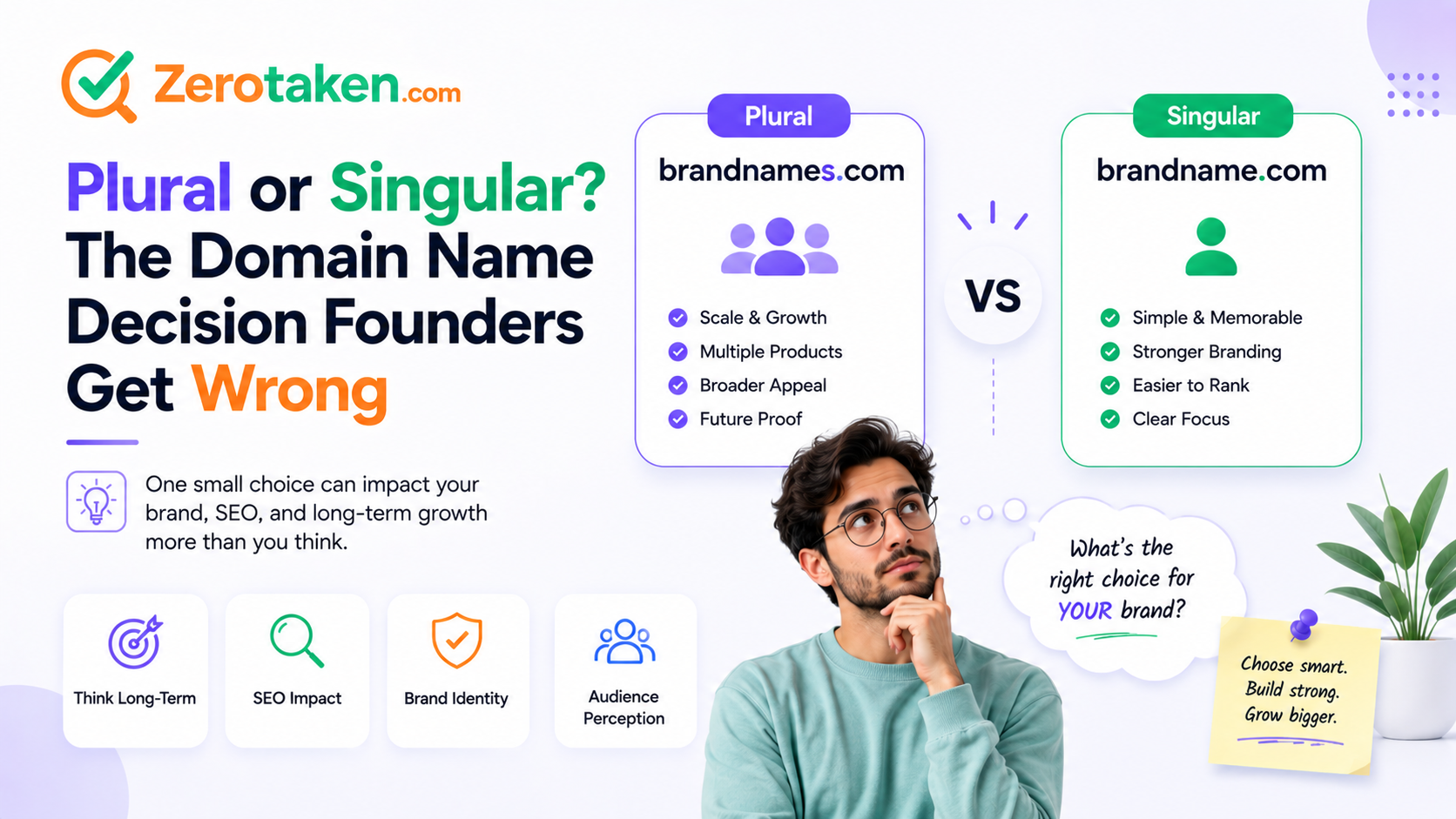
What's really at stake when you add an 's'?
The plural-vs-singular decision is not about grammar and it is barely about aesthetics. It is about who owns the version of your name that you don't. Every brand that lives at bloom.com has a shadow twin at blooms.com, and that twin is almost never unregistered — it's a florist, a competitor, a parked page, or a broker waiting for you to get big enough to overpay. The moment you pick one form, you are implicitly choosing to let someone else keep the other.
That matters because human memory does not store the 's'. People remember the word, the vibe, and roughly what you do — not whether the brand they heard about at dinner last week was singular or plural. So a meaningful slice of your own audience will reach for the wrong form on instinct, type it, and land on whoever owns your twin. The core question isn't 'which reads better on a slide.' It's 'which form can I own, and how much traffic do I bleed to the other one.'
Why does the plural/singular twin cost real traffic?
Because it multiplies the two ways people already reach you by mistake: word of mouth and muscle memory. Someone hears 'check out Card, the budgeting app,' half-remembers it, and types cards.com — the plural feels more natural to the mouth, so the brain adds the 's' automatically. If a competitor owns cards.com, you just paid to acquire a customer and handed them to a rival at the last step. This is the same type-in leak that makes .co risky next to .com, except the leak is baked into the word itself, not the extension.
The plural is a specifically greedy twin because English defaults to it. Ask ten people to say 'the app where you save recipes' and most will reach for 'Recipes' before 'Recipe.' Collections, marketplaces, and anything that holds more than one of a thing pull the tongue toward the plural — which means a singular brand in a plural-shaped category leaks harder than the reverse. If your product is inherently many-of-something and you own only the singular, you are fighting your customers' own grammar every time they type your name.
None of this shows up in your analytics, which is what makes it dangerous. You never see the visitor who typed the twin and bounced; there's no line item for 'traffic that went to the domain we didn't buy.' The cost is invisible, continuous, and compounds with every ad you run and every word-of-mouth mention you earn — you're paying to send a fraction of your own demand to someone else.
Singular or plural — which one reads as more brandable?
Default to singular for a pure brand. The strongest software names in the world are overwhelmingly singular — Stripe, Notion, Figma, Loom, Vercel, Linear. A singular word reads as a single, ownable identity: it points at your thing and nothing else. The plural quietly reframes the same word as a category or a container ('Rooms,' 'Cards,' 'Tools'), which makes you sound like a directory of the thing rather than the thing itself. For a company that wants its name to become a verb or a proper noun, singular is the cleaner asset.
The plural earns its keep when your product genuinely is a collection. Hotels.com, Cars.com, and Meta's Threads and Reels all wear the plural correctly because the product is, definitionally, many of something — many hotels, many cars, many posts. In those cases the singular would actually read as wrong, like a store called 'Shoe.' The plural signals inventory, breadth, community. That's a feature when you're a marketplace and a bug when you're a single sharp tool.
So the brandability test is really a positioning test: is your name a proper noun (one identity, one product) or a category label (a place that holds many things)? Proper nouns want singular. Category labels tolerate — sometimes require — the plural. The mistake is picking the plural because the singular was taken and then pretending it doesn't change what your name says about you.
When does the plural actually win?
The plural wins in three honest situations, and it's worth knowing them so you don't reject it out of reflex. First, when your product is a genuine collection or marketplace: 'Docs,' 'Threads,' 'Boards,' 'Rooms,' 'Trips' all read as native plurals because breadth is the whole pitch. Second, when the plural is simply the far cleaner available name — if the singular .com is gone or five figures on the aftermarket and the plural is sitting there at registration price, the ownable plural beats an unownable singular every time.
Third, and most overlooked: when the plural form is the phrase people actually search and say. Nobody googles 'best running shoe' — they search 'running shoes.' If your category lives in the plural in real speech, a plural domain matches the words already in your customers' mouths, and the singular is the one that will feel subtly off. Match the form to how humans talk about the thing, not to which looks tidier on a business card.
- Choose plural when: your product is a collection, marketplace, or community of many items (Rooms, Cars, Threads)
- Choose plural when: the singular .com is gone or overpriced and a clean plural is actually ownable
- Choose plural when: your category is spoken and searched in the plural ('running shoes', not 'running shoe')
- Lean singular when: you're building one sharp product or brand meant to become a proper noun (Stripe, Notion, Loom)
- Either way: assume the twin is owned by someone, and find out who before you commit
Does plural vs singular change your SEO?
Not through the domain, no. The presence or absence of an 's' in your domain string is not a ranking factor — exact-match keyword domains stopped carrying SEO weight over a decade ago, and Google ranks you on content, links, and brand authority regardless of whether you're recipe.com or recipes.com. Anyone telling you the plural 'ranks better because it matches the keyword' is selling a myth from 2011. Don't pick a form to please the algorithm.
There is one real, non-domain wrinkle, and it's about queries, not rankings. Search volume for the singular and plural of a term is often wildly different — 'running shoes' dwarfs 'running shoe,' while 'crm' has no plural at all. That difference matters for the keywords you target in your content and ads, not for the letters in your domain. Optimize your page titles and campaigns around the form people actually search; let your domain be chosen on brand and ownability instead.
The genuine risk near SEO isn't ranking — it's brand dilution. If your twin is owned by an active competitor who also ranks for your name, you'll spend authority teaching Google and customers which one is really you. That's a brand-confusion cost, not an algorithm penalty, and you neutralize it the same way every time: by controlling both forms so there's no rival version to be confused with.
How do you pressure-test plural vs singular before you commit?
Check both forms on the same day, before you fall in love with either. For every finalist, look up the singular and the plural on your primary extension and your backup — in one sitting — so you can see the whole board: which form is free, which is parked, and which is already a live business you'd be colliding with. The name you can actually own, twin included, beats the prettier name whose plural is somebody's storefront.
Then run the spoken test. Say the name out loud in a sentence a customer would use — 'I found it on ___' — and notice which form your own mouth reaches for. If you keep adding an 's' to your own singular brand, your customers will too, and you've just learned which twin you can't afford to leave unowned. This is the plural-vs-singular version of the radio test, and it's the cheapest research you'll ever do.
ZeroTaken is built for exactly this sweep: describe the idea, get brandable candidates, and check the real-time .com/.io/.co availability of every form side by side — without your best names being logged and resold to a broker. You can see the singular and the plural of a dozen ideas in the time it'd take to manually check three, and stop guessing which fork you're standing at.
Should you just buy both the singular and the plural?
If both are ownable, yes — and it's cheaper than the traffic you'd otherwise leak. Owning car.com and cars.com (or your real equivalents) runs well under a rounding error on your budget, and it erases the single biggest weakness of this whole decision in one move. You launch and market on the form that fits your positioning, point the twin at it with a redirect, and capture every customer who reaches for the wrong 's' instead of donating them to a competitor.
This isn't a call to hoard extensions. You don't need the .net, the .org, and eight country codes — that's wasted money for an early company. The disciplined version is narrow: your chosen form plus its singular/plural twin on the same extension, one redirected to the other. Buy the matched pair, redirect one, and you never have to think about the twin problem again. When you can only afford one, buy the form your customers say out loud — and know exactly who owns the other one.
So plural or singular — what's the final call?
Default to singular when you're building one sharp product meant to become a proper noun, and reach for the plural when your product is honestly a collection or when the plural is the word people actually search and say. Neither is a downgrade; they say different things about what you are, and the mistake is choosing by reflex instead of matching the form to your positioning. Pick on purpose.
But whichever form you choose, the decision underneath it is the same: the twin is almost never empty, and human memory won't reliably hold the 's.' Find out who owns the other version before you commit, own both if you can, and if you can only own one, own the one your customers' mouths reach for first. Decide the 's' deliberately, secure the pair, and get back to building the thing the name is for.