ZeroTaken
← All posts
Domains6 min readBy ZeroTaken Team

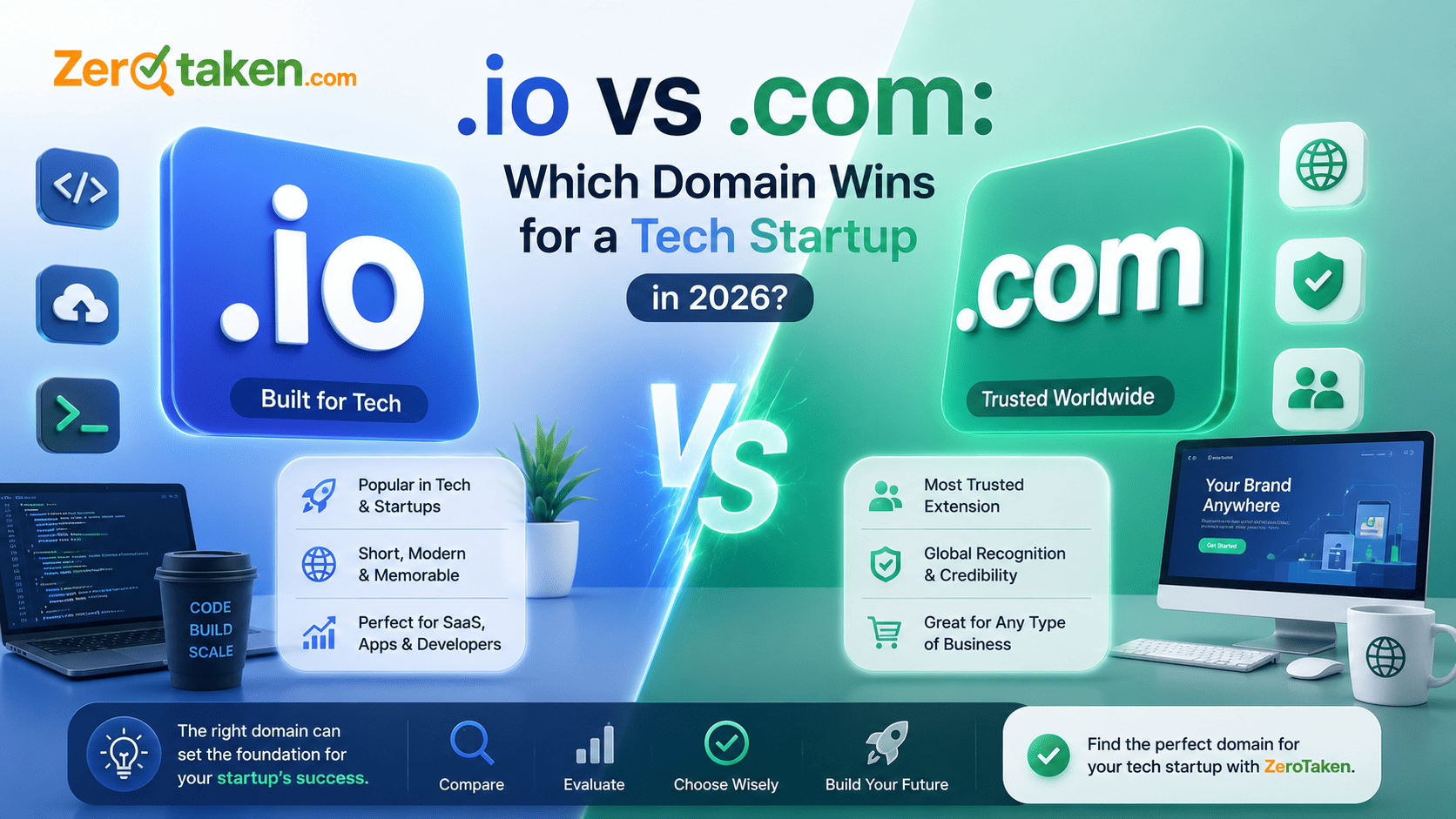
.io vs .com: Which Domain Wins for a Tech Startup in 2026?

If you are naming a developer tool, an API company, or a B2B software startup, you have almost certainly typed a name into a search box, watched the .com come back as taken, and stared at the available .io wondering if it is a smart signal or a rookie mistake. This is one of the most common naming forks tech founders hit, and the internet is full of lazy "it depends" answers. This guide gives you a real one: what actually separates .io from .com, what each costs, whether Google cares, the one geopolitical risk most .io advocates ignore, and a clear rule for which extension to pick.

.io vs .com: Which Domain Wins for a Tech Startup in 2026?

What actually separates .io from .com?

.com is a generic top-level domain (gTLD) with no country attached to it — it is the default namespace of the commercial web, with more than 160 million registrations. .io is technically a country-code top-level domain (ccTLD) assigned to the British Indian Ocean Territory, but almost nobody uses it that way. In tech circles, "io" reads as input/output — the two letters stamped on developer tools, APIs, and infrastructure products for a decade.

That is the real split. .com signals "we are a normal business the general public should trust." .io signals "we are built by engineers, for people who ship software." Neither is objectively better; they are aimed at different audiences. A payroll app for restaurant owners and a container-orchestration CLI should not make the same choice, and most of the bad domain decisions I see come from founders ignoring who is actually going to type their name.

Is .io worse for SEO than .com?

No. This is the fear that keeps founders up at night, and it is mostly unfounded. Google treats .io as a generic gTLD for ranking purposes, not as a geo-targeted country domain, so an .io site can rank globally on exactly the same footing as a .com. The extension to the right of the dot is not a ranking factor for generic queries — relevance, backlinks, page speed, and content depth are what move you up the results.

There is one honest caveat, and it is about humans, not algorithms. In a search results page or a shared link, a .com still reads as slightly more "official" to a mainstream audience, which can nudge click-through rates on consumer queries. For a developer-facing product, the opposite is often true — an .io can read as more credible to the exact people you want clicking. Optimize for your audience's instinct, not for a mythical Google penalty that does not exist.

How much more does .io cost than .com?

Budget for roughly 3x. A standard .com runs about $10–15 per year at registration and renewal. An .io typically lands between $35 and $60 per year depending on the registrar, and unlike some premium extensions it usually renews at that same rate rather than spiking. Over a five-year runway that is a difference of maybe $200 — a rounding error next to what you would pay a broker for a premium aftermarket .com.

So price should almost never be the deciding factor. The real cost comparison is availability: the short, brandable, one-word name you actually want is very likely gone on .com and demanding four or five figures on the aftermarket, while the same name may still be sitting there at standard price on .io. Paying $50 a year to own your exact brand beats paying $10 a year to own a compromised, hyphenated, or misspelled version of it.

Will the Chagos Islands deal kill the .io domain?

This is the risk most .io cheerleaders skip, so let's be straight about it. .io belongs to the British Indian Ocean Territory. In 2024 the UK agreed to transfer sovereignty of the Chagos Islands to Mauritius, which raised a real question: if the territory's ISO country code is eventually retired, the ccTLD tied to it could be scheduled for retirement too. There is precedent — codes like the Soviet Union's and the Netherlands Antilles' .an were wound down after the countries behind them dissolved.

Now the calibration, because panic is not warranted. IANA retirements historically run on multi-year transition timelines, not overnight switch-offs, and .io has enormous commercial entrenchment — retiring it cleanly would break a huge slice of the software industry, which creates heavy pressure to grandfather or reassign it rather than delete it. Nobody credible is saying .io disappears in 2026. But "probably fine for years" is not the same as "zero risk," and a serious founder prices that in.

The practical takeaway is not "avoid .io." It is: if you build your brand on .io, treat owning a fallback — ideally the matching .com — as insurance, not a nice-to-have. That single move neutralizes almost all of the downside.

When should a startup actually pick .io over .com?

Pick .io when your users live in a terminal and your product is infrastructure. Developer tools, APIs, CLIs, open-source projects, data platforms, and B2B software sold to engineers all wear .io naturally — the extension is a credibility cue to that crowd, and the availability of short, clean names there is dramatically better than on .com.

Lean .com when your audience is mainstream, when word-of-mouth and voice matter, or when trust and permanence are part of the sale. If a non-technical person will hear your name at a dinner table and try to type it later, they will type .com by reflex, and every detour costs you traffic. Fintech, consumer apps, marketplaces, and anything a grandparent might use should fight hard for the .com.

  • Choose .io: dev tools, APIs, CLIs, infra, open source, engineer-facing B2B
  • Choose .com: consumer apps, fintech, marketplaces, voice-driven or mass-market brands
  • Either way, verify the exact name across both extensions before you commit

Ready to check your name across both extensions?

The worst outcome is falling in love with a name, building a deck around it, and discovering later that the defensive extension you needed is gone. ZeroTaken checks .io and .com side by side in one search and never logs your queries, so you can test dozens of ideas without handing your best one to an aftermarket bot.

Brainstorm Your Domain Name with ZeroTaken

Describe your startup, SaaS, web app, or business idea, and let our AI brainstorm memorable, brandable name ideas and instantly check live availability.

Try AI Domain Generator

Should you just buy both .io and .com?

For most funded or fast-moving startups, yes — and it is cheaper than founders assume. Owning both your .io and its matching .com runs well under $80 a year combined. You launch and market on whichever fits your audience, redirect the other to it, and in one move you capture type-in traffic, block a competitor or squatter from planting a flag next to you, and hedge the ccTLD risk described above.

You do not need a defensive land-grab across a dozen extensions — that is wasted money for an early-stage company. The disciplined version is a matched pair: your primary extension for positioning, plus the .com as the trust-and-insurance layer. Buy the pair, redirect one, and stop thinking about it.

Brainstorm Your Domain Name with ZeroTaken

Describe your startup, SaaS, web app, or business idea, and let our AI brainstorm memorable, brandable name ideas and instantly check live availability.

Try AI Domain Generator

So what's the verdict?

If you are building for engineers, .io is a legitimate first-class choice, not a consolation prize — it signals exactly what you are, and the good names are still available at fair prices. If you are building for everyone else, the .com is worth fighting for because human reflex still routes to it. The SEO worry is a non-issue either way; the pricing gap is trivial; and the one genuine long-tail risk on .io is fully neutralized by owning the matching .com.

The mistake is not picking .io. The mistake is picking either one without checking whether you can quietly own both. Decide who your name is for, secure the pair, and get back to building the product.