
Should You Buy an Expired Domain? What to Check Before You Do
You found the perfect name, the .com is taken — but it's expiring next month, or already sitting on a drop-catch auction for $12. It feels like a loophole: skip the years someone else spent building the name and just inherit it. Sometimes that's exactly right. Other times you're buying a domain that Google has quietly blacklisted, that spam filters already distrust, or that still belongs to a company with a live trademark. The difference between a steal and a trap is almost never the price — it's the history, and history is the one thing the auction listing never shows you. This guide walks the actual expiration lifecycle, the risks that matter, and the exact checks that tell you which one you're looking at.
What actually happens when a domain 'expires'?
A domain doesn't blink from 'owned' to 'anyone can buy it' overnight — it moves through a fixed sequence, and where a name sits in that sequence changes both your odds and your price. When the registration lapses, it enters a grace period of roughly 30 to 45 days where the original owner can still renew at the normal price. Miss that, and it drops into redemption (about 30 more days) where recovery is still possible but costs the owner a punitive fee, usually $80 to $200. Only after that comes 'pending delete,' a final five-day window, at the end of which the name is purged from the registry and becomes freely registrable again.
This is why 'expired' rarely means 'available at $10.' Long before a name actually drops, backorder and auction services — GoDaddy Auctions, DropCatch, SnapNames — list soon-to-expire names and let people bid, then race to register the good ones the instant they release. So the practical choice is usually 'win it at auction now' versus 'wait for the drop and hope you catch it before a pro does.' Knowing which stage a name is in tells you which of those games you're actually playing.
Why would you want an expired domain instead of a fresh one?
The honest headline reason is inventory. Every clean, short, brandable .com was registered years ago, and a huge share of them are now abandoned side projects, dead startups, and lapsed vanity names. The expired market is where those names re-enter circulation — so if you want a real word or a tight two-syllable brand on .com, a dropped name is often the only place it exists at a sane price.
The second reason is inherited equity, and this is where people overpromise. A domain that ran a real business can carry existing backlinks, existing search indexing, even residual type-in traffic — genuine assets if the previous site was legitimate and topically close to yours. But be clear-eyed: 'domain age' by itself is not a Google ranking factor and never has been. What has value is a clean, relevant backlink profile, not the birthday on the WHOIS record. Buy the link equity if it checks out; don't pay a premium for age alone.
What's the catch — what can actually go wrong?
Everything good about an expired domain — its history — is also everything that can hurt you, because you inherit that history whether you wanted it or not. A name is dropping for a reason, and 'the founder moved on' is only one of them. The others range from annoying to fatal, and none of them show up on the auction page.
The failure modes worth fearing:
- Toxic backlinks: the domain was a spam site, a PBN, or a hacked link farm, and now points thousands of junk links at you — baggage that can trigger an algorithmic suppression from day one.
- A carried-over penalty: a manual action for spam or thin content can follow the domain across ownership changes; you don't automatically get a clean slate.
- Blacklist and reputation damage: if it hosted malware, phishing, gambling, or adult content, it may sit on spam blacklists, and your emails will land in junk and browsers may flag it before you've written a single line.
- A live trademark: an 'abandoned' brand name can still have an active trademark behind it, exposing you to a UDRP dispute or a takedown the moment you build on it.
- Auction fever: bidding wars routinely push a mediocre name past what a fresh, risk-free alternative would cost — you overpay for the privilege of inheriting someone else's problems.
How do you check a domain's history before you buy it?
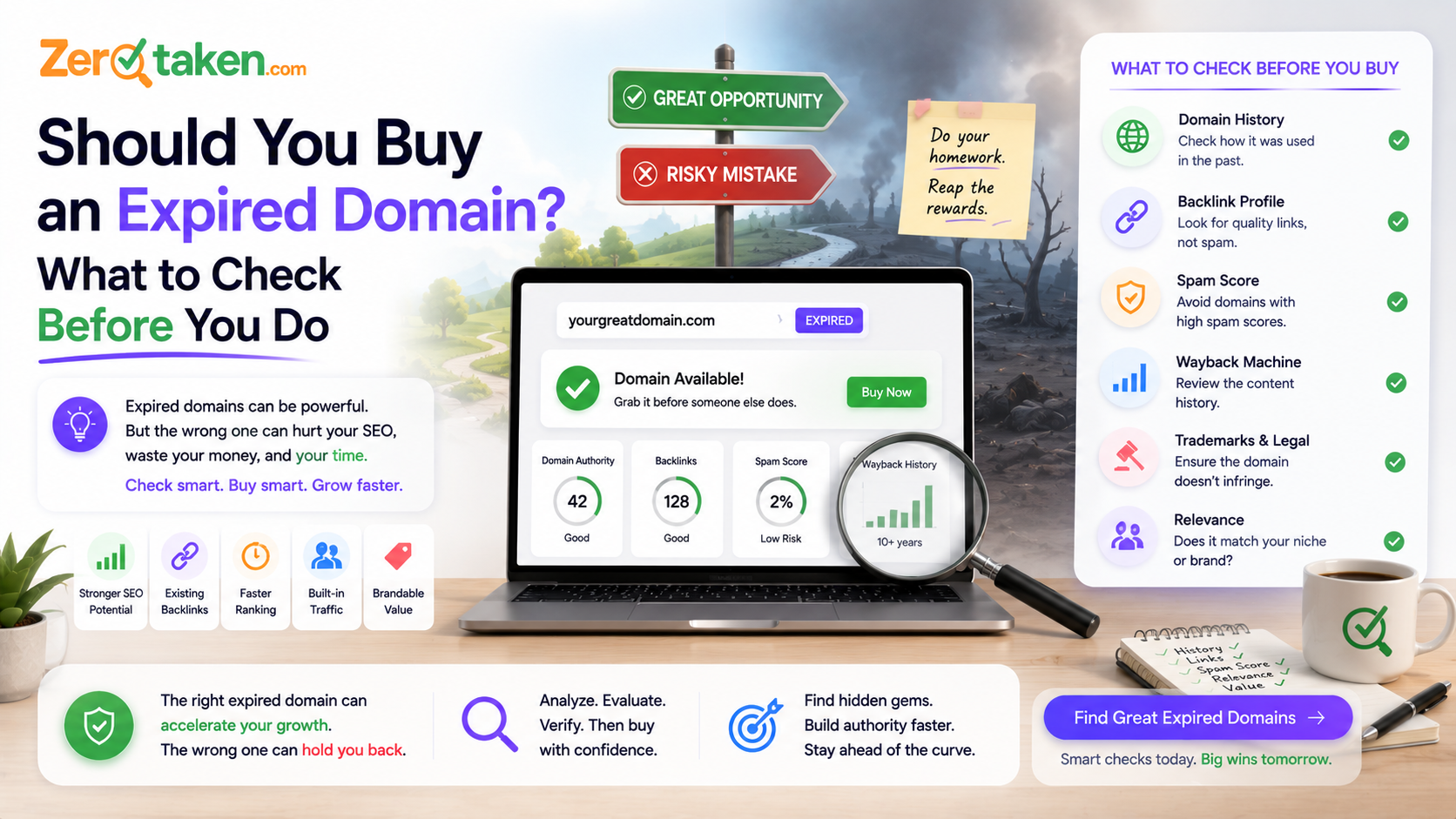
This is the whole game, and it takes about ten minutes. Never bid on or register an expired domain until you've run it through this list — the goal is to reconstruct what the name used to be, because 'clean and abandoned' and 'toxic and dumped' look identical until you look.
Run all six of these before you spend a cent:
- Wayback Machine (web.archive.org): pull up old snapshots. If it was a real, on-topic site that simply stopped, good. If it was a foreign-language pill store, casino, or auto-generated spam, walk away — that's the single fastest disqualifier.
- Backlink profile: run it through a backlink checker (Ahrefs and Moz both have free lookups). You want a modest, relevant, real set of links, not tens of thousands of comment-spam links from unrelated sites.
- Index check: search 'site:thedomain.com' on Google. A total de-index on a domain that clearly had content is a loud warning that it was penalized.
- Blacklist scan: check it against spam and malware lists (MXToolbox, Spamhaus) — non-negotiable if you plan to send email from the domain.
- Trademark search: run the brandable name through USPTO's TESS (or EUIPO for the EU). An abandoned domain is not an abandoned trademark.
- WHOIS and DNS history: use a WHOIS/DNS lookup to see how many hands it's passed through and whether it was recently parked or flipped — rapid ownership churn is a soft red flag.
Does buying an expired domain reset a Google penalty?
This is the myth that gets people burned, so here's the blunt version: no, you cannot count on it. Google associates penalties with the domain, and while a genuine change of ownership plus a disavow-and-cleanup effort can eventually earn a reset, there's no button, no guarantee, and no timeline. People assume registering a dropped name gives them a factory-fresh reputation; it doesn't.
If you find a name you love and the vetting turns up a penalty, treat that as a full stop, not a discount. Cleaning up an inherited manual action means disavowing the toxic links, possibly filing a reconsideration request, and waiting — weeks to months of work with no promised outcome. For a new brand, that is almost never worth it when a clean domain is a few dollars away. The only time it pencils out is when the specific name is genuinely irreplaceable and you have the SEO patience to rehabilitate it.
How do you grab a domain the moment it becomes available?
If a name you want is still owned but heading toward expiry, timing is the whole battle. You've got two real moves: place a backorder through a drop-catch service so they attempt to register it the instant it releases, or watch the expiry date yourself and pounce during the pending-delete window. Backorders cost money and still aren't guaranteed for a contested name — multiple services race the same drop — but for anything remotely desirable, a plain 'I'll check back later' loses to someone who automated it.
The cheaper discipline is simply to know the exact date. ZeroTaken's expiration monitor lets you track a domain you're eyeing so you're alerted as its registration lapses instead of finding out after a drop-catcher already flipped it. And the moment it does look free, re-verify before you celebrate — a 'for sale' listing or a stale WHOIS record is not the same as actually registrable, and confirming live availability is the one step people skip right before they lose the name.
Brainstorm Your Domain Name with ZeroTaken
Describe your startup, SaaS, web app, or business idea, and let our AI brainstorm memorable, brandable name ideas and instantly check live availability.
Try AI Domain GeneratorWhen is an expired domain worth it — and when should you just register fresh?
Buy expired when the specific brandable name you want only exists on the drop market and it passes every check above with a clean, relevant history. That's the sweet spot: you get a name you couldn't otherwise have, plus whatever legitimate link equity came with it, at a price you set a ceiling on. A short, real-word .com with a boring, on-topic past is worth paying an auction premium for — those don't come back around often.
Register fresh when you're chasing 'SEO age' as an abstraction, when the vetting turns up anything ugly, or when a brand-new invented name would serve you just as well. A made-up brand — the kind ZeroTaken generates by the dozen — has zero history to inherit, costs about ten dollars, and carries none of this risk. If your name doesn't have to be a specific pre-owned word, a clean fresh registration beats a discounted gamble every time. Don't buy someone else's baggage just because it's on sale.
So, should you buy that expired domain?
Expired domains are not a bargain bin; they're a due-diligence game. The winners treat the ten-minute history check as mandatory and the price as secondary — they'll happily pass on a $12 name with a spam past and pay $400 for a clean one, because they know the history is the asset, not the letters. The people who get burned do it in reverse: they fall for the price, skip the vetting, and inherit a blacklisted, penalized name they now have to explain to their email provider.
So the rule is simple. Reconstruct the name's past before you spend anything, treat any real red flag as a hard no rather than a haggling point, and remember that a clean, fresh, invented brand is always a legitimate — often smarter — alternative. Do the homework, and an expired domain can be the best name you'll ever own. Skip it, and it can be a problem you paid to adopt.