
7 Domain Name Mistakes Founders Make (and How to Avoid Them)
Your domain name is one of the few startup decisions that's cheap to make and expensive to unmake. Change your logo and nobody blinks. Change your name after launch and you're rebuilding email addresses, redirects, business cards, app-store listings, and every backlink you ever earned. The mistakes below are the ones we watch founders repeat — and every one of them is avoidable in the ten minutes before you click "buy."
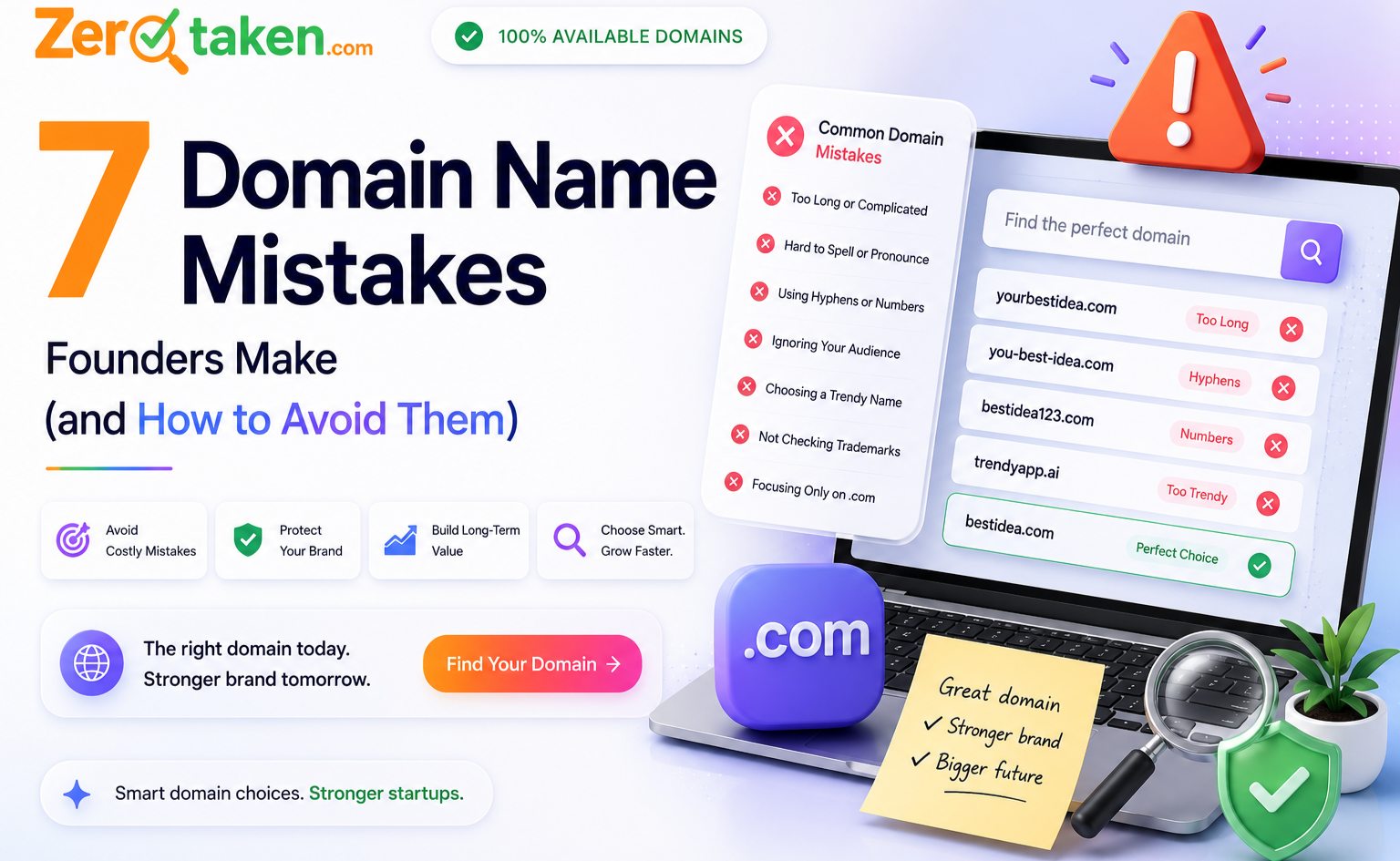
Mistake #1: Are you naming for this month instead of this decade?
The most common naming trap is describing exactly what you do today. "BostonDogWalkers," "OnlyInvoicePDF," "The2026PlannerApp" — each one is a fence you're building around your own future. The Boston walkers can't expand to Austin. The invoice tool can't add estimates. The planner is dated the moment the year turns.
Pick a name with room to grow. It doesn't have to be abstract — it just has to not actively contradict your version 3.0. Amazon didn't launch as "OnlineBooks.com" for a reason.
- Avoid a city or region unless you'll genuinely never expand past it.
- Avoid a single product noun if you plan to add product lines later.
- Avoid years, versions, or trend words ("Web3," "GPT") that age fast.
Mistake #2: Does your name survive the radio test?
Say your domain out loud to someone who's never seen it spelled. If they can't type it correctly on the first try, you'll spend the rest of your company's life spelling it for people. Every dropped vowel ("Flickr"), silent letter, or clever homophone is a tax you pay on every podcast interview, every phone call, every time a happy customer tries to tell a friend.
Big companies get away with creative spellings because they buy their way past the confusion with marketing budgets you don't have yet. Until you do, favour names that are spelled the way they sound.
Mistake #3: Are you "fixing" a taken name with a prefix or hyphen?
The perfect word is registered, so you reach for the workaround: gettapp.com, try-tapp.com, tapp-hq.com, tappapp.com. This is one of the quietest ways to bleed traffic. Anyone who hears "Tapp" will type tapp.com first — straight into your competitor's site or a parked page you don't own.
Prefixes like get/try/use and suffixes like app/hq can work, but only if the bare word isn't an active, confusable business. If the clean version is a live product, keep looking. A distinct name you own outright beats a borrowed one you're always one step behind.
- Hyphens get lost in speech ("is that with a dash?") and look dated on a card.
- Numbers create the same ambiguity: is it "4" or "four"?
- A prefix bolted onto someone else's live brand invites trademark trouble, not just lost traffic.
Mistake #4: Did you buy the domain before checking the trademark and handles?
"The domain is available" does not mean "the name is free." Someone can hold the trademark, own the matching social handles, or run an established business under the same name — and any one of those can force a rebrand later. Spend five minutes before you buy: search the USPTO (or your local registry), check the handles on the platforms you'll actually use, and Google the bare name in quotes.
The order matters. Check trademark and handles first, then register the domain — not the other way around. (We wrote a full guide on dodging trademark trouble if you want the deeper version.)
Mistake #5: Are you overpaying for a premium .com before you've proven anything?
There's a real temptation to drop $3,000–$10,000 on an aftermarket .com for a product that has zero users. That money is almost always better spent on the first six months of actually building the thing. A strong, brandable name on a $12 registration — or a credible alternative extension — gets you to launch just as well.
Buy the premium .com when the brand is worth defending, not before it exists. Plenty of well-known companies launched on a .io, .co, or .ai and only upgraded to the .com once traction justified the price.
Mistake #6: Have you read your domain as one lowercase string?
Domains have no spaces and no capital letters, and that's where accidents hide. "Experts Exchange" becomes expertsexchange.com; "Pen Island" and "Therapist Finder" go the same unfortunate way. Before you commit, write your name in all-lowercase with no spaces and read it cold — ideally in front of someone who'll tell you the truth.
Then check it in the languages your customers speak. A word that's perfectly neutral in English can be awkward, rude, or unpronounceable elsewhere. If you're going global, this is a five-minute check that saves an expensive one.
Mistake #7: Did you fall for the first name before seeing the alternatives?
Founders anchor hard on their first idea, then spend weeks trying to force a taken or awkward name to work instead of generating twenty fresh ones. The fix is boring and effective: brainstorm wide, then verify availability live before you get attached. It's far easier to let go of a name you thought of ninety seconds ago than one you've been defending for a month.
This is exactly the gap ZeroTaken is built for — describe the idea, get a batch of brandable candidates, and see which ones are actually registrable in real time, so you fall in love with a name you can actually own.
Brainstorm Your Domain Name with ZeroTaken
Describe your startup, SaaS, web app, or business idea, and let our AI brainstorm memorable, brandable name ideas and instantly check live availability.
Try AI Domain GeneratorWhat's the ten-minute checklist to avoid all seven?
None of these mistakes need a branding agency to dodge — just a short, deliberate pass before you buy:
- Will this name still fit in five years? (No cities, single products, or years.)
- Can a stranger spell it correctly after hearing it once?
- Is the clean, un-prefixed version free of an active competitor?
- Are the trademark and your key social handles actually clear?
- Am I paying a premium price I can't yet justify?
- Does it read cleanly as one lowercase string, in every market I'm entering?
- Have I looked at real alternatives, or just the first name I fell for?
Why is getting this right worth ten minutes?
Because a rebrand is one of the few founder mistakes that compounds. Every month you run under the wrong name, you accumulate more backlinks, more brand recognition, and more integrations that all have to be unwound when you finally switch. The name is cheap to get right and costly to get wrong — so spend the ten minutes now, not the quarter later.