
Building a Legal Tech Startup? Here Are 100+ Domain Names Still Available
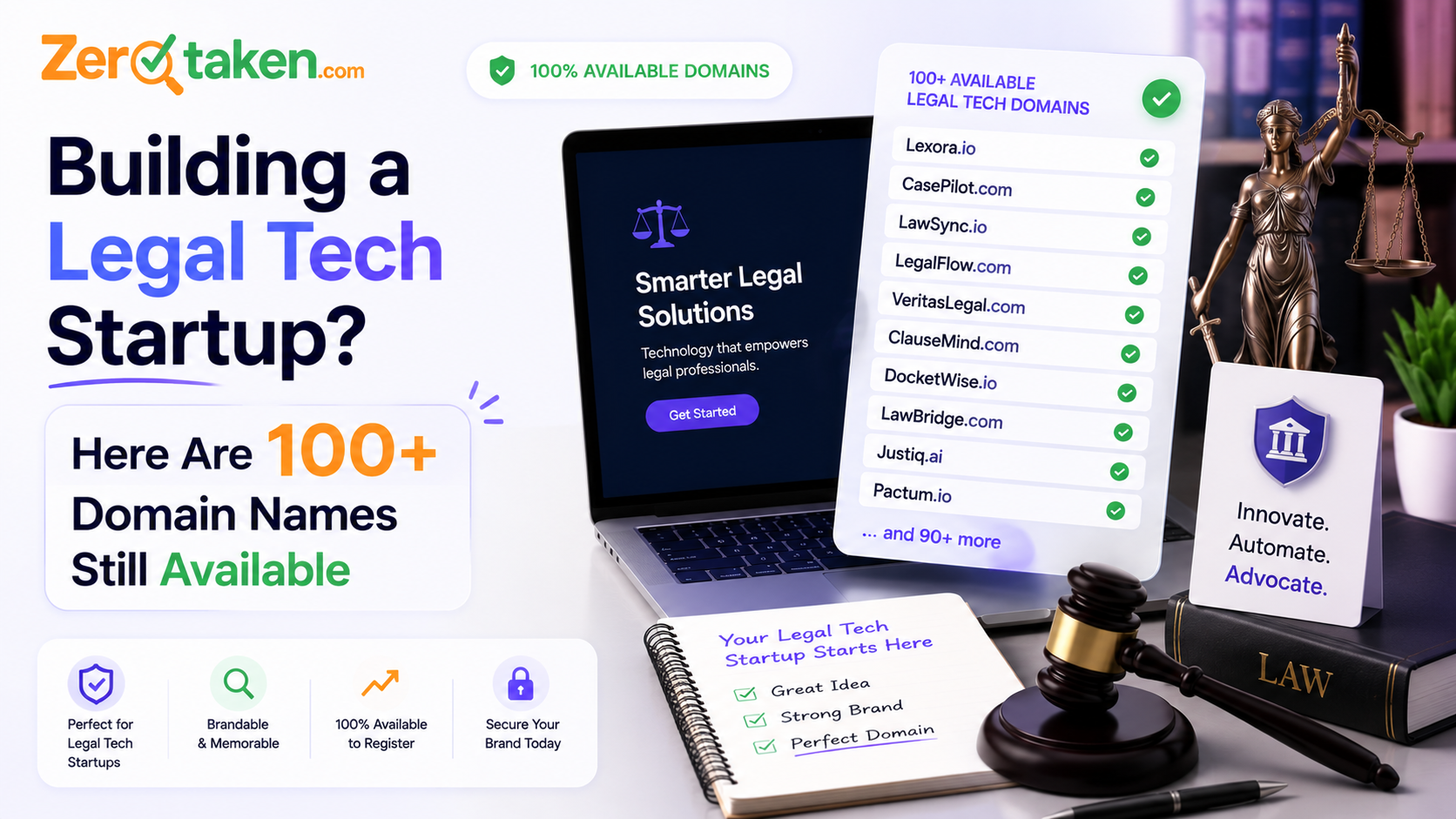
Law was, for a long time, the category everyone building software quietly skipped. It was slow, relationship-driven, allergic to change, and wrapped in enough compliance that most founders just went and built another CRM instead. That's over. Contract review, e-discovery, intake automation, matter management, and an LLM that can actually read a 90-page agreement and flag the indemnity clause are all live products with paying customers right now. Solo attorneys are buying tools their firms would never have approved five years ago, and in-house teams are under real pressure to do more with the same headcount. The idea is rarely the thing that stalls a legal tech founder — the name is. Every plain-English combo of law, case, and legal was claimed a decade ago. So we generated a big batch of brandable names built for legal tech, live-checked every one across .com, .io, .ai, and .co, and kept only what's still unregistered as of this run.
Why Is Legal Tech Suddenly Worth Building In?
For years the pitch died on the same objection: lawyers bill by the hour, so why would they buy software that makes them faster? What changed is that the work legal software can now do crossed a real line. Reviewing a stack of contracts for a single risky clause, summarizing a deposition, drafting a first-pass NDA, or surfacing the three relevant cases out of four hundred used to be junior-associate labor measured in billable hours. An LLM does a credible first draft of all of it in seconds, and clients have started noticing when a firm still charges like it doesn't.
The buyer side moved too. Solo and small-firm attorneys — the majority of the profession — now buy their own tools without waiting for an IT committee that doesn't exist. In-house legal teams are being told to absorb more work without more headcount. And a whole layer of legal-adjacent work — compliance, contract lifecycle, e-signature, entity management — is being rebuilt by people who never went to law school. That's a wide, funded, under-tooled market, which is exactly why the good names are going fast.
What Actually Makes a Legal Tech Name Work?
Legal tech has a naming trap the consumer world doesn't: sound too much like a law firm and you read as stuffy and expensive; sound too much like a generic SaaS app and you lose the credibility a lawyer needs before they'll trust you with a client's contract. The names that land split the difference — a root that signals 'this understands legal work' paired with a suffix that sounds like modern software, not a partnership letterhead.
- Roots that read 'legal work': lex, juris, case, docket, brief, counsel, verdict, statute, clause, plea, depo, escrow, arbit, mediate
- Roots that read 'trust and precision': ledger, codex, notary, mandate, precedent, filing — words that sound careful, which is what a lawyer is buying
- Suffixes that sound like a product, not a firm: -ly, -io, -base, -flow, -wise, -nest, -hub, -naut, and clean invented endings like -ara or -ify
- Mix them and you land on names like Jurisly, Caselytic, or Lawbase — nothing baroque, just something a managing partner can hear once, spell correctly, and not be embarrassed to put on an invoice
Nothing Clicking Yet? Describe Your Product and Let It Riff
Brainstorm Your Domain Name with ZeroTaken
Describe your startup, SaaS, web app, or business idea, and let our AI brainstorm memorable, brandable name ideas and instantly check live availability.
Try AI Domain GeneratorWhich Extension Fits a Legal Tech Startup — .com, .io, .ai, or .co?
.com is still the extension a general counsel or a solo attorney types from muscle memory, and in a trust-heavy category that matters more than it does for a consumer app. If a short, real .com for your name is sitting there unregistered, take it — but don't expect to find one easily, because legal is one of the oldest commercial categories online and the obvious combos have been gone for years. Only one name on this run cleared on .com, which tells you exactly how picked-over this space is.
.io reads as B2B software, which is precisely what most legal tech is — you're selling into firms and in-house teams, not to consumers off an app store. It carries zero baggage in front of a technical or operations buyer, and it's a completely reasonable place to launch a matter-management or contract tool. A large share of the names below only cleared on .io, and none of your buyers will think twice about it.
.ai is genuinely earned here rather than decorative, because so much of the current legal tech wave actually is AI: clause extraction, contract review, case-law search, deposition summaries. If your product really does the reading and reasoning, .ai tells that story before a prospect finishes your headline. If you're building a scheduling or billing tool with no model behind it, it'll read as a stretch — don't force it.
.co is the clean fallback when the .com is gone and you want something that still looks like a company rather than a side project. It's short, it's neutral, and it works fine on a business card in front of a partner. Several strong names here landed on .co, and it's an easy one to grow into.
Wait — Are These Domains Actually Free Right Now?
Every name below was checked live during this run, not pulled from a list someone assembled last year. We run a DNS lookup first, confirm through the official registry (RDAP) where one exists, and fall back to a live WHOIS check for extensions like .io and .co that don't expose a public registry API. If a name made this list, it passed those checks — we never guess, and we never label something 'available' just because a quick search came back quiet.
Legal tech names get registered constantly, and a good one can be gone within minutes of a list like this going live, so this page re-checks itself daily and swaps out anything that's since been claimed for a fresh, verified name. If something below fits what you're building, treat that as the cue to register it now — not to bookmark it and come back next week.
Should You Trademark-Check the Name Before You Commit?
In most categories this is good hygiene. In legal tech it's the whole ballgame, because your buyers are the exact people who sue over trademarks for a living — and a naming conflict that a consumer app might shrug off can become a genuinely expensive problem when your customers are litigators. An available domain only means nobody has registered that exact string. It tells you nothing about whether a firm, a filing service, or a competing tool already holds the mark.
So before you spend real money on branding, a logo, or a product launch, run the name through the USPTO database (or your country's trademark registry) and do a plain web search for anyone already operating under it in a legal or professional-services context. It's ten minutes of work that can save you a rebrand — and in this specific market, a cease-and-desist from someone who enjoys writing them.
One Habit Worth Building Before You Register
If you brainstorm name variations on a public domain search tool, know that some registrars log popular searches, and domain 'snipers' occasionally register anything that gets searched a lot before you reach checkout, then offer it back to you at a markup. It doesn't happen every time, but it happens often enough that a private domain checker — one that queries registries directly instead of caching and reselling your searches — is worth the extra few seconds.
That's the whole idea behind ZeroTaken: describe what you're building in plain language, get back a batch of brandable name ideas, and see live availability across every extension that matters, without your shortlist quietly ending up for sale back to you at a premium.
Check Your Own Legal Tech Idea Privately
Brainstorm Your Domain Name with ZeroTaken
Describe your startup, SaaS, web app, or business idea, and let our AI brainstorm memorable, brandable name ideas and instantly check live availability.
Try AI Domain GeneratorQuick Answers Before You Register
A few things founders usually ask once they've found a name they like:
- Do I need a .com to look credible to law firms? It helps, but it's no longer required. .io and .ai both read as legitimate, modern software to a technical or in-house buyer — save the premium .com hunt for after you've proven firms actually pay for the product.
- Is .law or .legal worth using instead? They exist and they're unrestricted, but they're long, easy to misspell aloud, and read as slightly generic. A crisp brandable name on .io or .co usually beats a literal keyword on a niche extension — you're building a brand, not a directory listing.
- My favorite name here got taken before I registered it — now what? Grab a close variant from the list, or describe your product to the generator above for a fresh verified batch. Legal tech names move fast, which is exactly why this list refreshes daily instead of going stale.
- Should the name say 'law' or 'legal' outright? Not necessarily. Plenty of the strongest legal tech brands use an invented or abstract root and let the product do the explaining — being instantly spellable and trademark-clear matters more than being literally descriptive.
Live Available Domains List
Click on any domain name to register it immediately at standard registry pricing.
Need something more custom?
Describe your exact startup concept, features, or project idea and let our AI brainstorm dozens of domain suggestions for you in real-time.
Run a parallel Multi-TLD check
Already have a brand name brainstormed? Verify availability across popular extensions like .com, .io, .ai, and .co in parallel in a single search query.
Need something more custom?
Describe your exact startup concept, features, or project idea and let our AI brainstorm dozens of domain suggestions for you in real-time.