
Your Company Name Is Three Words. Should the Domain Be an Acronym?
Your company is called something like Northbridge Capital Partners, or Open Signal Robotics, or Blue Harbor Analytics. Three words, maybe four, and the full-name .com is long, hard to say on a call, and probably taken anyway. So your eye drifts to the obvious shortcut: just use the initials. NCP. OSR. BHA. It's short, it's clean, big companies do it — IBM, HBO, BMW — so why not you? Before you register it, here's the honest version of what an acronym domain gets you, what it quietly costs, and the cases where it's genuinely the right call instead of a shortcut you'll regret.
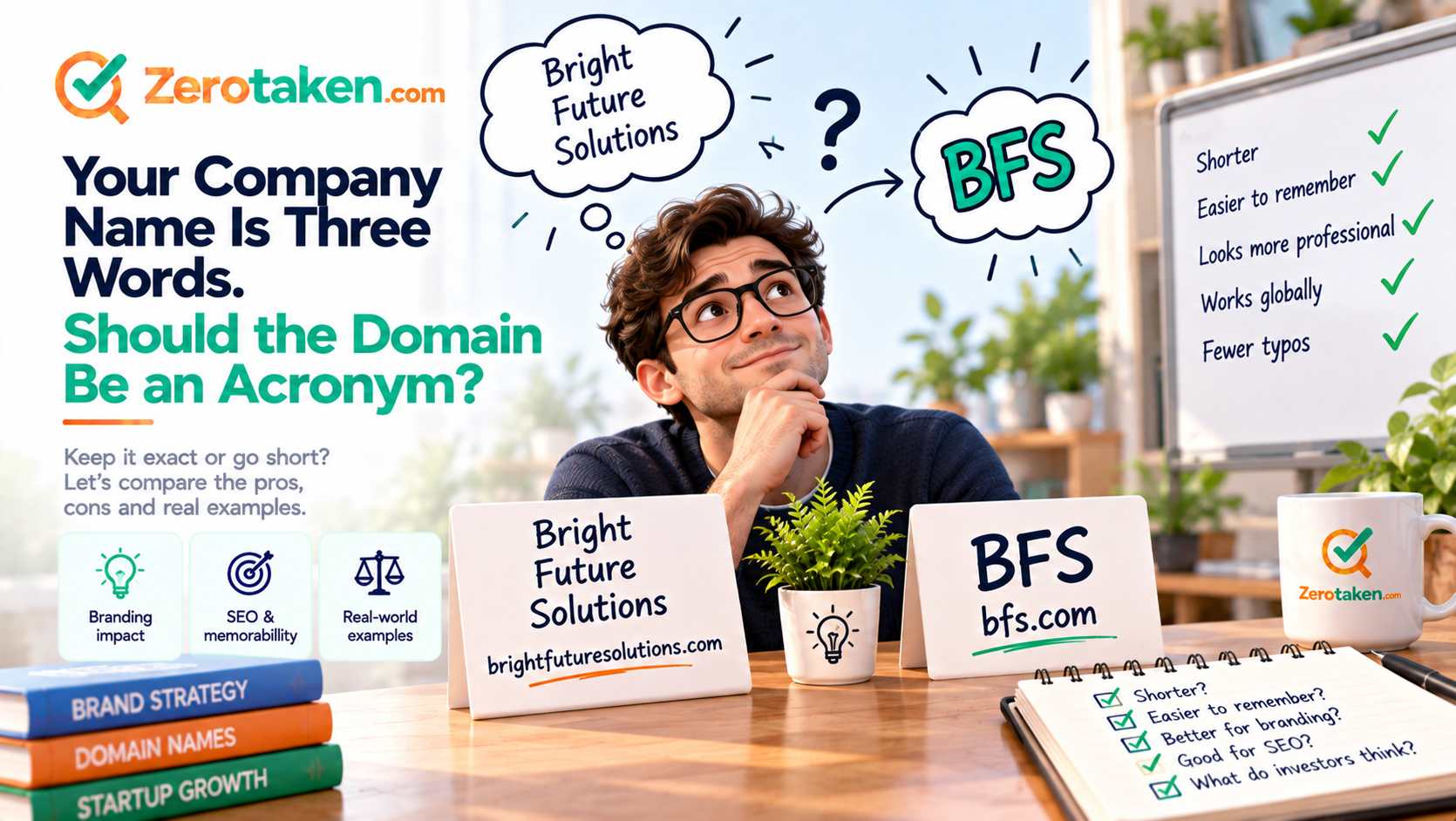
What counts as an acronym domain, and why are founders tempted?
An acronym domain is one built from the initials of your name rather than the words themselves — ncp.com instead of northbridgecapitalpartners.com, or a near-cousin like a three-to-five-letter mashup that isn't a real word. The appeal is immediate and real: it's short, it fits on a business card, it sounds 'corporate,' and it rescues you from a full-name domain that runs twenty-plus characters and nobody can spell over the phone.
The temptation gets stronger the longer your real name is. A founder staring at a four-word company name feels like they have two options — type out the whole mouthful or collapse it to initials — and the initials win on pure aesthetics. But that framing is a trap, because it hides a third option that beats both (more on that later), and because it skips the first question that actually decides this: can you even get the acronym you want?
Can you even get a good acronym domain in 2026?
Almost certainly not on .com, and this is the fact that ends most of these debates before they start. There are only 17,576 possible three-letter combinations, and every single three-letter .com has been registered for years — there are no free ones, full stop. The ones that change hands sell for five and six figures on the aftermarket, because an airline, a bank, and a university all want the same three letters. Four-letter .coms are effectively gone too. So when you picture 'ncp.com, clean and short,' you're picturing something that is either owned by an established company or priced like a used car.
What's actually available to you is the acronym on a different extension — .io, .co, .ai, .xyz — or a longer letter string that isn't a tidy three. And that quietly dissolves the main reason you wanted the acronym in the first place. If you're going to end up on ncp.io anyway, you're no longer choosing 'short and premium' over 'long and spelled-out.' You're choosing a meaningless string on a secondary extension over a real word, and that's a much worse trade than it looked.
The practical move is to check before you fall in love: put the full name, the acronym, and a couple of coined alternatives through the same availability search and see what's actually registerable at a normal price. The decision you think you're making often isn't on the menu.
Does an acronym actually help people remember you?
This is where the IBM comparison falls apart. IBM, HBO, and BMW are not evidence that acronyms are memorable — they're evidence that decades of recognition and billions in marketing can make anything memorable. Those companies spent half a century and enormous budgets teaching the world what three random letters mean. You are a startup with none of that runway, and a fresh acronym arrives in a customer's brain as pure noise: no meaning to hook onto, no image, nothing to reconstruct it from later.
Meaning is what makes a name sticky. Someone hears 'Blue Harbor' and gets a picture; they hear 'BHA' and get three consonants they'll forget by lunch. Worse, acronyms fail the radio test badly — say 'QXR' out loud and a listener can't tell if it's Q-X-R, a word, or how any of it is spelled. A meaningful short name, even a coined one, out-recalls a random initialism for an unknown brand every time. You're not borrowing IBM's shortcut; you're borrowing the hard part of its problem without the budget that solved it.
There's one honest exception, and it matters: acronyms that read as a pronounceable word. NASA and IKEA are technically initialisms, but your mouth treats them as words, so they get a word's memorability. 'An acronym' and 'a pronounceable word that happens to be made of initials' are two completely different naming decisions — the second can be excellent, the first rarely is.
What about SEO and search — do initials hurt you?
Not as a ranking penalty — Google doesn't dock you for a domain made of initials any more than it rewards one made of keywords. The real cost is discoverability and collision. Nobody searches for your initials cold, so the letters earn you no relevance, and when people do search your acronym, you're fighting a crowd: three letters will collide with a sports league, a government agency, a chemical compound, and forty other companies claiming the same abbreviation.
That collision is the quiet tax. A would-be customer who half-remembers your name types the acronym into Google and lands on a Wikipedia disambiguation page or a competitor who got there first. A distinctive word — especially a coined one — owns its own search results page from day one, which is worth far more to a young company than any theoretical keyword bonus. You want to be the only result for your name, and three generic letters guarantee you won't be.
When does an acronym domain actually make sense?
There are real cases where initials are the right answer rather than a shortcut — they just aren't the default for a brand-new consumer or SaaS startup. The pattern is: you already have recognition to lean on, the acronym behaves like a word, or your audience reaches you by clicking links rather than typing your name from memory.
- Your initials already read as a pronounceable word (NASA-style) — then you have a word, not an acronym, and most of the downsides vanish.
- You're an established organization whose full name is genuinely unwieldy and already widely abbreviated by customers themselves.
- You're B2B or enterprise, found through sales conversations, RFPs, and referrals rather than word-of-mouth typing — recall from a billboard matters less.
- The acronym is a secondary, link-first asset (a short internal or sharing domain) sitting behind a real primary brand, not the brand itself.
- You can secure the acronym on .com at a sane price — rare, but if it's genuinely yours and affordable, the case strengthens.
What's the smarter middle path most founders miss?
Stop treating it as 'full four-word .com versus the initials.' The best move is usually neither. Coin a short, sayable word that evokes your space — the Stripes, Notions, and Figmas of the world are short and brandable without being either a mouthful or a meaningless initialism. That gets you the length you wanted from the acronym and the memorability you'd have lost. A short invented word is almost always a better buy than three generic letters on a backup extension.
If you're attached to the initials for internal reasons, keep them as a vanity shortcut, not your identity. Register and build on a real brand name, then point a short acronym domain at it as a redirect for email signatures or sharing. You get the clean abbreviation where it's convenient without betting your brand's memorability on it. The failure mode to avoid is making the acronym your front door — printing it on everything — while a stronger name sat one search away.
And run the comparison honestly before committing. Line up the full name, the acronym, and two or three coined candidates, check them across .com and the extensions you'd accept, and judge each on what you can actually register, not what you wish were free.
How do you pressure-test the acronym against the alternatives?
The expensive mistake is committing to an acronym, ordering the business cards, and only then discovering the matching .com is a $40,000 aftermarket listing while a far better coined name was sitting unregistered the whole time. ZeroTaken lets you check the full name, the initials, and a batch of coined alternatives side by side in one search, with live availability instead of a registrar's upsell screen — so you're comparing real options, not guesses. It also doesn't log your queries, so you can test your best name ideas without feeding them to an aftermarket bot.
So should you use an acronym domain?
For a new, unknown startup: almost always no. The short .com acronym you're picturing isn't available at a price you'll pay, the version you can get is a meaningless string on a secondary extension, and initials cost you the one thing a young brand can't buy — memorability. You'd be taking on IBM's hardest problem without IBM's fifty-year head start, to solve a 'my name is too long' problem that a short coined word solves better.
Say yes only when the acronym reads as an actual word, when you already have the recognition to make three letters mean something, or when it's a convenience redirect behind a real brand. Otherwise, skip the initials, spend an afternoon finding a short, sayable name you can genuinely own across your search results, and register that instead. The acronym feels like the professional choice; for most founders, a distinctive word is the one that actually gets remembered.