
Probamos 200 dominios. Ni una sola palabra real estaba libre.
A los fundadores les encanta culpar a la mala suerte cuando el dominio que quieren ya está ocupado. Así que decidimos medirlo. Elegimos 50 palabras reales, simples, en inglés —el tipo de sustantivos limpios y evocadores que todo el mundo secretamente quiere para su marca— y 50 palabras inventadas. Luego pasamos cada una por el sistema de verificación de disponibilidad en vivo de ZeroTaken, tanto en .com como en .io: 200 dominios en una sola sesión, comprobados de la misma forma en que tú los comprobarías. El resultado no tuvo comparación. Ni uno solo de los 100 dominios de palabras reales estaba disponible —ni en .com, ni siquiera en el más nuevo y tecnológico .io. Los nombres inventados contaron una historia completamente distinta. Aquí está exactamente lo que encontramos, cómo lo encontramos, y qué significa para el nombre que estás a punto de elegir.
Añade ZeroTaken como fuente preferida en Google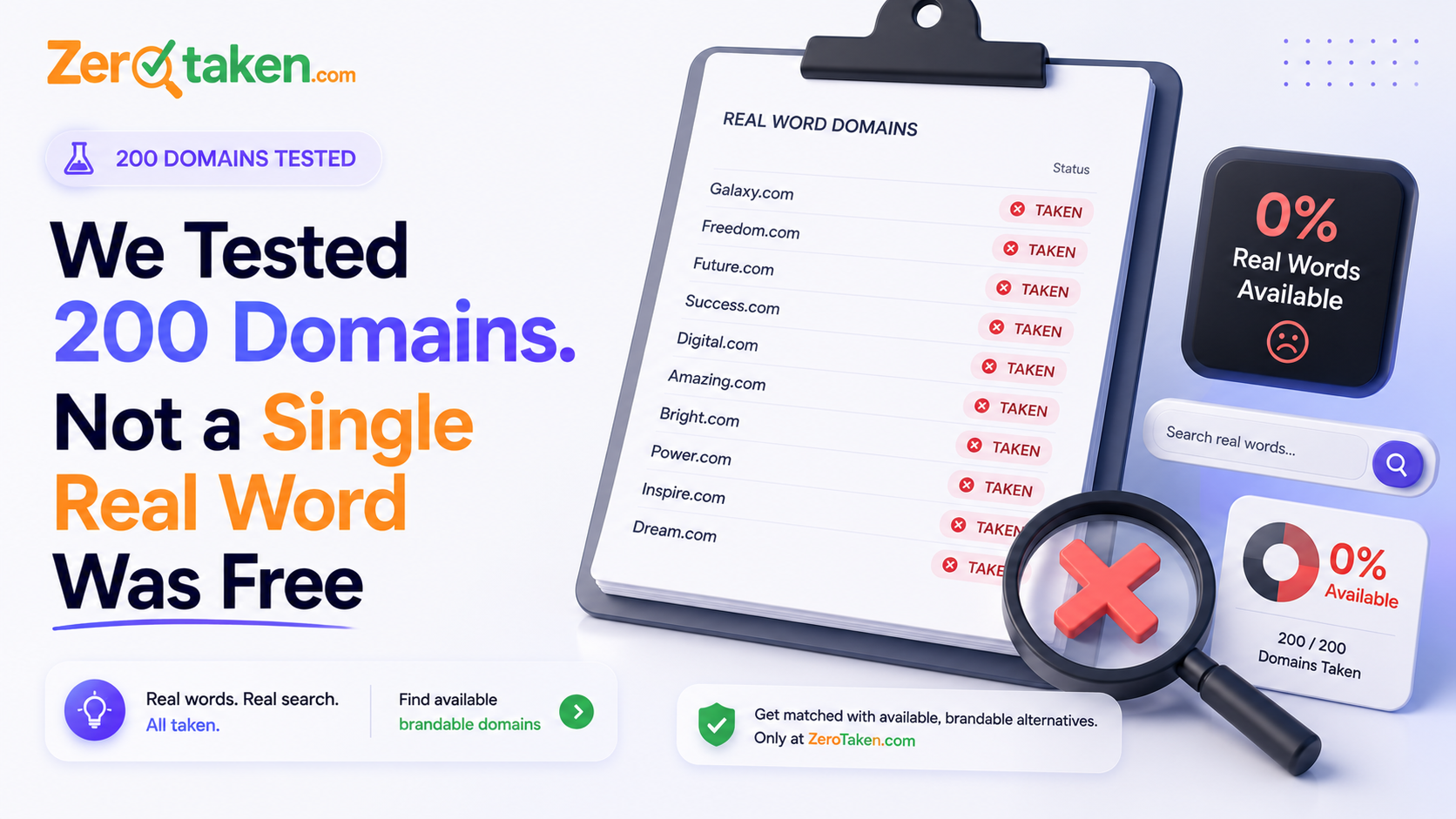
¿Qué probamos exactamente?
Queríamos un experimento justo, aburrido y reproducible, no una historia alarmista con datos elegidos a modo. Así que armamos dos listas de 50 palabras cada una y las tratamos exactamente igual.
El grupo A eran 50 palabras reales, simples, en inglés: sustantivos y adjetivos cotidianos con verdadero atractivo de marca —otter, meadow, lantern, ember, quartz, zephyr, willow, cinder, y así sucesivamente. Son exactamente las palabras que todo el mundo desearía poder tener.
El grupo B eran 50 palabras inventadas: combinaciones o cadenas creadas que no aparecen en ningún diccionario pero suenan como nombres modernos de startups —zenlio, brixon, glyntic, ploomex, quivex, fintavo, y similares.
Cada palabra se comprobó en dos extensiones, .com y .io, dándonos 200 verificaciones de disponibilidad en total. Las ejecutamos en vivo a través del mismo sistema de DNS más registro que usa nuestra herramienta de búsqueda, así que un resultado 'libre' significa que el dominio realmente no resolvía a nada en el momento en que lo comprobamos. Sin estimaciones, sin rascar listas viejas: una fotografía en vivo tomada de una sola vez.
¿Cuántas palabras reales seguían disponibles?
Cero. De 100 dominios de palabras reales — 50 en .com y 50 en .io — exactamente ninguno estaba libre.
Eso no es un artefacto de redondeo. Es un 0% limpio. Cada una de las palabras comunes en inglés que probamos ya estaba registrada, en ambas extensiones. Los resultados de .io son la parte que nos sorprendió incluso a nosotros: la gente trata a .io como la 'vía de escape' cuando el .com ya se fue, pero para palabras de diccionario simples esa vía de escape ya está cerrada con candado. Si la palabra existe en inglés, alguien ya tiene aparcado, desarrollado o acaparado tanto el .com como el .io.
La conclusión práctica es contundente: si tu estrategia de nombres es 'encontrar una linda palabra real que de alguna manera siga libre', tu tasa de éxito en nuestra muestra fue literalmente 0 de 100. No tienes mala suerte. El inventario simplemente ya no existe.
¿Los nombres inventados les fueron mejor?
Muchísimo mejor. De los 100 dominios de palabras inventadas que probamos, 39 estaban disponibles — una tasa de acierto del 39% frente al 0% de las palabras reales. Pero el promedio esconde la parte más útil, que es cómo se dividió entre las dos extensiones:
En .com, 5 de los 50 nombres inventados estaban libres — una tasa de disponibilidad del 10%. En .io, 34 de los 50 estaban libres — una tasa de disponibilidad del 68%. Las mismas palabras inventadas, la misma sesión, y .io resultó disponible casi siete veces más a menudo que .com.
Para resumir todo el experimento en una tabla: las palabras reales anotaron 0% en .com y 0% en .io; las palabras inventadas anotaron 10% en .com y 68% en .io. La palanca más grande sobre si un dominio está libre no es la extensión ni es la suerte: es si la palabra ya existe en inglés.
Para los curiosos: cinco .com inventados no estaban registrados al momento de la comprobación, incluyendo glyntic.com y ploomex.com. No te estamos diciendo que los compres —la disponibilidad de dominios cambia minuto a minuto y es posible que ya no estén libres— pero muestran el patrón. Una cadena ligeramente rara e inventada es la diferencia entre una puerta cerrada y una abierta.
¿Por qué .io es el arma secreta para nombres inventados?
La brecha entre el 10% (.com) y el 68% (.io) en exactamente las mismas palabras se reduce a antigüedad y volumen. El registro de .com acepta registros desde 1985 y tiene más de 150 millones de dominios activos; cuatro décadas de fundadores, inversores y acaparadores lo han recorrido de arriba a abajo. Incluso las cadenas inventadas más raras en .com muchas veces ya fueron tomadas de forma especulativa.
.io es más joven, más pequeño y, hasta hace poco, interesaba sobre todo a un público técnico. Eso significa que el estante de nombres inventados está mucho menos hurgado. Nuestros datos lo demuestran en vivo: la misma palabra inventada que está tomada en .com está, con más frecuencia que no, disponible en .io.
Esto no es una recomendación para agarrar .io por reflejo para todo —una marca de consumo que busca confianza masiva puede seguir queriendo pelear por un .com. Pero si estás construyendo una herramienta para desarrolladores, una API o una empresa de infraestructura, los números dicen que .io te da un grupo genuinamente más grande de nombres abiertos y con potencial de marca para elegir.
¿Por qué ya se fue cada buena palabra real?
Solo existe una cantidad limitada de palabras reales. El vocabulario común y con potencial de marca en inglés —el tipo contundente, de una sola palabra— suma decenas de miles bajos, no millones. Ese conjunto finito se topó con una demanda prácticamente infinita hace décadas.
Tres fuerzas terminaron el trabajo. Primero, el tiempo: .com lleva 40 años de registro continuo, y las mejores palabras se fueron temprano. Segundo, la inversión: los inversores de dominios tienen enormes carteras de palabras de diccionario precisamente porque son escasas y se revenden por cinco y seis cifras. Tercero, el registro defensivo: las empresas ya establecidas compran el .io, .co y .net de su .com para proteger la marca, retirando en silencio esas palabras de circulación en todas las extensiones a la vez.
Así que cuando tu .com de una palabra soñada ya está tomado, normalmente no está en uso activo: está aparcado, en venta o guardado en una cartera. Eso es un consuelo frío, pero replantea el problema correctamente: no estás compitiendo por una palabra que está a punto de liberarse. Estás compitiendo contra un mercado que decidió hace mucho que estas palabras son activos.
¿Qué deberías hacer realmente con esto?
Deja de gastar tu primera semana de búsqueda de nombre buscando una palabra real sin reclamar. Nuestros datos dicen que esa búsqueda no da nada. Usa esa energía en la estrategia que sí tiene inventario disponible: inventa un nombre.
Los mejores nombres de marca modernos son inventados —Stripe, Vercel, Twilio, Figma, Notion (una palabra real que fue una excepción costosa). Los nombres inventados están disponibles con más frecuencia, son más fáciles de registrar como marca y más fáciles de posicionar en buscadores porque no estás peleando contra un término genérico de diccionario. Nuestra tasa de disponibilidad del 39% para nombres inventados frente al 0% de palabras reales es el lado de la disponibilidad de ese mismo argumento.
Un ciclo práctico que funciona: genera un lote de nombres inventados pronunciables, compruébalos en vivo en .com y .io, y quédate con los que estén libres en la extensión que quieres. Eso es exactamente para lo que está construido ZeroTaken: describe tu idea, obtén nombres inventados con potencial de marca, y ve la disponibilidad en tiempo real en lugar de ir haciendo clic uno por uno en un registrador.
¿Qué tan honestos son estos datos, y cuáles son las advertencias?
Esto es una fotografía de 200 dominios, no un censo de todo el DNS. Un conjunto distinto de 50 palabras reales seguiría, según nuestra experiencia, regresando abrumadoramente ocupado, pero tus porcentajes exactos variarán según las palabras que elijas y el día en que compruebes.
La disponibilidad también es un blanco móvil. Cada número aquí refleja el momento en que hicimos la comprobación; un nombre que estaba libre esta mañana puede estar registrado para el mediodía, que es exactamente por qué una comprobación en vivo le gana a cualquier lista estática de 'nombres disponibles' que encuentres dando vueltas por internet.
Y 'disponible' no es lo mismo que 'bueno'. Un nombre inventado tiene que ser pronunciable, deletreable al decirlo en voz alta, y libre de significados desafortunados en otros idiomas antes de que valga la pena comprarlo. La disponibilidad solo te lleva a la línea de salida. El titular honesto se mantiene, de todas formas: en una prueba justa, las palabras reales quedaron 0 de 100, y los nombres inventados fueron los únicos con una puerta abierta.