
Should Your Domain Name Have Numbers or Hyphens? The Honest 2026 Answer
It always starts the same way. The name you want is taken, the clean .com is gone, and a workaround is sitting right there: pop a hyphen between the two words, or swap a number in for a syllable, and suddenly the exact domain you wanted is 'available.' It feels like a clever escape hatch. It's usually a trap. Numbers and hyphens don't just look a little off — they quietly leak traffic to a competitor, tax every conversation where you say the name out loud, and follow you around for the life of the brand. This guide is blunt about when they sink you, the handful of times they're genuinely fine, and the better move when your first-choice name is already gone.
Añade ZeroTaken como fuente preferida en Google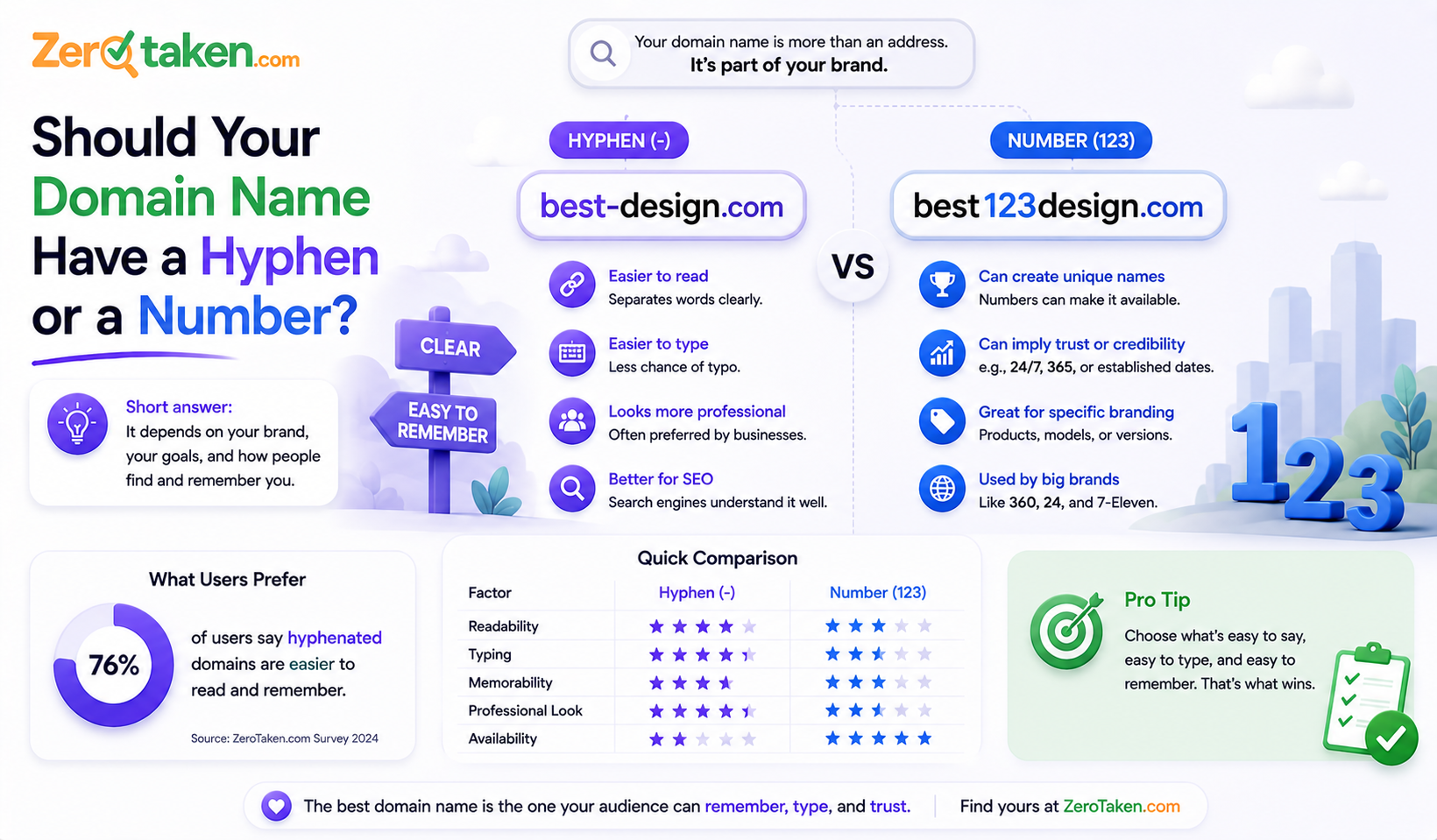
What's actually wrong with a number or hyphen in a domain?
The core problem isn't aesthetics — it's ambiguity the moment your name leaves the screen. A domain has to survive being spoken. Someone hears your name at a meetup, in a podcast ad, or from a friend, and then tries to type it later with nothing in front of them. A hyphen and a number both fail that test in the same way: the listener can't tell what they heard. Did you say 'get-fit.com' or 'getfit.com'? Was it 'go2market' with the digit or 'gotomarket' spelled out? Every time your name is spoken, you're rolling dice on whether it gets typed correctly.
That gap between how a name sounds and how it's spelled is a tax you pay forever. It's not a one-time design decision you make and forget — it's a small friction on every word-of-mouth referral, every conference introduction, every time someone reads your name aloud to a colleague. The whole job of a domain is to be the frictionless address people reach for without thinking. Numbers and hyphens add thinking, and thinking is where you lose people.
Are hyphens ever acceptable in a domain name?
For a brand you're building to last, the honest answer is almost never. A hyphen is invisible when spoken — nobody says 'get hyphen fit dot com' — so the single most common outcome is that people type the version without it and land somewhere else. If get-fit.com is your site and getfit.com belongs to someone else, you have just volunteered to send them a slice of your traffic every day, for free. You don't control the typo; they collect it.
Hyphens also carry a reputation problem you didn't sign up for. For twenty years, spammy and low-budget sites leaned on hyphenated exact-match domains ('cheap-car-insurance-quotes.com'), so a hyphen now reads, fairly or not, as a signal that the real name was taken and you settled. That's the exact impression a new brand can't afford to make in the first three seconds. When you look at the companies people actually trust, you don't find hyphens in the address bar — and that's not a coincidence.
The rare defensible use is a purely functional, non-brand domain nobody says out loud: an internal tool, a docs subdomain, a throwaway campaign URL. If a human will never speak it and it will never carry your brand's reputation, a hyphen is a non-issue. The instant the name is meant to be your identity — the thing on business cards, ads, and your logo — the hyphen has to go.
What about numbers — aren't some great brands numbered?
A few are, and they're instructive precisely because of how narrow the wins are. 99designs, 500px, and 23andMe all work — but notice what they have in common: the number is the point of the brand, not a substitute for a word. '99' means 'lots of designers,' '500px' references image dimensions, '23' is your chromosome pairs. The number carries meaning and there's only one obvious way to write it. That's the safe kind of number.
The dangerous kind is the number used as a lazy phonetic shortcut — '4' for 'for,' '2' for 'to' or 'too,' '8' for 'ate.' The instant you write 'names4startups' or 'go2market,' you've created two spellings of one spoken name and no way for a listener to know which you chose. Worse, you look like a 2005-era SEO domain, and you're probably handing the spelled-out version ('namesforstartups,' 'gotomarket') to whoever registered it. A number as a rebus is the worst of both worlds: it reads as dated and it leaks traffic.
The tiebreaker is simple. If the number is a genuine, meaningful part of the identity that a person would naturally write as a digit, it can work. If it's standing in for a word you'd otherwise spell out, it's a liability wearing a disguise.
Do numbers and hyphens actually hurt SEO?
Not directly, and it's worth being precise here because the myth cuts both ways. Google does not dock your ranking for having a hyphen or a digit in the domain — the string before the dot hasn't been a meaningful ranking factor for over a decade. If someone tells you a hyphen 'kills your SEO' mechanically, they're wrong. Content, links, and brand authority decide rankings, not punctuation.
The damage is real but it's indirect, and it shows up everywhere that humans, not algorithms, make the decision. A hyphenated or number-swapped domain earns fewer direct-navigation visits (people mistype it), fewer clean word-of-mouth referrals (people mishear it), and lower click-through when it looks spammy in a list of search results. Those are all things Google measures — and a name that quietly underperforms on trust and memorability underperforms in the rankings too, just through the side door rather than the front.
So the accurate framing is: the algorithm doesn't care, but every human in the funnel does, and the algorithm ultimately follows the humans. You're not avoiding a penalty. You're avoiding a slow, compounding drag on the exact signals that do move rankings.
Isn't a hyphen a smart way around a taken name?
It's the most tempting trap in domain hunting, and it's the one to walk away from fastest. Adding a hyphen or number to a name someone already owns doesn't get you around them — it chains you to them. You've built your brand next to an incumbent who owns the cleaner, more obvious version of your own name. Every customer who hears about you and drops the hyphen (or spells out the number) lands on their doorstep instead of yours. You are, in the most literal sense, marketing for the other domain.
There's a legal edge to this too. If the name you're 'working around' is a real, established brand, taking the hyphenated or numbered variant of their name can read as trademark infringement or bad-faith registration — the kind of thing that ends in a cease-and-desist or a UDRP dispute, not a clever growth hack. You don't want your whole identity resting on a domain someone can credibly argue you shouldn't have.
The mindset shift that saves founders here: a name you can't cleanly own is not your name. If the only version available is the hyphenated or numbered one, the market is telling you to keep looking, not to accept the consolation prize and build a company on top of it.
When do numbers or hyphens actually make sense?
There are honest exceptions — they're just narrower than the situations people try to use them for. Reach for a number or hyphen only when it clears this bar, and treat anything outside it as a hard no.
- The number carries real meaning and has one obvious spelling (500px, 23andMe, 99designs) — it's part of the idea, not a phonetic shortcut.
- A hyphen genuinely improves readability of otherwise-ambiguous smashed words, and the name will rarely be spoken aloud (some non-brand, functional URLs).
- You're registering a defensive variant to protect a clean primary domain you already own — never as the address you actually promote.
- It's a temporary, internal, or campaign-only URL that will never appear on a business card, an ad, or in a spoken introduction.
What should you do instead when your first-choice name is taken?
Change the word, not the punctuation. A taken name is a prompt to find a better word, and there are more paths than founders assume: coin a short brandable word that doesn't exist yet (the Twilio/Vercel route), add a real second word that reads cleanly with no hyphen (Squarespace, DoorDash), or lead with a strong verb or noun that captures the feeling instead of the literal keyword. Any of these beats a hyphen because the result is a name a stranger can hear once and type correctly.
The other honest option is a different extension on a clean, unpunctuated name. A solid .co, .io, or a relevant new extension paired with a crisp word will almost always outperform the hyphenated or number-swapped .com — because the name itself survives being spoken, which is the thing that actually matters. Don't mangle a good word to force a .com when a clean word on a good extension is right there.
This is exactly the sweep ZeroTaken is built for: describe your idea and get brandable, unpunctuated candidates with live .com/.io/.co availability side by side, so you can find a name you can cleanly own instead of a compromise you'll spell out for the rest of the company's life. Test twenty clean options in the time it takes to talk yourself into one bad hyphen.
So should you use a number or a hyphen — final call?
Default to no, and make the exceptions earn their place. A hyphen is invisible when spoken and reads as second-choice on sight; a number used as a phonetic shortcut does the same damage with extra retro baggage. Both quietly hand traffic to whoever owns the clean version, and both tax every conversation where your name is said out loud rather than read. That's a steep, permanent price for the short-term relief of grabbing the exact string you first wanted.
The only numbers and hyphens worth keeping are the ones that carry genuine meaning and have a single obvious spelling — and those are rare enough that you'll know one when you see it. For everything else, treat a taken name as a signal to find a cleaner word, not to punctuate your way past it. Pick a name a stranger can hear once and type right the first time, verify you can actually own it, and go build. The clean name is the one that compounds.