
Should a Local Business Put Its City in the Domain Name?
A local business owner's domain instincts are usually wrong in a predictable way: they cram the city and the service into the name (austinplumbingpros.com) because it feels like it will rank. It rarely does, and it locks you into a name you will outgrow the day you open a second location or add a service. The better default is a short brand name on a .com, with the city shown where Google and customers actually look. This guide covers when a geo domain is still defensible, whether local extensions like .nyc or .london are worth it, and a simple decision rule you can apply in five minutes.
Añade ZeroTaken como fuente preferida en Google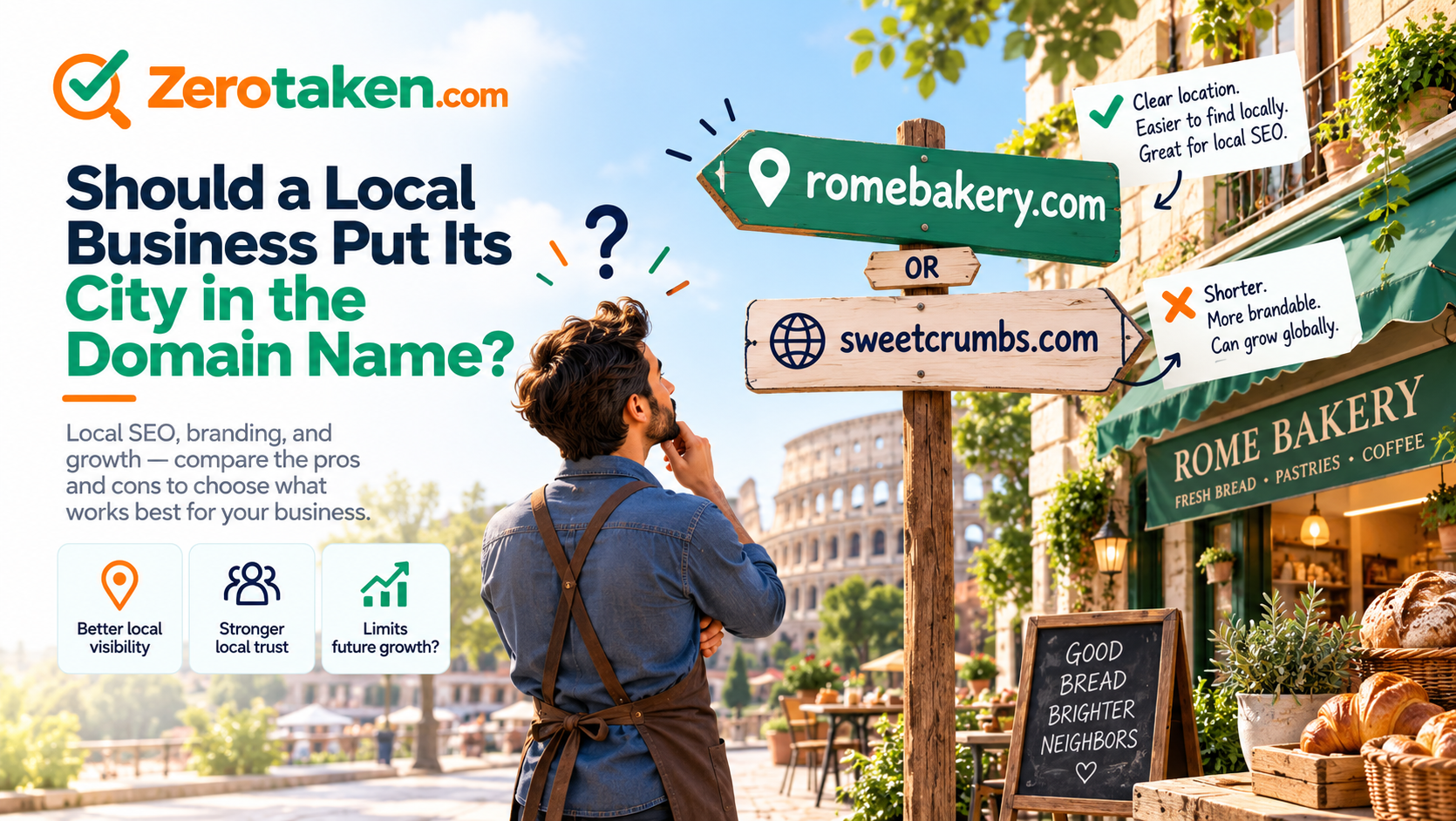
Does having the city in your domain help you rank locally?
Much less than owners assume. Local results are driven mostly by your Google Business Profile, reviews, proximity to the searcher and the relevance of your pages. The words in your domain are a minor, shared signal at best, and Google has spent years discounting exact-match domains that exist purely to match a query.
What a geo-keyword domain does reliably is change how people perceive you. 'austinplumbingpros.com' reads like a lead-generation site, the kind that resells your calls. A name like 'Kettle & Pine' reads like a business. For services where trust decides the sale (dentists, lawyers, contractors), that perception matters more than a marginal keyword signal.
Put the city in the places that actually carry local relevance: your page titles, headings, address block, Business Profile and service-area pages. None of that requires it in the domain.
When is a city-or-service domain actually the right call?
There are three honest cases. Everything else should be a brand name.
- You are a deliberately single-location business with no plan to expand, and the city is part of how customers already say your name (for example, a neighborhood institution everyone calls by its place).
- You are building a local lead-generation or directory site, where the geo-service phrase is the product, not a brand.
- You need a fast, throwaway landing page for a seasonal or one-off service and the cost of rebranding later is close to zero.
Are local extensions like .nyc, .london or .berlin worth it?
Mostly as a secondary asset, rarely as your main address. City and regional extensions exist and some have real local pride, but customers type .com by default, and mobile keyboards and spoken directions both favor it. Every time someone mishears or mistypes your extension, you lose a visit you paid to earn.
The risk is also practical: email addresses on an unfamiliar extension are more likely to be doubted or mistyped, and printed materials, vans and signage freeze whatever you choose. If a local extension is available and cheap, it can make sense as a redirect that points at your main .com, or as a campaign domain for a neighborhood promotion. As the only domain, it is a bet on customer behavior that the evidence does not support.
A country-code extension is a separate question with its own rules. If you only serve one country and your customers expect the local version, see our guide on country-code domains versus .com.
What happens to a geo domain when the business grows?
This is the strongest argument against baking the city in. A business named after Denver that opens in Boulder either looks out of place or rebrands. Changing a domain later means migrating redirects, rebuilding search history, reprinting everything and re-earning reviews' worth of trust, a cost we break down in our guide on changing your domain later.
Services drift too. The 'plumbing' business that adds drain cleaning, water heaters and emergency repair outgrows a name that only says plumbing. A brand name absorbs all of that; a keyword name fights it.
The cheap insurance is to choose a name that works at any size and let location live in the content. You can always add pages for new towns. You cannot cheaply rename a domain.
How do you build a name that still feels local?
Local does not have to mean literal. Strong local brands signal place through tone and context while keeping the name portable.
Pair the brand with the place in your visible copy: a tagline, a footer address, 'Serving the Hudson Valley' on every page. Use a name with a regional reference that stays flexible (a river, a landmark, a local word) rather than a city-plus-service formula. And keep it short and easy to say aloud, because local businesses spend a lot of time giving their website out over the phone and across a counter.
Then run the same checks as any other business: can someone spell it after hearing it once, is it clear of nearby trademarks, and is the matching social handle usable. You can check a shortlist of names and extensions in ZeroTaken before falling in love with any of them.
- Say it out loud to a stranger and see if they type it correctly.
- Check the name against other businesses in your field and region, not just the global web.
- Confirm you can claim the same name on your Google Business Profile, Instagram and Facebook.
- Avoid hyphens and numbers, which fall apart in speech.
Should you buy the geo domain too, as a backup?
Usually not. Defensive buying makes sense when someone could realistically confuse customers or hijack your brand, and a keyword-plus-city variant is rarely that. If a competitor or lead-gen operator registers it, they gain little against a business with real reviews and a recognizable name.
The one exception is a close misspelling or the same name on a neighboring extension, which people will genuinely type by mistake. That is covered in our piece on buying multiple extensions defensively. Spend that money on the brand .com first, and on getting your Business Profile reviews up second.
What's the five-minute decision rule?
Ask three questions. Will you ever add a location, service or product line outside the current words in the name? If yes, use a brand name. Can customers say and spell it correctly after one hearing? If no, simplify. Is the .com available at a normal registration price? If yes, take it and stop shopping.
If the answers send you to a brand .com, put the city in your titles, headings, schema and Business Profile, and let the name do the one job it is good at: being easy to remember and hard to confuse. That combination beats an awkward keyword string in nearly every real-world case.