
.co vs .com: ¿importa realmente la extensión para tu startup?
Tecleaste el nombre de tus sueños en una barra de búsqueda, el .com salió ocupado, y ahí estaba: la misma palabra disponible de par en par en .co. Se parece casi a .com —una letra más corta, limpia, con potencial de marca— y por un segundo sientes que encontraste un vacío legal. Luego se cuela la duda. ¿Los clientes simplemente teclearán .com y terminarán en un competidor? ¿Google lo trata como de segunda clase? ¿Es .co una elección real o una trampa disfrazada de una? Esta guía responde todo eso con datos concretos en lugar del habitual encogimiento de hombros de 'depende': qué es realmente .co, si perjudica al SEO, cuánto cuesta, el único riesgo de comportamiento humano que de verdad importa, y una regla para saber cuándo elegirlo.
Añade ZeroTaken como fuente preferida en Google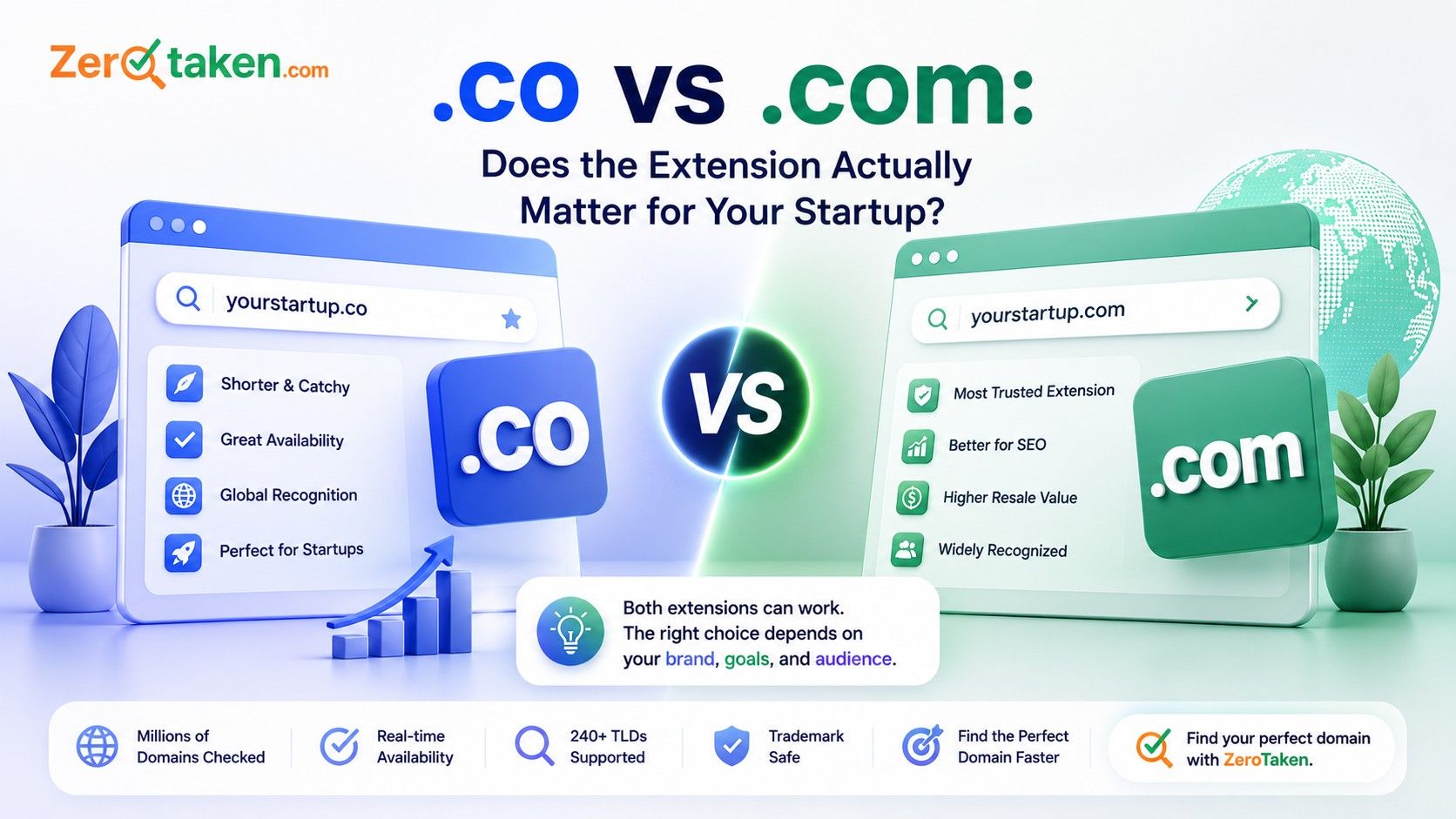
¿Qué representa realmente .co, y quién lo administra?
.co es técnicamente el dominio de código de país para Colombia, pero así no es como el mundo lo usa. En 2010 se relanzó para registro abierto y global, y se comercializó como abreviatura de 'company' (compañía), 'corporation' (corporación), y 'commerce' (comercio) —una alternativa con sabor empresarial a .com para fundadores que llegaron después de que todos los buenos .com ya se habían ido. Ese marketing funcionó en gran medida: hoy .co se lee como una extensión de startup, no como una colombiana, de la misma forma que .io se lee como 'input/output' en lugar de 'Territorio Británico del Océano Índico'.
La conclusión práctica es que .co lleva una vibra específica. Dice 'empresa moderna que no pudo conseguir, o no quiso pagar de más por, el .com'. Para una marca joven de tecnología o de consumo, esa es una señal perfectamente respetable. Para un banco, un bufete de abogados, o cualquier cosa donde el primer instinto de un cliente sea desconfiar de ti, esa misma señal juega en tu contra. Saber en qué grupo estás es la mayor parte de esta decisión.
¿Es .co malo para el SEO comparado con .com?
No. Google ha declarado que trata a .co como un dominio de nivel superior genérico en lugar de bloquearlo geográficamente a Colombia, lo que significa que un sitio en .co puede posicionarse globalmente en igualdad de condiciones que un .com. Las letras después del punto no son un factor de ranking para búsquedas genéricas —la relevancia, los enlaces entrantes, la calidad del contenido, y la velocidad del sitio deciden dónde aterrizas, y a ninguno de esos les importa si estás en .co o en .com.
La única advertencia honesta es sobre las personas, no sobre los algoritmos. En una página de resultados, un .com todavía se lee como marginalmente más 'oficial' para una audiencia general, lo que puede empujar un poco el click-through en búsquedas de consumo. Esa es una brecha de percepción que cierras con una marca fuerte y buenos snippets, no una penalización incorporada en el motor de búsqueda. Si alguien te dice que .co 'no puede posicionarse', está repitiendo un mito de hace una década.
¿Cuánto cuesta un dominio .co comparado con un .com?
Presupuesta aproximadamente 2 a 3 veces el precio de un .com, y vigila la renovación. Un .com estándar cuesta entre 10 y 15 dólares al año en registro y renovación. Un .co usualmente ronda los 25 a 35 dólares al año —pero a los registradores les encanta ofrecer una promoción de primer año (a veces por menos de 10 dólares) en .co y luego renovarlo al precio completo de 30 dólares o más. Siempre lee el precio de renovación, no el precio de etiqueta, porque vas a poseer este nombre durante años, no meses.
Incluso a 3 veces el precio, el costo casi nunca es el verdadero factor decisivo —la brecha es quizás 100 dólares en un horizonte de cinco años, un error de redondeo al lado de los otros costos de una startup. La verdadera compensación es la disponibilidad: el nombre corto de una sola palabra que realmente quieres muy probablemente esté ocupado o cueste cinco cifras en el mercado secundario de .com, mientras que la misma palabra puede seguir disponible a precio estándar en .co. Pagar un poco más para poseer tu marca exacta vence a pagar menos por un compromiso con guion o mal escrito.
¿Los clientes teclearán accidentalmente .com en lugar de .co?
Este es el riesgo real con .co, y es lo único que separa esta decisión de cualquier otro debate de extensiones. Porque .co se ve y suena como un .com recortado, una parte de tu audiencia —especialmente usuarios generales, no técnicos— teclearán .com por pura memoria muscular. Si ese .com pertenece a un competidor, a un okupa de dominios aparcados, o a un corredor, le estás entregando silenciosamente tu tráfico de tecleo directo todos los días.
La advertencia más citada aquí es Overstock, que se rebrandeó como o.co en 2011, invirtió mucho en promocionarlo, y luego dio marcha atrás después de que los ejecutivos dijeran que los clientes seguían tecleando o.com y perdiéndose. Contrasta eso con cómo despliegan .co realmente los usuarios más grandes: t.co (Twitter) y g.co (Google) son acortadores de enlaces detrás de escena, no marcas que se le pida a nadie teclear de memoria. La lección no es 'nunca uses .co' —es 'nunca uses .co como tu marca principal de consumo sin controlar el .com correspondiente'.
Para una herramienta de desarrollador, un producto interno, o una marca B2B cuyos usuarios te alcanzan haciendo clic en enlaces en lugar de teclear desde una valla publicitaria, este riesgo se reduce a casi nada. El problema del tecleo directo solo muerde cuando tu crecimiento depende de que la gente recuerde tu nombre y lo teclee de memoria.
¿Cuándo debería una startup realmente elegir .co sobre .com?
Elige .co cuando tu nombre exacto de una sola palabra esté disponible ahí y el .com esté ocupado o tenga un precio absurdo, y cuando tu audiencia te encuentre a través de enlaces, búsquedas, y tiendas de apps en lugar de teclear tu nombre de memoria. El SaaS en etapa temprana, los productos adyacentes a desarrolladores, las comunidades, y las marcas centradas en enlaces llevan bien el .co, y la disponibilidad de nombres cortos y limpios es dramáticamente mejor que en .com.
Inclínate de vuelta hacia .com cuando tu crecimiento dependa del boca a boca, de la voz, o de una audiencia general que escuchará tu nombre una vez e intentará teclearlo después. Si un cliente no técnico podría decir tu nombre en voz alta y buscar un teclado, teclearán .com por reflejo —y cada suposición incorrecta es tráfico perdido o un golpe a la confianza. Cuando tengas dudas sobre en qué grupo estás, asume el más cauteloso.
- Elige .co: SaaS en etapa temprana, marcas centradas en enlaces y comunidades, productos encontrados a través de búsqueda o tiendas de apps
- Elige .com: apps de consumo, fintech, cualquier cosa vendida por voz, boca a boca, o confianza de mercado masivo
- De cualquier forma: verifica el nombre exacto en ambas extensiones antes de enamorarte de él
¿Listo para comprobar tu nombre en .co y .com?
El peor resultado es comprometerte con un .co, imprimir las tarjetas de presentación, y solo entonces descubrir que el .com correspondiente pertenece a alguien que ahora sabe exactamente cuánto vale para ti. ZeroTaken comprueba .co y .com lado a lado en una sola búsqueda y nunca registra tus consultas, así que puedes poner a prueba docenas de nombres sin filtrar tu mejor idea a un bot del mercado secundario.
¿Deberías simplemente comprar tanto .co como .com?
Si puedes, sí —y es más barato de lo que la mayoría de los fundadores asumen. Poseer tu .co más su .com correspondiente cuesta bien por debajo de 50 dólares al año combinados. Lanzas y comercializas en el que se ajuste a tu audiencia, apuntas el otro hacia él con una redirección, y en un solo movimiento capturas el tráfico de tecleo directo que de otro modo perderías, bloqueas a un okupa de plantar una bandera junto a tu marca, y borras la mayor desventaja de elegir .co en primer lugar.
No necesitas un acaparamiento defensivo extenso a través de una docena de extensiones —eso es dinero desperdiciado para una empresa temprana. La versión disciplinada es un par emparejado: tu extensión principal para el posicionamiento más el .com como la capa de confianza y seguro. Compra los dos, redirige uno, y deja de pensar en ello.
Entonces, ¿cuál es el veredicto sobre .co vs .com?
.co es una elección legítima y moderna —no un premio de consolación— para el tipo correcto de marca: centrada en enlaces, impulsada por búsqueda y tiendas de apps, vendida a personas que te alcanzan haciendo clic en lugar de teclear de memoria. El miedo al SEO es un no-problema, la brecha de precio es trivial, y los buenos nombres cortos todavía están ahí. Su única debilidad real es el impuesto de la confusión con .com sobre el tráfico de tecleo directo, y esa debilidad queda casi por completo neutralizada en el momento en que posees el .com correspondiente.
Así que el error no es elegir .co. El error es elegir .co como tu marca de cara al público mientras el .com queda sin reclamar para que un competidor o un okupa lo agarre. Decide para quién es tu nombre, asegura el par si puedes, y vuelve a construir.