
Can Someone Type Your Domain After Hearing It Once? The Radio Test
You will spend weeks agonizing over whether your name is clever, short, and available — and almost no time on the one moment that decides whether people actually reach you: someone says your domain out loud, and a stranger has to type it from memory. That happens on a podcast, in a hallway at a conference, over a phone call, in a car with no keyboard in sight. If the listener hesitates, guesses wrong, and lands on a parked page or a competitor, every dollar you spent getting your name into that conversation just evaporated. The radio test is the cheapest, fastest filter in naming, it takes ten minutes, and it quietly kills more otherwise-good names than any availability check ever will. Here is how to run it and when it's safe to fail.
Añade ZeroTaken como fuente preferida en Google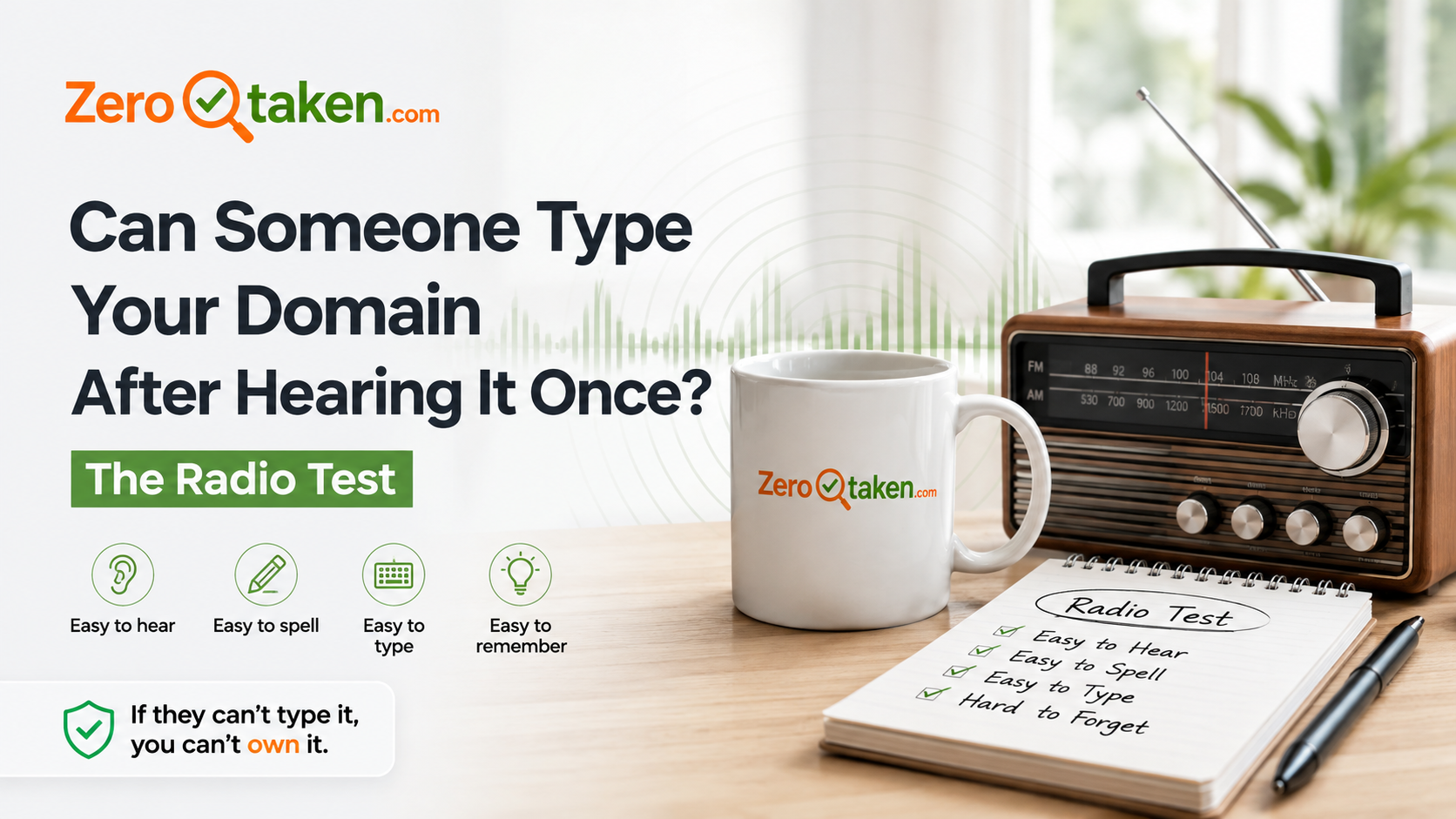
What is the radio test for a domain name?
The radio test is simple: say your full domain out loud, exactly once, to someone who has never seen it written down — and see if they can type it correctly, with no follow-up questions. That's the whole test. No spelling it out, no "that's with two Ns," no showing them a slide. If they get it on the first try, your name passes. If you find yourself adding "...spelled the normal way" or "...like the word but without the E," it fails.
It's called the radio test because radio is the purest version of the problem: audio only, no visual, one pass, and the listener is usually driving or doing something else. But the real-world stakes are broader than radio. Every word-of-mouth referral, every podcast mention, every time a customer tells a friend your name at dinner, is a radio test you don't get to supervise. Your name is going to travel by sound whether you designed for it or not. The test just makes that failure visible before you commit.
Why does say-and-spell matter more than being short or clever?
Because length and cleverness are things you notice; spellability is a tax the world pays without you ever seeing the bill. A name that's one letter too long costs you nothing — people still type it fine. A name that sounds like three different spellings costs you a slice of every single person who ever hears it and doesn't reach the site. You never see those people. There's no error page for "typed a plausible-but-wrong version of your domain and gave up." The loss is invisible, which is exactly why founders underweight it.
This is also where clever backfires. The coined misspelling that looks distinctive on your logo — the dropped vowel, the swapped letter, the number standing in for a word — reads as personality on screen and as an obstacle course out loud. The listener has to hear the sound, guess which of several spellings you chose, and get it right first try. Distinctiveness you can see is an asset. Distinctiveness you can only see is a leak. A plain, spellable name that a stranger nails on the first attempt beats a witty one they fumble every time, and it isn't close.
What actually makes a domain fail the radio test?
The failures are predictable, and once you know the pattern you'll hear them instantly. Most names die on one of a handful of ambiguities — the moment where a sound maps to more than one spelling and the listener has to guess.
Run your name against this list out loud. If any of these apply, you have a spelling fork, and every fork is a place you lose people who heard you clearly and still typed the wrong thing.
- Homophones and number words: 'to / too / two / 2', 'for / four / 4', 'you / u' — the listener can't hear which one you chose.
- Dropped or swapped vowels: 'Flickr vs Flicker', 'Lyft vs Lift' — great logos, but the default spelling is the one people will type.
- Doubled letters you can't hear: 'Dribbble' has three Bs and nobody guesses that from sound.
- Silent letters and unusual spellings: names that use 'ph' for 'f', a silent 'k', or a foreign spelling of a familiar sound.
- Ambiguous word boundaries in compounds: 'penisland' vs 'pen island' — say a two-word name slowly and check it doesn't collapse into something else.
- The extension itself: '.io' is often heard as 'eye-oh' and typed as letters or guessed as '.com'; if you say the domain and not the TLD, people default to '.com' anyway.
How do you actually run the radio test in ten minutes?
Don't rely on your own ear — you already know the spelling, so you can't hear the ambiguity anymore. You need people who don't. Here's a protocol that takes one coffee break and gives you a real answer instead of a hunch.
First, the voicemail version: say your domain into a voice memo the way you'd leave it on a phone message — natural pace, once, no spelling. Send that audio (not text) to three or four people who've never seen the name, and ask them to reply by typing the domain they'd go to. Second, watch where they diverge. One person typing a variant is a coincidence; two people landing on the same wrong spelling is your name telling you which fork it has. Third, do the auto-complete check: type your name into a search bar and into your phone's keyboard — if autocorrect fights you or suggests a more common spelling, so will every phone your customers own.
The bar to clear is unanimous, unassisted, first-try. If three strangers hear it once and all three type the same thing you intended, you have a name that survives contact with the real world. If they scatter, you don't have a name problem you can fix with a better logo — you have a name that will leak traffic forever.
When is it actually fine to fail the radio test?
The radio test matters in proportion to how often your name travels by sound, so there are real cases where you can wave it off. If your entire growth model is paid search, SEO, and links — people arrive by clicking, never by typing from memory — then say-and-spell almost never fires, and you can prioritize distinctiveness instead. A lot of B2B software that grows through content and demos lives here. Nobody is verbally recommending your API gateway at a barbecue.
The other honest exception is when the misspelling is the brand and you're prepared to pay to teach it. Companies with deliberately mangled names didn't get away with it for free — they spent years and marketing budget hammering the spelling into people until the odd version became the expected one. That's a real strategy, but it's a strategy with a bill attached, and it only pays off at a scale most startups never reach. If you're pre-launch and choosing between a name you'd have to teach and one people already spell right, the second one is a discount you'd be crazy to refuse.
Everyone else — anyone hoping for word of mouth, referrals, podcasts, being told to a friend, said in a meeting — should treat a failed radio test as a hard stop, not a nice-to-have. The default, until you have a specific reason otherwise, is: if they can't spell it, don't ship it.
What do you do when your say-able name is already taken?
This is the trap the radio test walks you into: the clean, spellable names are exactly the ones already registered, so passing the test and finding something available feel like opposite goals. They're not — you just have to generate against both filters at once instead of falling in love with a taken name and then mangling it into availability. The mistake is starting from 'the perfect word is gone' and dropping a vowel to free up the domain. You just failed your own radio test to win an availability check.
The better move is to widen the pool while keeping the spellability bar fixed: try natural two-word combinations, a plain prefix or suffix, or an adjacent real word that still says itself — and only keep the candidates a stranger could type on first hearing. Then check availability across those in one pass rather than one at a time. That's the workflow ZeroTaken is built for — describe your idea, get brandable names generated, and see live availability so you can filter for 'spellable and actually free' together instead of trading one for the other.
Whatever tool you use, keep the order right: generate for sound first, check availability second. A name that's available but unspellable isn't a win — it's a permanent, invisible leak you signed up for on day one. Pick the name a stranger can type after hearing it once, and let availability decide between the ones that pass, not the other way around.