
When Should You Actually Buy Your Domain Name?
You have a name you like. The .com is available right now, tonight, for about twelve dollars. And you are hesitating — because you haven't incorporated yet, haven't built anything, haven't decided if this is even the idea. So you close the tab and tell yourself you'll grab it once things are further along. That instinct is the single most expensive habit in early-stage naming, and this guide is about fixing it: when to actually pull the trigger on a domain, why waiting quietly costs you names, whether the 'registrars steal your searches' rumor is real, and when hesitating is genuinely the smart move.
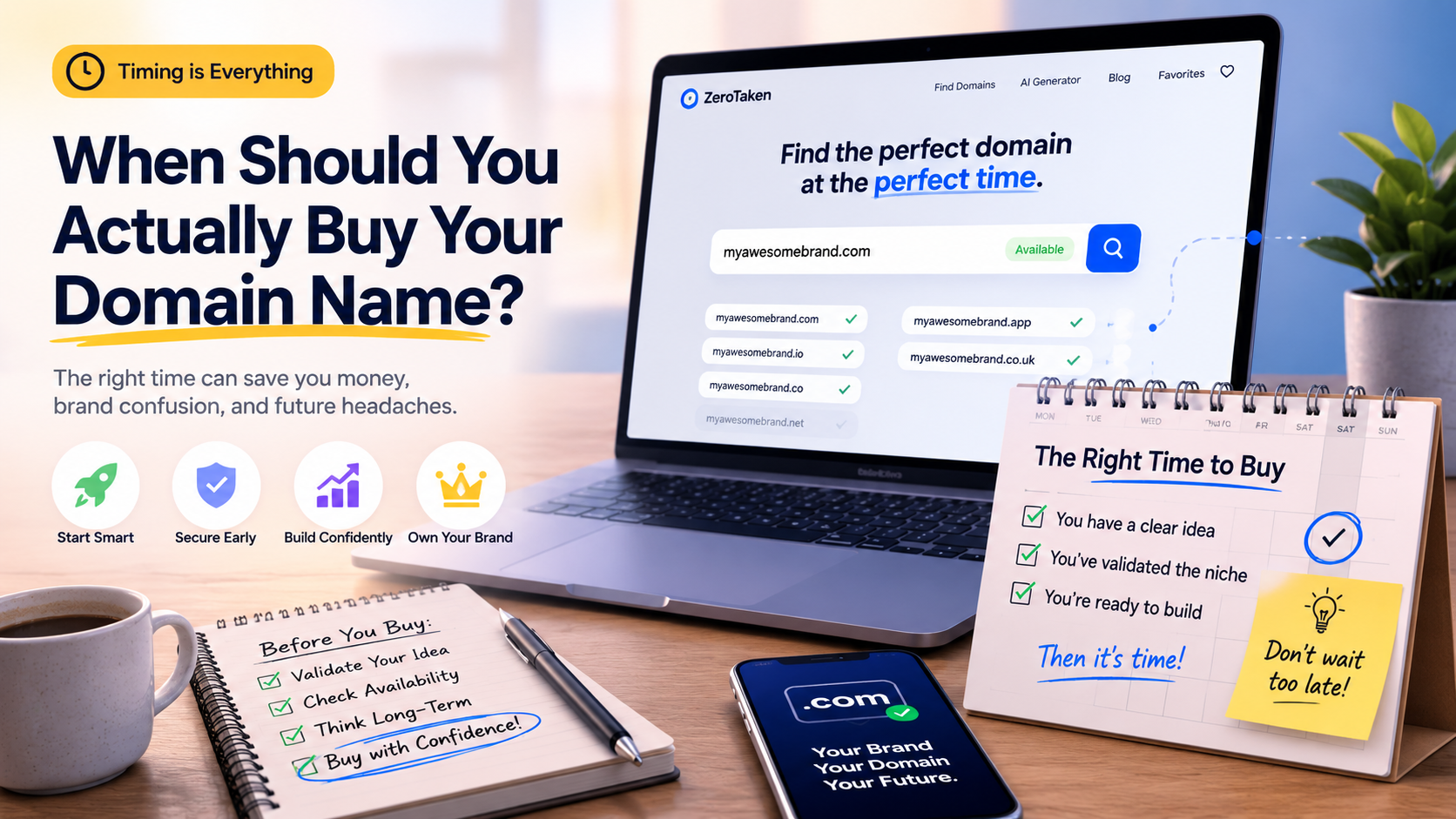
When should you actually buy your domain name?
Buy it the moment it survives your shortlist — the moment you'd be genuinely annoyed to lose it. Not when you incorporate, not when you launch, not when you're finally 'sure.' A domain is the one asset in your entire startup that someone else can permanently take while you deliberate, and it is also the cheapest thing you will ever buy for the company. Put those two facts side by side and the timing answers itself: secure it early, decide slowly.
The trigger is not 'I'm certain this is the business.' It's 'this name made my final two or three, and I'd hate to watch it get taken while I think.' At ten to fifteen dollars a year you can hold a name for the entire length of your deliberation for less than the cost of one lunch. Waiting until you're sure gets the sequence exactly backwards — you buy the cheap insurance first, then take all the time you need to decide whether you'll ever cash it in.
Why does waiting even cost you the name?
The honest reason is not a conspiracy — it's just volume. Hundreds of thousands of domains are registered worldwide every single day, and the short, clean, brandable names are a scarce shared pool that everyone is drawing from at once. Every day your candidate sits unregistered, it is exposed to every other founder, side-project builder, and idea-guy running the same brainstorm you are. You are not racing against a spy who saw your search; you are racing against ordinary demand.
This is why 'I'll buy it when I'm ready' fails so reliably. Readiness takes weeks; the name market moves every morning. Founders come back to a name they loved two weeks ago and find it registered — not because anyone targeted them, but because a good name is a good name to everyone, and one of those everyones simply got there first. The name did not become unavailable because you weren't ready. It became unavailable because it was good and you didn't own it yet.
Do registrars or search tools steal the domains you look up?
This is the fear that makes founders paranoid about even checking availability, so let's put it to rest. The rumor is called 'domain front-running' — the idea that the moment you search a name, the registrar quietly grabs it so it can sell it back to you at a markup. Reputable registrars do not do this today; it would be commercial suicide. The fear traces to a real 2008 episode where one large registrar briefly started 'reserving' searched-but-unregistered domains, framed it as customer protection, drew a wave of backlash, and backed off. That single incident is why the myth still circulates — and why serious tools now go out of their way to promise they never log or resell your searches.
The practical lesson is not 'never check availability' — you have to check, because buying a name blind is far worse. The lesson is to check with a tool that isn't in the business of selling the names it watches you type. ZeroTaken checks availability across extensions in one search and never logs your queries, so you can pressure-test your whole shortlist without wondering who else now knows your best idea. Then, the instant a name clears, buy it at a reputable registrar — don't sit on the open tab.
How much does it really cost to sit on a domain before you launch?
Almost nothing — and that is the entire argument. A standard .com runs about ten to fifteen dollars a year at registration and renewal. If it takes you six months to validate the idea, you have spent maybe seven dollars to guarantee the name is still yours at the finish line. Now price the alternative: the name gets taken, and you are either renaming — new logo, new decks, lost momentum, a confused early audience — or paying an aftermarket broker four or five figures to buy back the exact thing you could have owned for the price of a coffee.
People misprice this because twelve dollars feels like a purchase while losing a name feels abstract until the day it actually happens. Flip the framing: a domain is not a product you're buying, it's an option you're holding. Twelve dollars to keep your favorite name on the table for a full year is the highest-leverage insurance in your early budget. Nothing else you spend money on this early protects this much future value for this little.
Should you buy the domain before you've settled on the exact name?
Yes — once you've narrowed to a real shortlist. Register the one or two front-runners you'd be upset to lose, and let the maybes go. If your top choice has a fork you're genuinely torn on — the .com versus a clean alternative extension, or a version with and without a prefix — buy the pair that actually protects you and drop everything weaker. The goal is to take your finalists off the market, not to own every idea you've ever had in the shower.
Where founders go wrong is the opposite extreme: treating cheap registration as a license to hoard. Forty speculative domains for products you will never build is five hundred dollars a year of renewals and a graveyard of names you'll forget to cancel. Secure the finalists for the idea you are actually pursuing — the handful you'd fight to keep — and stop there. ZeroTaken makes it quick to check a shortlist across extensions in one pass, which is exactly the point: check widely, but buy narrowly.
Does owning the domain actually protect your brand?
Only technically, not legally — and confusing the two is a real trap. Registering a domain gives you the exclusive right to use that exact string as a web address, and nothing beyond that. It does not grant you a trademark, does not stop someone else from trademarking the name and later challenging your right to the domain, and does not reserve the name across other extensions or social platforms. Two unrelated companies can own name.com and name.io at the same time, and neither can force the other off.
So buy the domain early for the reason that genuinely holds — it's a scarce, first-come asset that disappears if you wait. But don't let owning it lull you into thinking the name is locked down. If the name really matters to the business, the domain is step one; a trademark search, and eventually a filing, is a separate and later step that guards against a completely different threat. Owning the domain stops the next founder from taking your address. Only a trademark stops them from taking your name.
When should you not rush to buy a domain?
There are two honest exceptions. First, don't buy a name you haven't sanity-checked for the things that make a name unusable — an existing trademark in your exact industry, a cringe reading when the words smash together, a spelling nobody will get right when you say it out loud. Twelve dollars is cheap, but buying a name you'll have to abandon anyway is still waste, and worse, it hands you a false sense of progress. Do the two-minute checks first, then buy.
Second, don't rush the defensive land-grab. You do not need to buy your name across a dozen extensions the day you register the .com — that's a later, optional move for when you have traction actually worth protecting. Early on, secure the one or two extensions that matter for your brand and stop. 'Buy early' applies to the name you're committing to, not to every hypothetical variation you can imagine at 2 a.m.
So when do you actually buy?
The rule is simple enough to act on tonight: the moment a name clears your shortlist and you'd be genuinely annoyed to lose it, buy it. Not when you incorporate, not when the site is ready, not when you feel 'sure' — because certainty takes weeks and the name market resets every morning. A domain is the rare startup asset that is both trivially cheap and permanently losable, and that combination has exactly one correct response: secure it first, deliberate second.
Waiting feels responsible. It isn't. The responsible move is to spend the twelve dollars, take the name off the table for everyone else, and then take all the time you need to decide whether it's the one. The founders who lose their favorite name almost never lost it to a competitor or a spy — they lost it to their own hesitation.