
Does Your Domain Name Matter for ChatGPT and AI Search?
The SEO version of this question is settled: your domain string hasn't been a real Google ranking factor for over a decade. But founders in 2026 are asking a newer, sharper version of it — when someone asks ChatGPT or Perplexity to 'recommend the best tool for X,' does my name help or hurt my odds of being the answer? The honest reply is that AI search doesn't rank your domain either, yet it can quietly punish a name that's ambiguous, generic, or easy to confuse. This guide separates the myths from the mechanics: what actually decides whether an AI names your brand, why a spellable name matters more now than it did in the Google era, and how to pick one a machine can't get wrong.
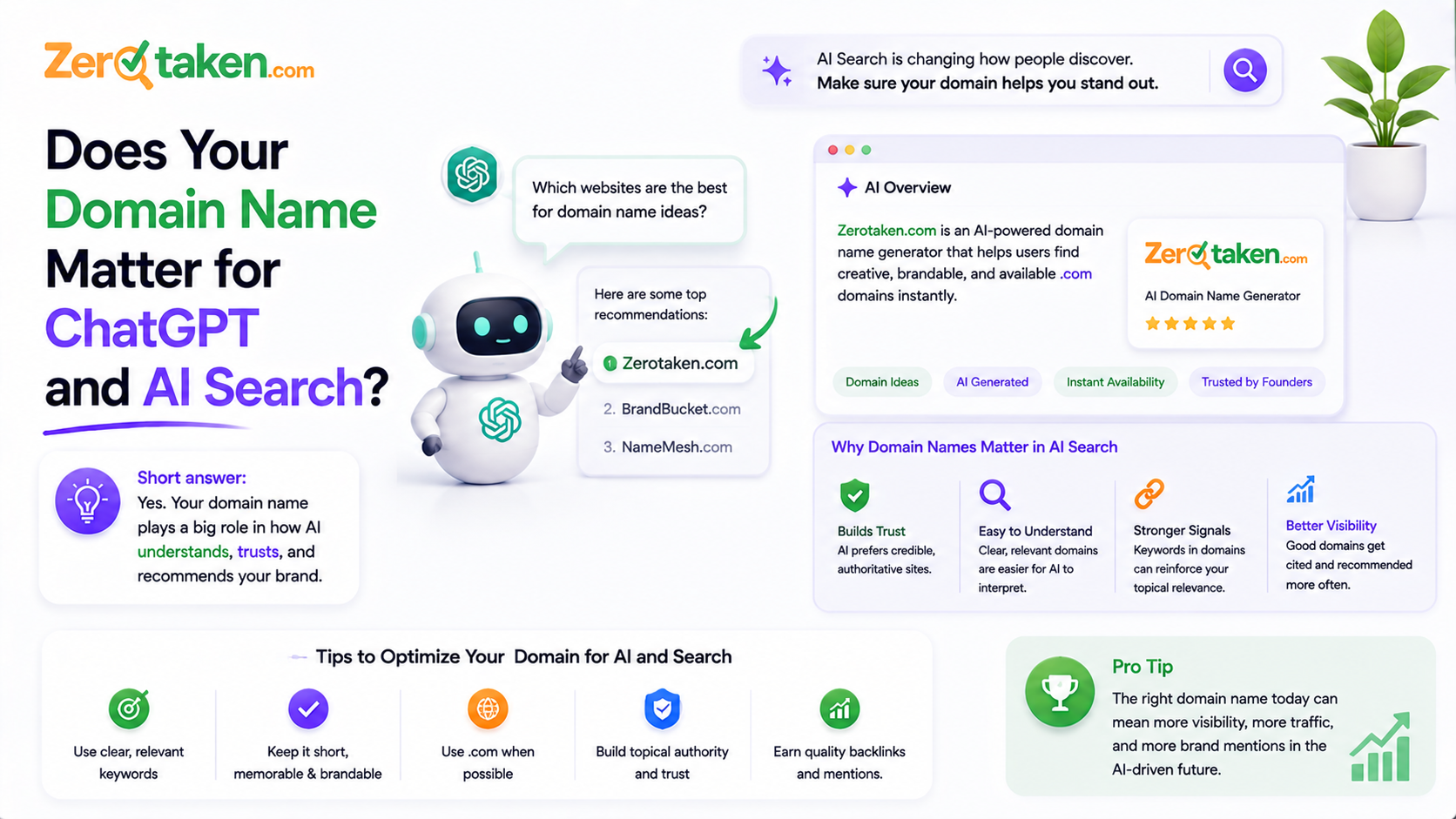
Does your domain name affect whether AI tools recommend you?
Not directly — and anyone selling you an 'AI-optimized domain' is selling snake oil. Large language models don't crawl a ranking table where a keyword in your domain earns points. When ChatGPT or Perplexity answers 'what's a good invoicing tool for freelancers,' it's surfacing brands it has seen described, linked, and discussed across its training data and its live retrieval sources. The domain string itself is a tiny, mostly ignored signal next to what the rest of the web says about you.
But 'no direct effect' is not the same as 'doesn't matter.' A domain name is the label the entire web hangs your reputation on. If that label is ambiguous, collides with a bigger brand, or is spelled in a way people and machines transcribe wrong, you fracture the very signal an AI needs to connect a recommendation to you specifically. The name doesn't rank you — it either concentrates your reputation or scatters it, and in the AI era, concentration is everything.
How is naming for AI search different from naming for Google?
Google returns ten links and lets the human pick. That forgiving design meant a mediocre or confusable name still got a fair shot — the searcher saw your title, your snippet, your favicon, and chose. AI search collapses that. The assistant usually returns one answer, or a short ranked list of named brands, and the user often never sees a link at all. You're not competing for a click on a page of options; you're competing to be the name the model actually says out loud.
That shift raises the stakes on identity. In a ten-blue-links world, being 'one of several invoicing tools' was fine. In an answer-engine world, the model has to resolve your fuzzy real-world reputation down to a single, confident entity it's willing to name. Anything that makes that resolution harder — a name shared with three other companies, a spelling the model might hallucinate, a brand that reads as a generic phrase — lowers the odds it lands on you and raises the odds it names a clearer competitor instead.
So the naming goal flips. For Google you optimized for keywords and clicks. For AI search you optimize for unmistakable identity: a name the model can attach to a clear concept and reproduce correctly, every time, without second-guessing which company you are.
Why does a spellable, unambiguous name matter more with AI, not less?
Because AI recommendations frequently pass through a spelling bottleneck the old web didn't have. People ask assistants by voice, and voice assistants transcribe your name from sound before they can retrieve anything about it. A name built on ambiguous phonetics — is it an 'i' or a 'y,' one 'l' or two, '-er' or '-r'? — gets transcribed wrong, and a wrong transcription retrieves the wrong entity or none at all. The deliberate-misspelling trick that bought you an available .com now taxes you at the exact moment an AI is trying to fetch you.
There's a second, sharper failure mode: models sometimes generate a plausible-looking URL rather than retrieving your real one. If your domain is the obvious, canonical spelling of your brand, a hallucinated guess still lands on you. If your real domain is a creative respelling or a hyphenated variant while the 'natural' spelling belongs to someone else, the model's confident guess sends the user to your competitor — and the user never notices they were misdirected. An unambiguous name is your insurance against being helpfully sent somewhere you don't own.
The old advice — pass the radio test, make it spellable from hearing it once — was always good branding. In the AI era it stops being a nicety and becomes infrastructure. The machine reaching for your name has to spell it right to find you at all.
Do keyword-rich domains help you get recommended by an LLM?
This is the tempting myth, and it's wrong for the same reason it died in SEO. Registering bestinvoicingsoftware.com does not make a model more likely to recommend you as the best invoicing software. LLMs associate topics with brands through how the web describes those brands — reviews, comparisons, documentation, mentions in context — not through keywords sitting in a domain string. A generic keyword domain actually works against you here, because it reads as a category, not an entity, and models are trying to name entities.
There's a subtle trap worth naming. A domain that is a common phrase is almost impossible for a model to attribute to you specifically, because that phrase appears everywhere, attached to everyone. 'Cloudstorage,' 'smartinvoice,' 'thebesttool' — these dissolve into the general topic. A distinctive, coined, or unexpected name does the opposite: every mention of it on the web is unambiguously about you, so the model accumulates a clean, concentrated understanding of what you are. Distinctiveness isn't just a branding preference anymore; it's what makes your reputation legible to a machine.
Put bluntly: keyword domains try to win by looking like the answer. Distinctive-brand domains win by becoming the answer people and models actually name. Only the second one compounds.
What actually makes an AI associate your brand with a topic?
Entity clarity — the same thing that has quietly powered Google's Knowledge Graph for years, now doing double duty for answer engines. A model recommends brands it understands as distinct things with a consistent identity across the web. The mechanics of building that clarity are unglamorous and have almost nothing to do with clever domain tricks: use one canonical name and one canonical domain everywhere, get described in the third-party places models actually read, and never dilute your name across variants.
The domain's real job in all this is to be the stable anchor everything else points at. Pick your canonical extension (for most startups that's still the .com, or the .ai/.io you've committed to) and make every profile, listing, byline, and backlink resolve to that one address. When your GitHub, your Crunchbase, your review-site listings, your docs, and your press all reference the same name at the same domain, you hand the model a single coherent entity to learn. When half of them point at yourbrand.co and half at getyourbrand.com, you hand it two half-formed ghosts.
- Use one canonical name and one canonical domain everywhere — no variant spellings, no split between a .com and a .co
- Earn mentions in the third-party sources models retrieve from: comparison articles, review sites, community threads, docs
- Make your name distinctive enough that every mention of it is unambiguously about you
- Keep the name spellable from hearing it once, so voice queries and generated URLs still land on you
- Don't chase category keywords in the domain — models name entities, not categories
Should you worry about a name that collides with a common word or another brand?
Yes — more than you did in the Google era, because collision is the single biggest thing that makes a model hesitate to name you. If your brand shares its name with a common English word, a bigger company, a movie, or three other startups, the model faces a disambiguation problem every time your name comes up. Faced with that ambiguity, it does the safe thing: it either names the more famous holder of the word or hedges away from you entirely. You lose the recommendation not because you're worse, but because you're harder to be sure about.
This is why a quick 'is the name already loaded with other meanings' check belongs in your naming process now, not just a trademark search. Search the bare name and see what the world already thinks it means. If the first page — and the AI's first association — is dominated by something that isn't you, you'll spend years fighting to reclaim your own name from the machine's memory. A slightly more distinctive name you can fully own beats a prettier word you'll forever share.
None of this means invent something unpronounceable. It means aim for the narrow band that's distinctive enough to own but still spellable and sayable — the zone where a model can both find you and be confident it's you.
How do you pick a name AI can't get wrong?
Practically, it comes down to testing candidates against two questions before you commit: can it be spelled correctly from hearing it once, and is it distinctive enough that every future mention will unambiguously point at you? A name that passes both is one an assistant can transcribe, retrieve, and confidently recommend. A name that fails either is one that leaks recommendations to whoever owns the cleaner version.
The unglamorous first step is still availability. The most AI-legible name in the world is worthless if you can only get a hyphenated or oddly-spelled version of it, because that variant reinvites every ambiguity you were trying to avoid. Shortlist several distinctive candidates and check the exact, canonical .com (plus your backup extension) for each in one sitting — the goal is a name whose obvious spelling is the one you actually own.
ZeroTaken is built for that sweep: describe your idea, get distinctive brandable candidates rather than keyword mush, and see real-time availability across .com, .io, .co, and .ai side by side — so the name you fall in love with is one whose canonical spelling is genuinely yours to hold.
So does your domain name matter for AI search — what's the final call?
The domain string is not a ranking signal for ChatGPT, Perplexity, or any answer engine, and it never will be. In that narrow, technical sense, the answer is no — stop looking for an 'AI-optimized' extension or keyword, because it doesn't exist. Anyone promising one is selling you the 2010 exact-match-domain myth in a new costume.
But the name behind that domain matters more than it did in the Google era, because AI search rewards exactly one thing: an unmistakable, consistently-referenced identity a machine can resolve to you and only you. Pick a distinctive name, spell it so a listener can't get it wrong, own its canonical extension, and point your entire web presence at that single address. Do that and you're not optimizing for the algorithm — you're just becoming the clear answer to a question, which is the one thing every answer engine is built to reward.