
Should You Use Your Own Name as Your Domain?
It is the most tempting shortcut in naming: you can't think of a brand, so you just register yourname.com and start building. No brainstorming, no availability roulette, no trademark worry — it's your name, and nobody can argue you don't own it. For a portfolio, a freelance shingle, or a personal blog, that instinct is exactly right. But the same choice that feels safe for a solo consultant can quietly wall in a product that was supposed to grow past you — the day you want to hire, sell, or raise, a domain with your name on the door starts working against you. This guide draws the line clearly: when your own name is the smartest domain you can pick, when it's a trap dressed up as convenience, and what your real options are when the .com of your name is already gone.
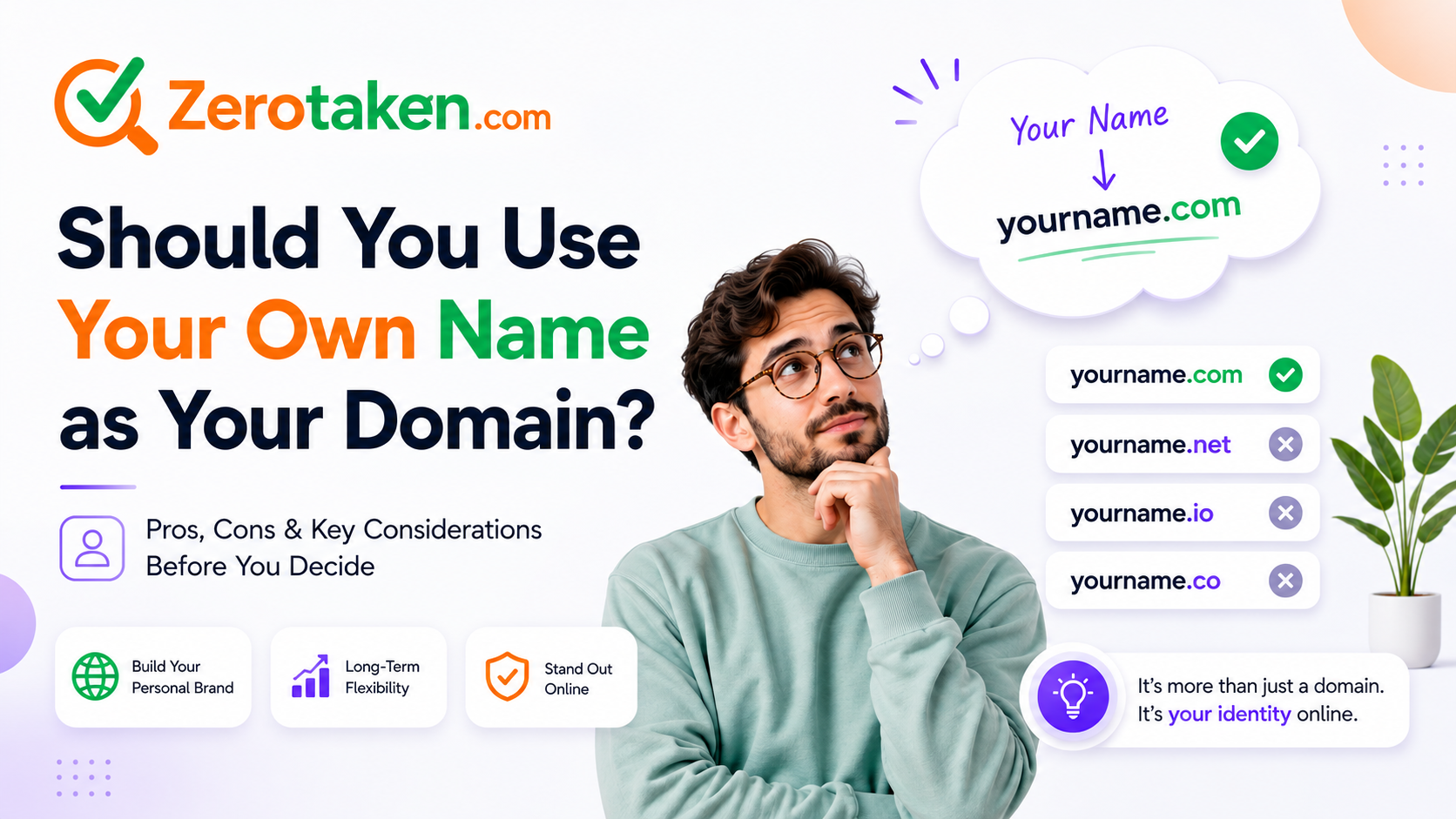
When does using your own name as your domain actually make sense?
Use your name when you are the product. If people hire, follow, or read you — not a company — then your name is the brand, and yourname.com is the strongest domain you can own. Consultants, freelancers, coaches, authors, designers, solo developers, creators, angel investors, and anyone building a personal reputation all fall here. The domain says the thing your prospect most wants confirmed: this is really them, and there is a real person accountable behind the work.
It also wins on the boring-but-real axes. It never goes stale — you can pivot from writing to consulting to launching a product and the domain still fits, because you are the constant. It is trivially memorable to anyone who already knows you, which is most of how a personal brand actually spreads. And it sidesteps the entire availability grind: you skip the naming spreadsheet and the fifty taken .coms, because there is only one name you're checking.
When is your name the wrong choice for a domain?
Use a brand name — not yours — when the thing you're building is meant to outlive or outgrow you. A software product, a startup that will raise money, anything you might one day sell, and anything you want a team to rally behind all need a name that isn't tied to a single human. The tell is simple: if the sentence 'we're hiring a team to run this' sounds normal, your personal name on the domain will start to feel wrong the moment that team exists.
There are quieter costs too. A personal-name domain makes it awkward to bring on a co-founder who now works under your surname. It confuses customers about whether they're buying a product or booking you personally. And it leaks your identity into your WHOIS records and marketing in a way some founders would rather keep separate from a commercial venture. None of these matter for a freelancer. All of them matter for a company.
The cleanest test is the exit question: could you ever want to hand this off — sell it, spin it out, or walk away while it keeps running? If yes, don't stamp your name on the front door.
What happens to a personal-name domain if you want to sell or raise money?
It gets complicated fast, and that complication has a price. An acquirer buying yourname.com is buying a domain that is literally your identity — they'll want it transferred cleanly, but the name still reads as 'the founder's personal site,' which weakens the asset and invites awkward negotiations about your ongoing involvement. Investors notice the same signal: a personal-name domain can read as a lifestyle project or a solo hustle rather than a company built to scale without its founder.
This is the part founders underestimate because it lives in the future. On day one, yourname.com is free of friction and yours forever. On the day a term sheet or an acquisition offer lands, it becomes a thing to untangle. Migrating a brand off a personal domain after you have traffic, backlinks, email history, and printed materials is real work and real SEO risk — far more expensive than the ten minutes it would have taken to pick a company name up front.
The practical rule: if there is any realistic path where this becomes a company with outside money or an exit, buy a separate brand domain now and keep yourname.com as your personal home. Owning both is cheap. Rebranding under pressure is not.
Your exact name is taken — what are your real options?
Common names get claimed early, so firstlast.com being gone is the default, not the exception. Before you settle for something clumsy, work through the ladder in order — the goal is a name a stranger can hear once and type correctly, and most of these clear that bar.
Start at the top and stop at the first option that stays easy to spell out loud. Avoid the bottom of any registrar's suggestion list — hyphenated or number-padded versions of your name (john-smith-77) read as spammy and get typed wrong every time.
- Add your middle name or initial: the johnqsmith version is often still open when plain johnsmith is long gone
- Use first initial + last name, or first name + last initial: jsmith / johns variants
- Add what you do: johnsmithdesign.com, johnsmithwrites.com, hey-johnsmith style greetings
- Move to a personal-friendly extension: .me, .dev (great for developers), .design, .co, .io, or your country code
- Use the handle you already own everywhere else, so your domain matches your social identity
Does a personal-name domain hurt you in search or with trademarks?
Search is a non-issue — Google ranks a personal-name domain on the same footing as any other, judging content, links, and relevance, not whose name is in the URL. The only friction is competition for your own name: if you share it with a famous namesake or a hundred other professionals, ranking first for '[your name]' takes the same content and links any competitive term would. That's a marketing reality, not a penalty.
Trademarks are where a personal name is genuinely weaker. Personal names are hard to protect as trademarks unless they've acquired real commercial distinctiveness, which means a personal-name brand gives you less legal ground to stand on if a namesake or a copycat shows up. It cuts both ways: you also can't easily stop someone who legitimately shares your name from using it. If defensible brand protection matters to what you're building, that's another vote for a distinct, coined brand name over your own.
Ready to check whether your name is free across extensions?
Before you commit to any version of your name, check the whole set at once — the .com, the personal-friendly extensions like .me and .dev, and the middle-initial fallbacks — so you're choosing from what's actually available instead of discovering the good option was free all along after you settled. ZeroTaken checks your name across extensions in a single search and never logs your queries, so you can test every variant without a registrar bot watching which ones you like.
Should you buy your name as a domain even if you won't use it yet?
Yes — this is one of the few defensive registrations genuinely worth the money. yourname.com is cheap insurance against a future where a namesake, a recruiter-bait site, or a squatter owns the first result for your name. For anyone who might ever job-hunt, freelance, publish, or raise their profile, controlling the search result for your own name is worth roughly a coffee a year, and the version you'd want is only getting scarcer.
You don't need a sprawling land grab across a dozen extensions — that's wasted money. Buy the .com if it's there, add the one alternate that fits your field (a developer's .dev, a designer's .design), point them at whatever you have now — even a LinkedIn or a one-page bio — and set auto-renew so a lapsed card never hands your name to a stranger. That's the whole disciplined version: own your name, park it, forget about it until you need it.
So what's the verdict — use your name or not?
Use your name when you are the thing being sold — freelance, consulting, creative, and personal-brand work all belong on yourname.com, and trying to hide behind an invented brand there just adds a layer between you and the trust you're trying to build. Use a separate brand name the moment you're building something meant to grow a team, take investment, or one day run without you; stamping your name on a company you might sell is the single most common naming regret founders describe.
When you're unsure which one you're building, do both: register yourname.com as your permanent personal home, and give the venture its own brand domain so it can grow up and move out on its own. The two together cost less than a single month of almost any other startup expense — and picking right up front is far cheaper than migrating a brand off your own name after the traffic, the backlinks, and the business cards already point there.