← All posts
SEO6 min readBy ZeroTaken Author

Do Domain Names Still Affect SEO in 2026? An Honest Answer

Founders agonize over whether their domain needs a keyword in it, whether .com beats .io for rankings, and whether the perfect name is worth losing a search-friendly one. Most of that worry is a decade out of date. The short version: your domain is a weak, mostly indirect SEO signal, and trying to game rankings with it usually backfires. This is a straight answer on what domains do and don't do for search in 2026 — including AI search — so you can stop optimizing for a factor that barely moves and start optimizing for the ones that do.

Do Domain Names Still Affect SEO in 2026? An Honest Answer

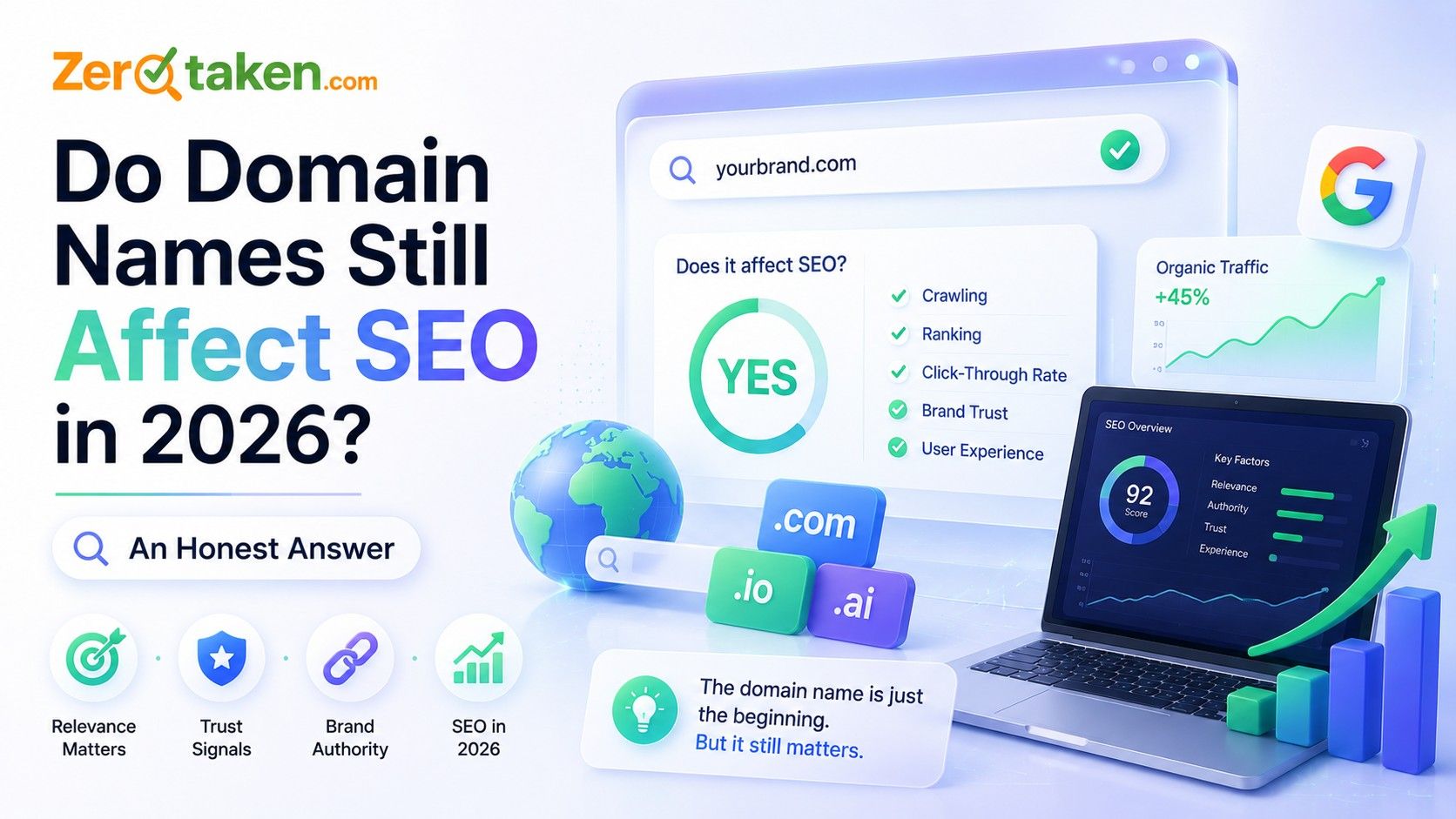
Do domain names still affect SEO in 2026?

Directly? Barely. Indirectly? A little. The domain itself is not a meaningful ranking lever the way it was in 2010, when stuffing your target keyword into the domain could float a thin site to page one. Google spent years deliberately draining that power out of the algorithm, and it succeeded.

What still matters is second-order: a domain people trust and remember gets clicked more, linked to more, and searched by name more — and those behaviors feed signals Google does care about. So the domain is a lever on your brand, and your brand is a lever on SEO. Optimizing the domain directly for keywords is optimizing the wrong end of that chain.

What happened to exact-match domains?

In September 2012, Google shipped the Exact Match Domain (EMD) update, which stripped the ranking advantage from low-quality sites that ranked mainly because their domain matched the search query — think buycheapinsuranceonline.com. Overnight, a huge category of keyword-in-domain plays lost their edge.

That update didn't ban keyword domains; it just stopped rewarding the domain for its own sake. A genuinely good site on an exact-match domain still ranks fine — because of the site, not the URL. The takeaway is that a keyword in your domain is no longer a shortcut, and building a brand around a generic keyword phrase now costs you distinctiveness for a ranking benefit that no longer exists.

Does putting a keyword in your domain still help at all?

The direct ranking boost is effectively zero — Google's own search advocates have said for years that keywords in the domain don't give you a ranking bump. There are two thin indirect effects, and they cut both ways.

On the plus side, an exact-match or partial-match domain can nudge click-through when the query and the domain visibly line up, and it gives you keyword-rich anchor text when people link using your bare URL. On the minus side, a keyword domain reads as generic and less trustworthy, which can suppress clicks and makes you nearly impossible to distinguish from competitors on the same phrase. For almost every real business, the branding cost outweighs the microscopic SEO upside.

Which domain-related factors actually move rankings?

The signals that genuinely matter are about trust and behavior, not string-matching. None of them require a keyword in your name:

  • Branded search volume — people typing your name into Google is one of the strongest brand signals there is, and a memorable domain is what makes that name sticky.
  • Click-through rate from the results page — a clean, credible-looking domain earns more clicks than a hyphenated or spammy-looking one for the same position.
  • Backlinks and mentions — earned by the content and the brand, not the URL, but a name people can spell and say out loud gets cited correctly more often.
  • HTTPS — a genuine, if lightweight, ranking signal since 2014; it's table stakes now, not a differentiator.
  • A clean history — an aged or dropped domain can carry old spam penalties or toxic backlinks. If you buy an expired domain, check its history before you build on it.

Does your TLD — .com vs .io vs .xyz — affect rankings?

Not directly. Google has stated repeatedly that new generic TLDs (.io, .app, .dev, .xyz, and the rest) are treated the same as .com for ranking purposes. There is no algorithmic penalty for a non-.com extension and no bonus for a .com. A site on .xyz can and does outrank .com competitors every day.

The one real exception is country-code TLDs. A ccTLD like .de or .co.uk sends a geotargeting signal that tells Google the site is aimed at that country — useful if you're local, limiting if you're global. (A handful of ccTLDs like .io and .co are treated as generic by Google and carry no geo signal.)

Where extension choice actually bites is trust and click-through, which are indirect. Users still associate .com with legitimacy, so an unfamiliar extension can cost you a few clicks — not because Google downranks it, but because a human hesitated. That's a branding and conversion consideration, not a ranking one.

How do domains affect discovery in AI search and LLMs?

This is the part that's genuinely new in 2026. A growing share of discovery happens inside AI answers — chat assistants, AI overviews, and LLM-powered search — where the classic ten blue links never appear. In that world, being mentioned by name matters more than ranking for a keyword.

AI systems surface brands they can recognize as distinct entities. A clear, brandable, unambiguous domain helps in three concrete ways: it's easier for a model to associate with your content, easier for a user to recall and type after they hear it in an AI answer, and less likely to be confused with a competitor on a generic phrase. A keyword-blob domain does the opposite — it blends into the category instead of standing out from it. If anything, the shift toward AI discovery raises the value of a distinctive name and lowers the value of a keyword-matched one.

What should you actually optimize your domain for?

Optimize for memory and trust, not for keywords. A name that's easy to say, spell, and remember will do more for your long-term search performance — through branded search, direct traffic, and correct citations — than any keyword ever could. Practical rules of thumb:

Brainstorm Your Domain Name with ZeroTaken

Describe your startup, SaaS, web app, or business idea, and let our AI brainstorm memorable, brandable name ideas and instantly check live availability.

Try AI Domain Generator
  • Pick a short, brandable, easy-to-spell name over a keyword-stuffed one — distinctiveness beats descriptiveness.
  • Prefer .com when you can get it, for trust and click-through; a solid alternative like .io, .co, or .ai is fine and won't hurt rankings.
  • Avoid hyphens and numbers — they read as spammy, get misheard, and quietly depress clicks.
  • Keep it pronounceable: if you can't say it cleanly out loud, it won't survive word-of-mouth or an AI voice answer.
  • Check the history of any pre-owned or expired domain before committing, so you don't inherit someone else's penalties.

So should SEO drive your domain choice at all?

No — and treating it as an SEO decision is the mistake. The domain's real job is to be a brand asset that's memorable and trustworthy; do that well and the indirect SEO benefits follow on their own. Chase a keyword instead and you trade a distinctive brand for a ranking edge that Google removed over a decade ago.

So free yourself from the keyword constraint and pick the name you'd be proud to say on a podcast. When you're ready to find one that's actually available, ZeroTaken generates brandable options and live-checks availability across .com, .io, .ai and more — so you can choose for brand, not for a search factor that no longer moves.