
Brandable vs Keyword Domains: Which Should Your Startup Pick?
You hit this fork the second you start naming a company: do you buy meaning.com — the literal keyword for what you do — or do you invent something like Stripe, Notion, or Figma that means nothing until you make it mean something? One camp swears keyword domains sell themselves; the other says every enduring brand is a made-up word. Most advice on this splits the difference and tells you "it depends," which helps nobody. This guide takes a side. Here is what a keyword domain actually gets you in 2026, why the SEO argument for it has quietly collapsed, when it still genuinely wins, and the rule I'd use to decide.
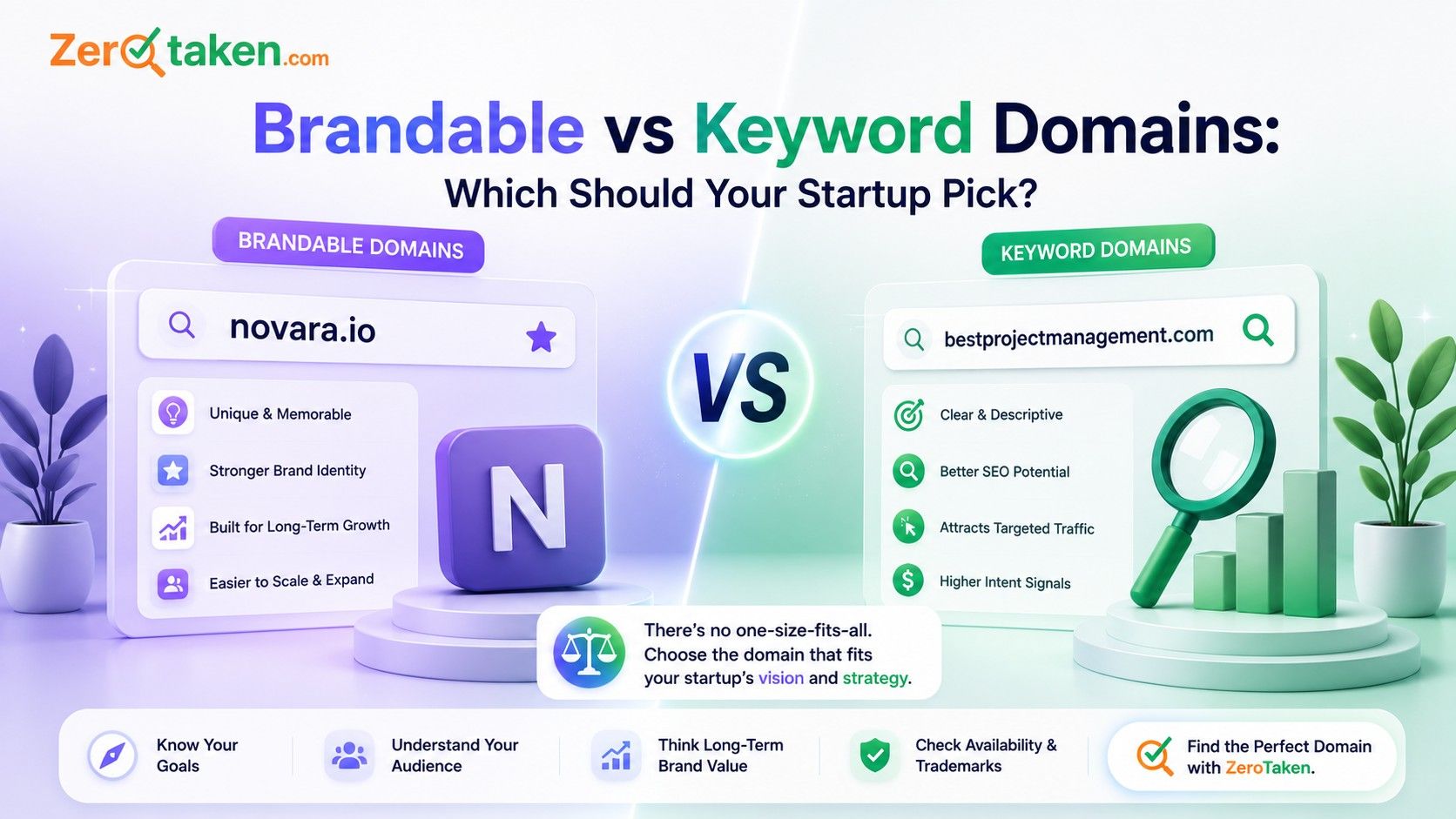
What's the real difference between a brandable and a keyword domain?
A keyword domain describes what you do in plain words: bestcheapflights.com, dallasplumber.com, emailmarketing.io. Someone reading it knows your category before they click. A brandable domain is a coined or evocative word that carries no literal meaning on day one — Stripe, Notion, Figma, Vercel, Klarna — and becomes valuable only after you attach a product to it. The keyword domain rents meaning it didn't build; the brandable domain builds meaning it will own.
That distinction matters more than it looks. A keyword domain is doing marketing for a category, and a category is something anyone can enter. A brandable domain is doing marketing for you specifically, and nobody else can be you. When founders pick keyword domains, they're usually optimizing for the first click from a stranger. When they pick brandable ones, they're optimizing for the tenth mention from a customer. Those are different games, and most startups are playing the second one whether they realize it or not.
Do keyword domains still help you rank on Google?
Barely, and not the way people think. There was a real era — roughly 2005 to 2012 — when owning creditcards.com or carinsurance.com was a genuine ranking cheat code. Google leaned on the words in the domain as a relevance signal, and exact-match domains (EMDs) shot to page one on the strength of their name alone. That era is over. Google shipped an explicit EMD update in 2012 to demote low-quality exact-match sites, and every core update since has pushed ranking weight toward content depth, backlinks, page experience, and demonstrated expertise.
So no, a keyword in your domain is not going to carry you anymore — the words on your pages and the sites linking to you do that work now. What a keyword domain still gives you is a small, human nudge: in a crowded search results page, seeing your literal query in the URL can lift click-through a little. That's a conversion-rate effect on people already looking, not a ranking effect that puts you in front of them. Don't buy a keyword domain expecting free rankings. That check bounced a decade ago.
Which one do people actually remember?
Brandable names win memory, and memory is the whole game once you're past your first hundred customers. A generic phrase slides off the brain because it's already occupied by the category — say "cheap flights" to someone and they think of the concept, not your company. A distinctive coined word has nowhere else to live in their head, so it sticks to you. This is why the companies you can name from memory are almost all invented words, and why the keyword domains you've used are ones you re-Google every time instead of typing directly.
There's a defensive angle too. You cannot trademark a purely descriptive term — "best email marketing" is a description, not a mark — which means a keyword domain often can't be protected, and competitors can legally crowd right up against it with near-identical names. A brandable, coined word is exactly the kind of distinctive mark trademark law was built to protect. So the brandable name isn't just easier to remember; it's the only one of the two you can actually fence off and defend as you grow.
When does a keyword domain still win?
It genuinely wins in a few honest cases, and pretending otherwise would be dishonest. The clearest is local and service SEO with low brand ambition: if you're a plumber, a locksmith, or a dentist competing on "[service] [city]" searches, a name like austinemergencyplumber.com does real work, because your buyers search by need, not by brand, and they'll never say your name at a party anyway. The domain is the whole marketing plan, and that's fine.
The other case is a fast, unglamorous affiliate or lead-gen play where you're monetizing search intent rather than building an asset you'll sell in ten years. If the entire strategy is to rank a thin site for a commercial phrase and collect clicks, matching the phrase in the domain squeezes out a bit more CTR and costs you nothing in brand equity you were never going to build. Just be clear-eyed that you're building a traffic machine, not a company — and that machines like that are the ones Google's updates target most often.
When should you go brandable?
Almost every time you intend to build something that lasts. If you're raising money, hiring a team, or planning to still be around when the category shifts under you, you want a name you own outright — legally, phonetically, and in your customers' memory. Venture-scale companies are brandable by default because a coined word gives you room to expand: Amazon wasn't stuck selling books, and Stripe wasn't boxed into a single payment method, precisely because their names never described a narrow thing.
A brandable name also ages better through pivots. A keyword domain locks you into the keyword — the day your emailtool.com company becomes a full CRM, the name is actively lying about what you do. A coined word carries you across that transition without a rebrand, a domain migration, or the SEO bloodbath that comes with both.
- Go brandable: funded startups, consumer apps, anything you'll trademark, anything that might pivot
- Go keyword: local service SEO, single-purpose lead-gen, thin affiliate sites you won't grow
- Either way, secure the matching .com before you commit — reflex still routes there
What about a hybrid — a brandable name with a keyword baked in?
This is the underrated middle path, and for a lot of B2B startups it's the smart one. A hybrid takes a real, meaningful root and twists it into something coinable and ownable: Shopify (shop + -ify), Mailchimp (mail + a memorable animal), Contentful (content + -ful), Zendesk (zen + desk). You get a whiff of what the product does and a distinctive, trademarkable, memorable word — the hint of a keyword without surrendering the brand.
The trap to avoid is the fake hybrid that's really just a keyword phrase wearing a costume — getbestemailapp.com or theemailtool.io. Bolting "get," "try," "app," or "the" onto a generic phrase doesn't make it brandable; it makes it forgettable and unownable at once, the worst of both. A real hybrid is one word that could plausibly be a made-up brand. If your candidate reads as a sentence, it's a keyword domain in disguise, and you should either commit to a true keyword play or invent something cleaner.
Ready to find a name that isn't taken?
The reason this debate feels so hard is availability: the perfect keyword .com sold years ago, and most "obvious" brandable words are gone too, so founders settle for a hyphenated, misspelled, or wrong-extension compromise out of exhaustion. That's a search problem, not a strategy problem. ZeroTaken generates brandable and hybrid candidates from a plain description of your idea and checks them live across .com, .io, .ai, and .co in one pass, so you can see what's actually free before you fall in love with a name you can't have.
Brainstorm Your Domain Name with ZeroTaken
Describe your startup, SaaS, web app, or business idea, and let our AI brainstorm memorable, brandable name ideas and instantly check live availability.
Try AI Domain GeneratorSo which should you pick?
Default to brandable, and treat keyword domains as a specialized tool for a specific job. If you're building a company — something you'll fund, staff, trademark, and grow through pivots — a coined or hybrid word is the correct answer, because it's the only one of the two you can own, defend, and make unforgettable. The SEO edge that once justified keyword domains is gone; the memory and defensibility edge that favors brandable names is stronger than ever.
Reach for a keyword domain only when you're deliberately building a traffic play instead of a brand — local service SEO or single-purpose lead-gen, where buyers search by need and you'll never need to say the name out loud. Everywhere else, invent the word, secure the matching .com as insurance, and go spend your energy making that word mean something.