
You Have Three Domain Names on Your Shortlist. Here's a 7-Point Scorecard to Pick the Winner
Most founders don't fail at finding a domain. They fail at deciding. You end up with three candidates, you like all of them on Monday, you hate all of them on Wednesday, and two weeks later someone else registers the one you wanted. The fix is not more brainstorming. It's a scorecard: seven questions, each scored 1 to 5, with weights that reflect what your business actually needs. It takes fifteen minutes, it turns a vague feeling into a ranking, and when two names tie it tells you exactly which criterion to argue about.
ZeroTaken'ı Google'da tercih edilen kaynak olarak ekle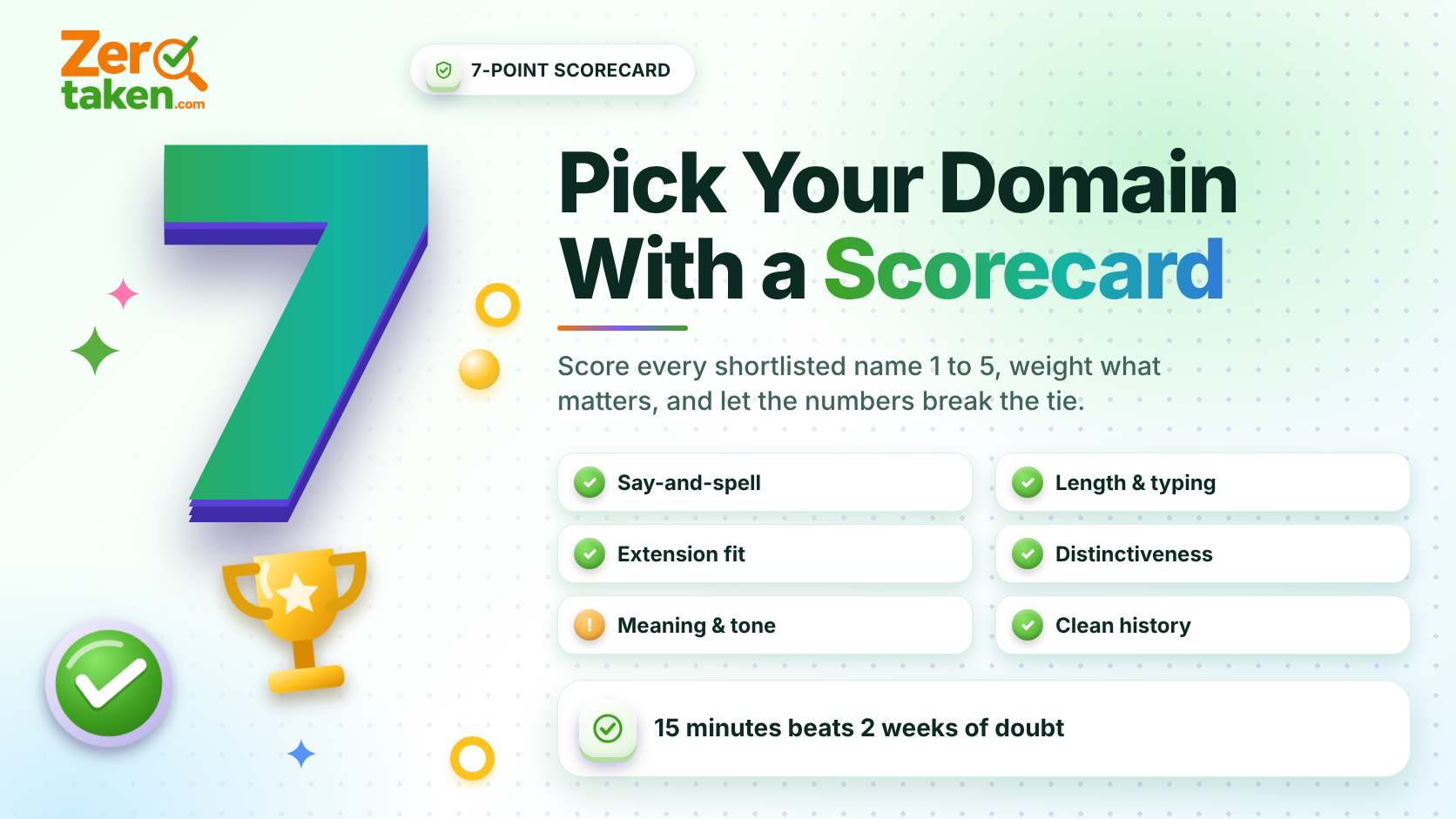
Why does a scorecard beat gut feeling for choosing a domain?
Gut feeling is dominated by whichever name you looked at last, and by how recently you said it out loud. A scorecard forces you to compare every candidate against the same questions, so a name can't win just because it was the most recent one in your head.
It also exposes disagreement early. If you and your co-founder score the same name differently, the gap lands on one specific criterion (usually memorability or extension), and that is a far more productive argument than 'I just don't love it.'
Keep the rules simple: score each criterion from 1 (poor) to 5 (excellent), score every candidate blind to the others if you can, and write the score down before you discuss it.
What are the seven criteria to score every candidate on?
These are the seven that actually move outcomes. Each one is a question you can answer in under a minute per name.
- Say-and-spell: tell the name to someone once, out loud. Can they type it correctly? Any 'is that with one L or two?' drops it to a 2 or lower.
- Length and typing: under about 10 characters is easy, 11 to 14 is fine, beyond that every extra letter costs you in word-of-mouth and mistyped URLs.
- Extension: .com scores 5 for almost every audience. Strong alternatives for the right niche (.ai for AI products, .io for developer tools) score 3 or 4. Anything else scores 1 or 2 unless the audience already expects it.
- Distinctiveness: search the bare name in quotes on Google. If page one is full of other businesses, you will fight them for attention forever. An empty page one is a 5.
- Meaning and tone: does it hint at what you do or how you want to feel, without boxing you in? A name that would be wrong after your first pivot caps at a 3.
- Clean history: look at the name on social handles, and check for trademark conflicts in your market. A close existing brand in your category is a 1 no matter how good the domain looks.
- Staying power: would you be comfortable seeing this name on an investor deck, a press article and a tattoo-level-committed t-shirt in five years? This is the 'will I still like it' test.
How do you weight the criteria for your own business?
Equal weights are a fine start, but they are rarely right. A consumer app that spreads by word of mouth should weight say-and-spell and length double. A B2B product sold through outbound email can live with a slightly longer name but should weight distinctiveness and trademark cleanliness double, because buyers will search for you by name before replying.
A practical default: multiply the two criteria that matter most to your growth channel by 2, leave the rest at 1, and total it up. Maximum is 45, and in practice anything above 34 is a name you can commit to without regret.
Resist the temptation to adjust the weights after you see the totals. Decide the weights first, or you are just reverse-engineering the answer you already wanted.
- Word-of-mouth consumer product: double say-and-spell and length.
- B2B or outbound sales: double distinctiveness and clean history.
- Developer or technical audience: double extension fit and say-and-spell.
- Global audience: double say-and-spell (it has to survive other accents) and meaning.
What does a scored shortlist actually look like?
Say you are naming a scheduling product and you are down to three invented placeholders: Calmora, TimeNest and Bookwell. Here is the shape of a result, not a verdict on real inventory.
Calmora scores 5 on say-and-spell, 4 on length, 5 on extension if you get the .com, 4 on distinctiveness, 3 on meaning (it sounds calm but says nothing about scheduling) and 4 on both history and staying power. TimeNest scores lower on distinctiveness because several products already use 'nest' naming, but higher on meaning. Bookwell loses points on tone: it reads as a book product, and that mismatch costs a 2 on meaning.
Notice what happens: two names finish within three points of each other, and the scorecard points at the single criterion separating them. That is your tiebreaker conversation. It will take ten minutes instead of ten days.
What do you do when two names tie?
A tie almost always means the names are both good enough, which is the best problem to have. Break it with the one criterion that is hardest to change later.
You can change your tagline, your logo and your colors next year. You cannot cheaply change your domain, your legal name and the habits of your first thousand users. So when scores tie, favor the name with the stronger extension and the cleaner trademark position, even if the other one is a little more fun.
If it is still a coin flip, flip it, then notice whether you feel relief or disappointment at the result. That reaction is data the scorecard can't give you.
When should you stop scoring and just register?
Stop when one name clears your threshold and you have run the Google and trademark checks on it. Further scoring is procrastination dressed up as diligence, and every day of delay is a day someone else can take it.
Before you commit, check the exact spelling is still open. With ZeroTaken you can verify availability for each finalist across extensions in seconds, which is the last box to tick before you register.
Then register the winner for more than one year if you can, turn on auto-renew, and move on to the real work: building the thing the name is going to sit on.