
Can You Use an Emoji (or an Accent) in Your Domain Name?
Your dream .com is gone, so you start getting creative — and somewhere in that spiral you wonder: could I just put an emoji in it? A little rocket, a fire, a heart? Or spell your brand the way it's actually written in French, or Japanese, or Cyrillic, accents and all? The surprising answer is yes, you technically can — both emoji domains and accented, non-English domains exist and you can register some of them today. The far more useful answer is that for almost every founder, doing it as your real domain is a quiet mistake. This guide explains how these domains actually work under the hood, why your clever 🚀.ws shows up as random gibberish in the browser bar, exactly what breaks when your domain isn't plain English letters, and the narrow cases where a non-ASCII domain is genuinely the right move.
Can you actually register a domain with an emoji or accent in it?
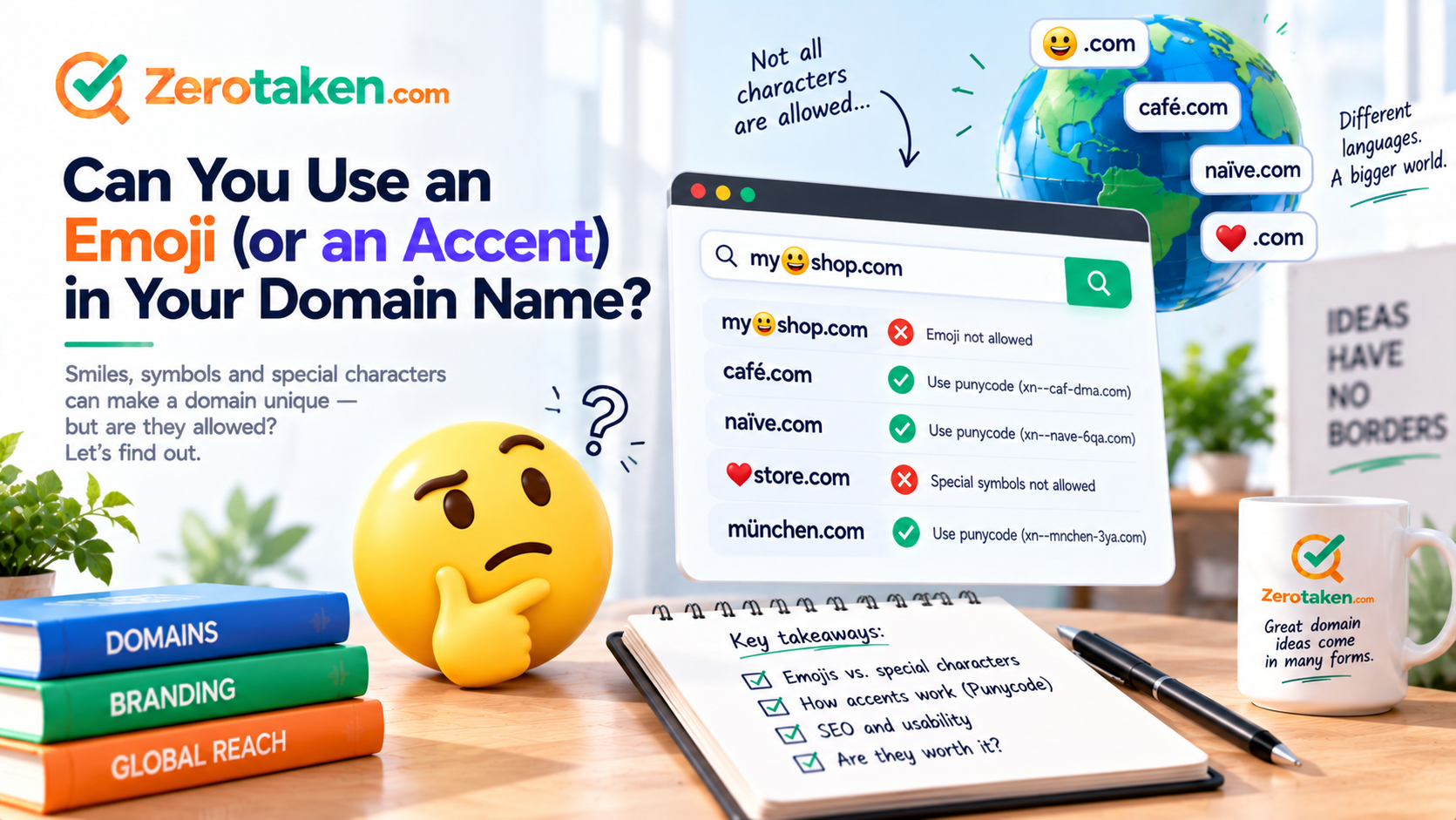
Sometimes. The catch is that the Domain Name System itself only understands plain ASCII — the 26 English letters, the digits 0–9, and the hyphen (registrars call it the "LDH" rule). An emoji or an é is not in that set, so it can't live in DNS directly. Instead, there's a translation layer called IDNA (Internationalized Domain Names in Applications) that converts your fancy characters into an ASCII string prefixed with xn--, a format called Punycode. münchen.de is really stored and resolved as xn--mnchen-3ya.de. A single-emoji domain like 💩.la is stored as xn--ls8h.la. The pretty version is just a costume the browser sometimes agrees to draw over the real, ugly one.
Accented and non-Latin domains (IDNs) are widely supported: most major registries, including .com itself, accept a defined set of scripts — Latin with diacritics, Chinese, Arabic, Cyrillic, and more. Emoji domains are a different, wilder story. The .com and .net registries do not allow emoji, and the technical standard (IDNA2008) doesn't classify emoji as valid domain characters at all. A handful of country-code registries — historically .ws, .to, .fm, .la and a few others — sell them anyway, which is the only reason emoji domains exist. So "can I?" splits in two: accented/foreign-script domains, yes, on most extensions; emoji domains, only on a small set of ccTLDs that opted to ignore the standard.
Why does your emoji domain turn into 'xn--...' everywhere?
This is the problem that sinks most of these domains before they start. Because the real address is the Punycode string, anything that shows a URL has to decide whether to render the friendly version or the raw xn-- version — and modern browsers are deliberately stingy about it. To fight scams (more on that next), Chrome, Safari and Firefox only display the Unicode form when the characters all belong to a single, expected script; otherwise they fall back to showing the literal xn-- string in the address bar. Emoji labels almost never pass that test.
So the domain you picked because it looked delightful frequently renders as https://xn--ls8h.la — in the address bar, in a copied-and-pasted link, in an autofill suggestion, in someone's browser history. Your "memorable" URL becomes a string nobody can read, retype, or trust. You've taken on all the branding cost of an unusual domain and lost the one thing that made it appealing: that it looked like the emoji. For a name that's supposed to spread by being seen, that's close to fatal.
Wait — can't lookalike characters be used to scam people?
Yes, and that's exactly why browsers clamped down. Many non-Latin alphabets contain characters that render identically to English ones — a Cyrillic "а" is visually indistinguishable from a Latin "a," and Greek and other scripts offer similar twins. Attackers exploit this with homograph (or homoglyph) attacks: they register a lookalike of a trusted brand using a swapped-in foreign character, so the URL looks like the real thing but resolves somewhere else entirely. Security researchers have demonstrated flawless fakes of major-brand domains this way.
The fallout lands on legitimate non-ASCII domains. Registries now block mixing scripts within a label, browsers show Punycode whenever anything looks off, and security-minded users have learned to treat an xn-- address bar as a yellow flag. None of that is your fault if you register an honest accented domain — but you inherit the suspicion anyway. It's worth knowing that the entire ecosystem around non-ASCII domains is shaped by defending against abuse, and that shows up as friction for everyone.
What actually breaks when your domain isn't plain ASCII?
Resolving the website is usually the part that works. It's everything wrapped around the domain that quietly fails, and the failures are the kind you discover after you've printed the business cards.
- Email is the big one: professional email on a non-ASCII domain relies on Email Address Internationalization (EAI), which is still patchily supported. Plenty of mail servers, CRMs, and payment providers will reject or mangle an address at a xn-- domain.
- Signup forms and validators routinely refuse anything that isn't a-z in the domain, so users may not even be able to enter your address on third-party sites.
- Typing is painful: nobody can type an emoji, and few can type an é or a Cyrillic character, into a desktop address bar without copy-paste. Word-of-mouth and the 'say it out loud' radio test collapse completely — how do you dictate 🚀?
- Tools mangle it: some analytics platforms, ad networks, link shorteners, and social cards handle Punycode inconsistently, splitting your traffic data or refusing the link outright.
- The one thing that's fine: TLS/SSL certificates. Let's Encrypt and other CAs issue certificates for IDN/Punycode domains, so HTTPS is not the blocker — everything human-facing is.
Are non-English (IDN) domains ever the right call?
Yes — this is the legitimate half of the topic. If your primary audience natively reads a non-Latin script, a domain in that script can be a real asset. A business serving Chinese, Arabic, Russian, or Greek customers may find a native-script domain more memorable and more trustworthy to exactly the people it's for, and some markets have their own established IDN extensions (Russia's .рф, for example) that locals recognize instantly. Google treats IDNs and their Punycode equivalents the same way for ranking, so there's no inherent SEO penalty.
The discipline is to never make the IDN your only identity. Register the plain-ASCII or transliterated version as your canonical domain — the one that goes on invoices, in your email, and in your app store listing — and treat the native-script domain as a localized front door that redirects to it. That way you serve local users the name they'd expect while keeping a bulletproof ASCII address for email, forms, and everyone typing from a foreign keyboard. An IDN as a supporting act is smart; an IDN as your sole home inherits every problem above.
When do emoji domains actually make sense?
Rarely, and never as your real website. The one place they shine is a short-lived, seen-not-typed campaign: a splashy vanity redirect on a cheap emoji-friendly ccTLD, pointed at your real domain, used on a poster, a QR code, or a single social push. Big brands have run emoji-URL stunts for exactly this — a memorable image on a billboard that quietly forwards somewhere sensible. The emoji does the attention-grabbing; the ASCII domain behind it does the actual work.
Go in with clear eyes, though. The good single-emoji domains were snapped up by speculators years ago and are priced accordingly, the emoji-selling registries are smaller and less battle-tested than the majors, and the moment your emoji URL needs to be typed, emailed, or spoken, it dies. Buy one as a disposable marketing toy if the campaign math works — never as the address you build a company on.
So what should you actually do?
Make a plain-ASCII domain your real, canonical home — the address that carries your email, your logins, and your reputation. It types cleanly on every keyboard, survives the radio test, and never surprises a user with a xn-- string. Get that locked first, then decide whether a non-ASCII domain adds anything: an IDN redirect if you're serving a specific-script market, or an emoji domain only as a throwaway campaign link. Both are toppings, not the meal.
Before you fall for a clever emoji or accented spelling, check whether the boring, dependable ASCII version of your name is actually free — that's the one worth fighting for. ZeroTaken lets you test the plain version across .com, .io and other extensions in one search, so you find out in seconds whether you even need a workaround.
So what's the verdict?
You can put an emoji or an accent in a domain — but the DNS turns it into Punycode, browsers expose that Punycode to fight scams, and email, forms, typing and word-of-mouth all take the hit. For the vast majority of founders, a non-ASCII domain trades a moment of novelty for permanent friction.
The honest exceptions are narrow: a native-script IDN for a market that reads that script, always paired with an ASCII canonical, and an emoji domain as a disposable campaign redirect. Anything beyond that, and you're building your company on an address your own customers can't type. Secure the plain-English name, treat everything else as a redirect, and get back to building.