
Will Your Domain Name Survive a Pivot? How to Pick One That Won't Box You In
Your product will change. The first version of almost every startup is a guess, and somewhere between month six and month eighteen a lot of founders discover the real business is adjacent to the one they launched. The domain name is the one asset that is painful to change and easy to get wrong in the first week. A name that described your v1 perfectly can become an apology in your v2. This guide gives you a blunt test for whether a name will survive a pivot, the three name types that don't, and what to do if you're already stuck in one.
Добавьте ZeroTaken в избранные источники Google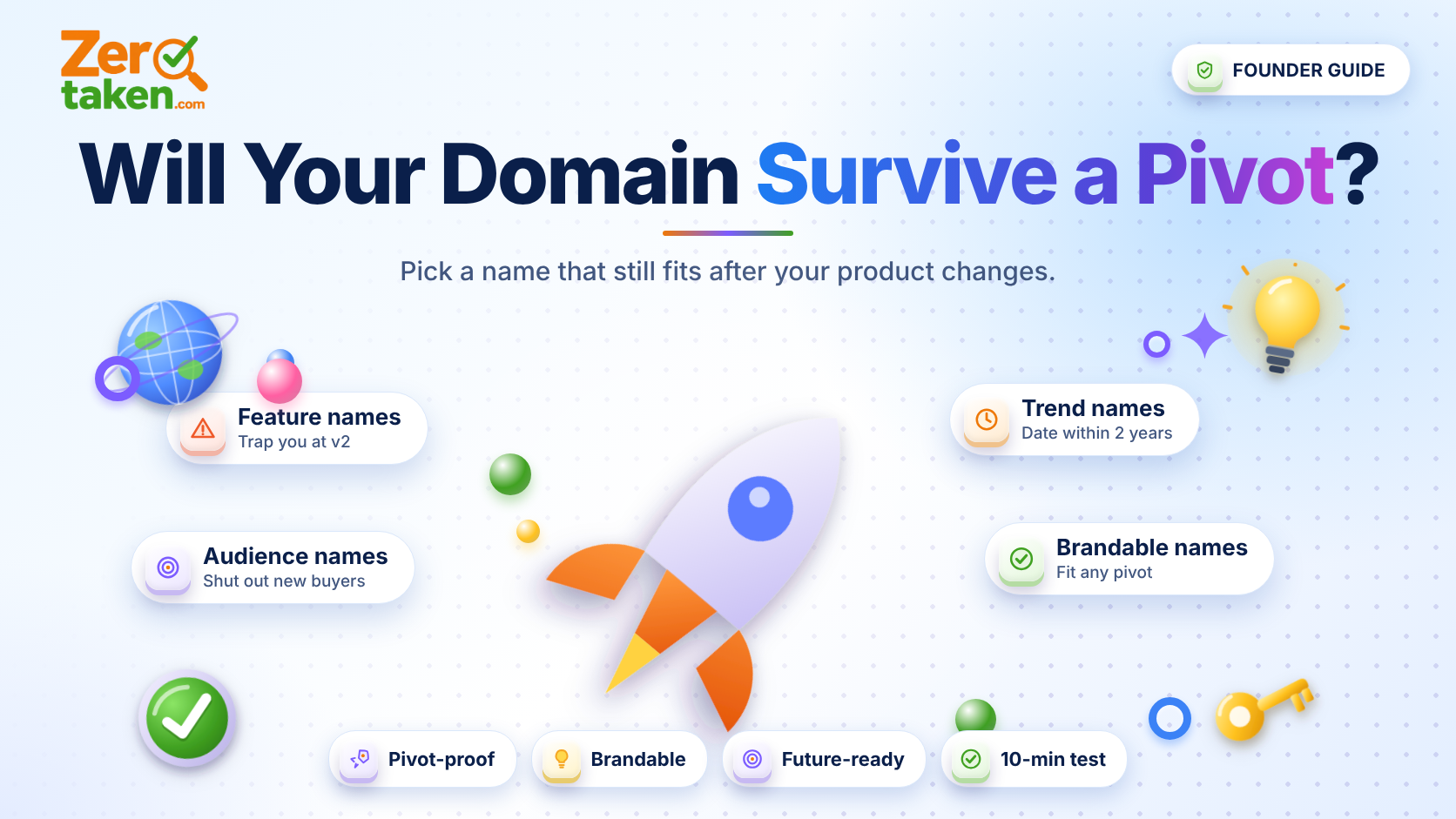
Why does a domain name make pivots harder?
Because your domain is the one thing every other asset points at: backlinks, email addresses, app store listings, invoices, social bios, printed cards. Changing your product costs a sprint. Changing your domain costs you a migration, a dip in search traffic, and a stretch of explaining to customers why the address they bookmarked now redirects somewhere else.
The asymmetry is the point. Your product is supposed to be cheap to change, and your name is supposed to be the stable part. A domain that bakes in today's product turns that around, and every pivot has to fight the name as well as the market.
What are the three kinds of names that trap you?
Almost every pivot-trapped name falls into one of these. Check your shortlist against them before you buy anything.
- The feature name: invoicegenerator.com, pdfsplitter.io. It describes one function. The day customers ask for the second function, the name starts to feel wrong, and you can't sell a platform from a URL that says 'tool'.
- The audience name: dentistbooking.com, freelancerinvoices.co. It names who you serve today. If the best-paying customers turn out to be clinics, agencies, or a different profession entirely, the name tells them this product isn't for them.
- The technology name: gptwriter.ai, blockchainledger.io. It rides a trend. Trend vocabulary dates fast, and a name built on this year's buzzword looks like a time capsule within two years.
What does a pivot-proof name look like?
It points at an idea or a feeling instead of a feature, a customer, or a technology. Think short invented words, evocative single nouns, or real words used out of context. None of those describe what the company does today, which is exactly why none of them become wrong later.
The practical test is the 'new product sentence'. Fill in this sentence with the most likely wrong turn your company could take: 'Welcome to [name]. We now also do ____.' If the sentence sounds absurd or needs an apology, the name is a trap. If it sounds like normal company talk, it's safe. A name like Stripe or Notion survives any sentence you put after it. 'Welcome to invoicegenerator.com, we now also do payroll' does not.
How do you stress-test a name before you buy it?
Run the shortlist through three questions. They take ten minutes and they are worth more than another round of brainstorming.
- Product test: list the two most likely adjacent products you might build in two years. Would the name still fit comfortably on both? One yes isn't enough.
- Customer test: would a customer from the second-most-likely segment feel welcome on this domain? If the name excludes them, pick another.
- Age test: does the name contain a year, a trend word, or a technology that could look dated by the time you raise your next round? If yes, drop it.
Isn't a descriptive keyword domain better for SEO?
Less than founders assume. Search engines don't reward keywords in the domain the way they did a decade ago, and what actually moves rankings — content, links, and brand searches — transfers to any name. What the keyword name does give you is an early-stage convenience: people instantly understand the product. That convenience is real, but it expires the moment you outgrow it.
If your gut still says descriptive, there is a middle path: pick a brandable name for the company and describe the product in the tagline and homepage headline. The headline can change in an afternoon. The domain can't.
What if you're already in a name that doesn't fit?
Don't rush to rename. A rename is worth it when the name actively costs you deals or confuses customers every week, not when it merely feels slightly narrow. If you do decide to move, the sequence matters more than the speed.
Buy the new domain first and keep the old one for as long as you can afford to. Set up permanent 301 redirects from every old URL to its exact new equivalent, not just the homepage. Update your email addresses, Search Console property, and every profile that links to you. Announce the change to customers before the redirect goes live, and keep the old domain registered for years afterwards, since old links and printed materials never fully disappear.
How do you find a name that clears the pivot test and is actually free?
Brainstorm for evocative, non-descriptive options first, then check which ones you can really register. Strong abstract names get taken fast, so you'll want to compare a lot of candidates rather than fall in love with one. A tool like ZeroTaken lets you generate ideas from a plain-English description of your concept and check live availability across extensions, so you can drop the taken ones early and spend your energy on the stress tests above.
Whatever you pick, run it through the new-product sentence one more time before you pay. If you'd be embarrassed to say it after the pivot, you'll be embarrassed in a year.