
Starting a Newsletter, Podcast or YouTube Channel? Here's How to Pick the Domain
Every creator starts on someone else's land: Substack, Spotify, YouTube, Instagram. The platform owns the feed, the algorithm and the relationship with your audience. The only piece of the stack you actually own is a domain name. Most creators treat it as an afterthought, grab whatever matches their show title, and discover two years later that the name doesn't fit the thing they've become. Here is how to choose one that does the job a creator domain is really for: being the permanent address of your audience.
Добавьте ZeroTaken в избранные источники Google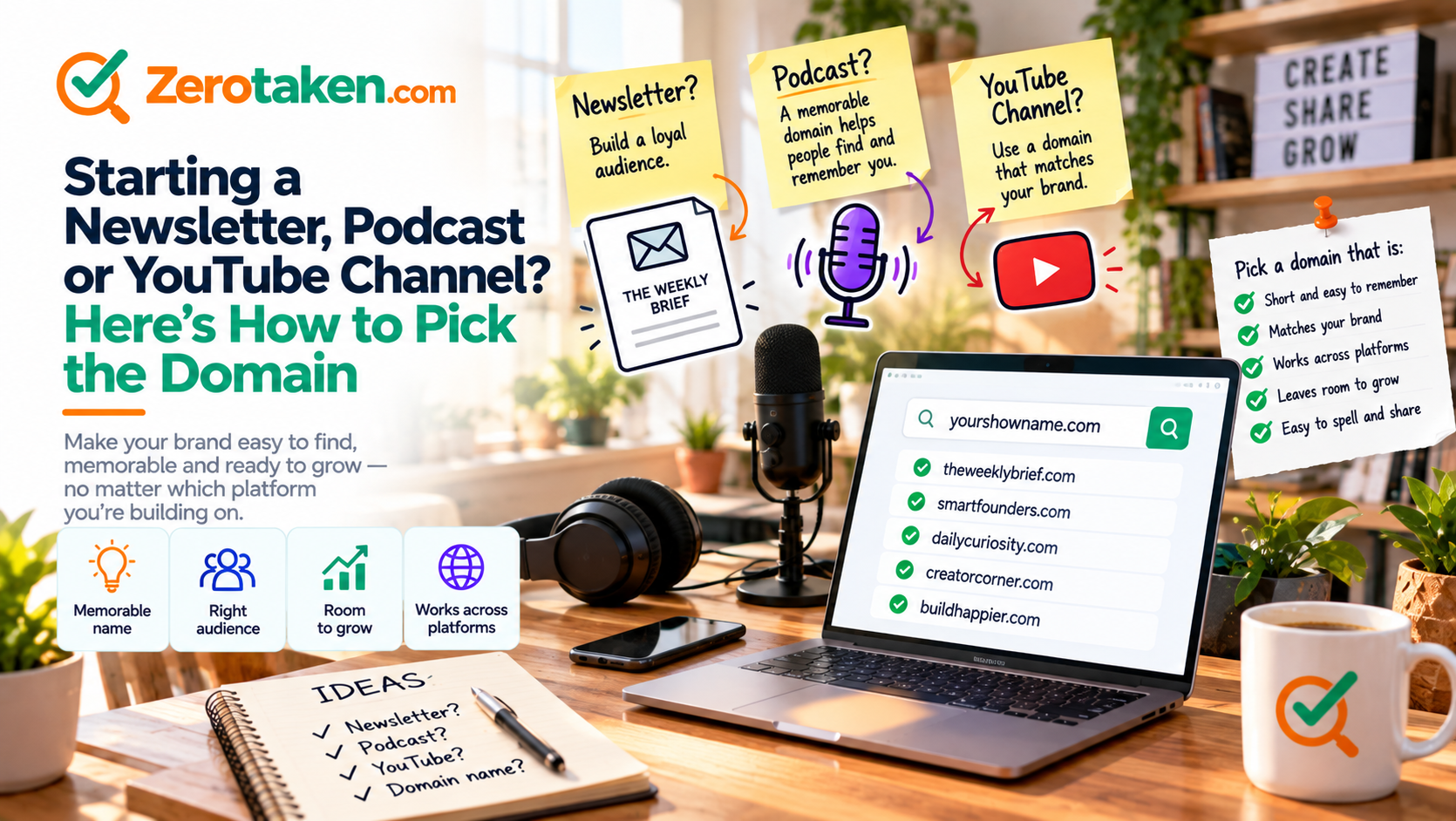
Why does a creator even need a domain?
Because platforms change the rules and you don't get a vote. Newsletter tools raise fees, podcast apps merge, social accounts get suspended, and a video channel can lose half its reach in one algorithm update. If your audience only knows you as 'the show on platform X', every one of those events is a crisis. If they know you as yourdomain.com, it's an inconvenience: you point the domain somewhere else and the audience follows.
A domain also gives you the two things platforms rarely do: an email list you can export, and a URL that works in every medium. It goes in the podcast outro, the video description, the conference slide and the book footnote, and it never needs a 'find me on' disclaimer.
Should the domain match the show name or the person?
This is the central decision, and the answer depends on what you expect to be doing in three years, not what you're doing this month.
A personal-name domain is a bet on you. It survives any change of topic, format or platform, and it compounds across everything you ever make: newsletter, course, book, consulting. The cost is that it's hard to sell, hard to hand to a co-host and awkward if your name is common or hard to spell.
A show-name domain is a bet on the format. It's easier to remember, easier to market, and it can become an asset someone else could one day run. The cost is that it ties you to a topic. A podcast called 'The Seed Round' is a strange home for the day you stop covering startups.
- Solo expert, consulting or books in the future: use your own name, or a name plus a one-word descriptor.
- Multi-host show, interview format or something you might sell: use a standalone brand name.
- Both apply: register both. Make the brand name primary and redirect the personal name to it, or the reverse. Don't split your audience across two sites.
Does the domain have to match the show title exactly?
No, and forcing it is how creators end up with bad domains. If thefoundersdiary.com is taken, resist the urge to add a hyphen or settle for a strange extension just to keep the title intact. Your listeners will type what they hear, so a close variant on a clean .com beats an exact match on a clumsy one.
The workable move is to adjust the domain, not the title: add a short, natural word that describes the format ('foundersdiarypodcast.com', 'readthefoundersdiary.com') or tweak the show title itself before you've built any audience around it. Changing a name before episode ten costs nothing. Changing it after episode a hundred costs you your search rankings, your artwork and your listeners' muscle memory.
Why is spoken clarity the most important test for podcasts and video?
Audio and video are the only mediums where your domain is delivered by voice, and people can't see how it's spelled. Say it aloud to three friends and ask them to write it down. If anyone hesitates between 'two' and 'to', 'for' and 'four', 'c' and 'k', or asks whether there's a hyphen, the domain will leak listeners every single episode.
The fix is mostly about avoiding ambiguity rather than being clever. Skip numbers and hyphens, skip invented spellings, and prefer words with one obvious spelling. For a deeper version of this test, see our guide on the radio test for domain names.
Which extension should a creator choose?
.com is still the default your audience will type when they guess, and for a podcast outro that guessing behaviour is exactly the scenario you're designing for. If the .com is gone, a few extensions are genuinely reasonable for creators: .fm for audio shows, .tv for video, and .co or .io if your audience is tech-adjacent and used to them.
Be honest about the cost of leaving the .com: some share of people who hear your domain will type .com out of habit and land on someone else's site, or a parked page. If you can't get the .com, don't pick a name where the .com owner is an established competing show. Check what lives at the .com before you commit, not after.
How do you handle the handle problem?
Ideally, your domain, newsletter name, podcast title and social handles are all the same string. In practice you'll rarely get all of them. Prioritise in this order: the domain first (it's the one thing that's permanently yours), then the handle on the platform where your audience actually lives, then everything else.
A consistent but slightly longer handle is better than a perfect handle that differs on every platform. If your domain is thefoundersdiary.com, 'thefoundersdiary' on every platform is easier to remember than a clever shorter variant that changes from app to app.
- Check the domain and the handles on your two or three key platforms at the same time, before you design a logo.
- Reserve handles you don't plan to use yet. They cost nothing and can't be taken later.
- If a handle is taken by an abandoned account, it still isn't yours. Don't build a plan that depends on reclaiming it.
What should you do on day one, before the first episode?
Register the domain before you announce anything, including to friends. Point it at a simple page with an email signup, even if it's three sentences. That page is the start of your owned audience, and it means every mention of your show from day one gets counted.
Then set up a custom email address on the domain for sponsors and guests. 'hello@yourshow.com' reads as a business, a free webmail address reads as a hobby, and sponsors notice.
What mistakes do creators make with domains?
The pattern across creators is consistent: the problems are rarely about picking a bad name, they're about treating the domain as disposable.
- Building the audience on a platform subdomain (yourshow.substack.com) and never moving to a custom domain, which makes leaving later far more painful.
- Registering the domain in a collaborator's or producer's personal account. If the relationship ends, so does your control. The domain should be in your name or your company's.
- Letting it lapse. Turn on auto-renew and keep a current payment method; a lost domain is a lost archive of every link you've ever shared.
- Naming the show after a trend or a guest topic that dates quickly.
- Not redirecting variants. If you own both the .com and a typo-prone alternative, make one point at the other.
What's the short version?
Choose the domain as the permanent address of your audience, not as a label for the current format. If you're the product, use your name; if the show is the product, use a brand that could outlive your topic. Make it passable the first time someone hears it, put it on a .com if you can, and register it before you announce anything. If you want to check a shortlist quickly, ZeroTaken's domain search shows which names are actually free to register right now.