
Should You Use Your Country's Domain (.de, .co.uk, .in) Instead of .com?
The .com you wanted is gone, but there it is on your national extension — .de, .co.uk, .in, .com.au — clean, short, and often cheap. For a lot of founders that feels like the obvious escape hatch: it's local, it looks legitimate, and nobody's squatting it. But a country-code domain isn't just a cheaper .com with a flag on it. It quietly makes a decision about who your company is allowed to be — one country's business, or the world's. This guide cuts through the folklore: what a ccTLD really signals, the one Google setting that makes this choice mostly irreversible, which country codes are secretly treated as global, the ownership risks that don't show up until it's too late, and a rule for when your country's domain is the smart pick versus a cage you built yourself.
Добавьте ZeroTaken в избранные источники Google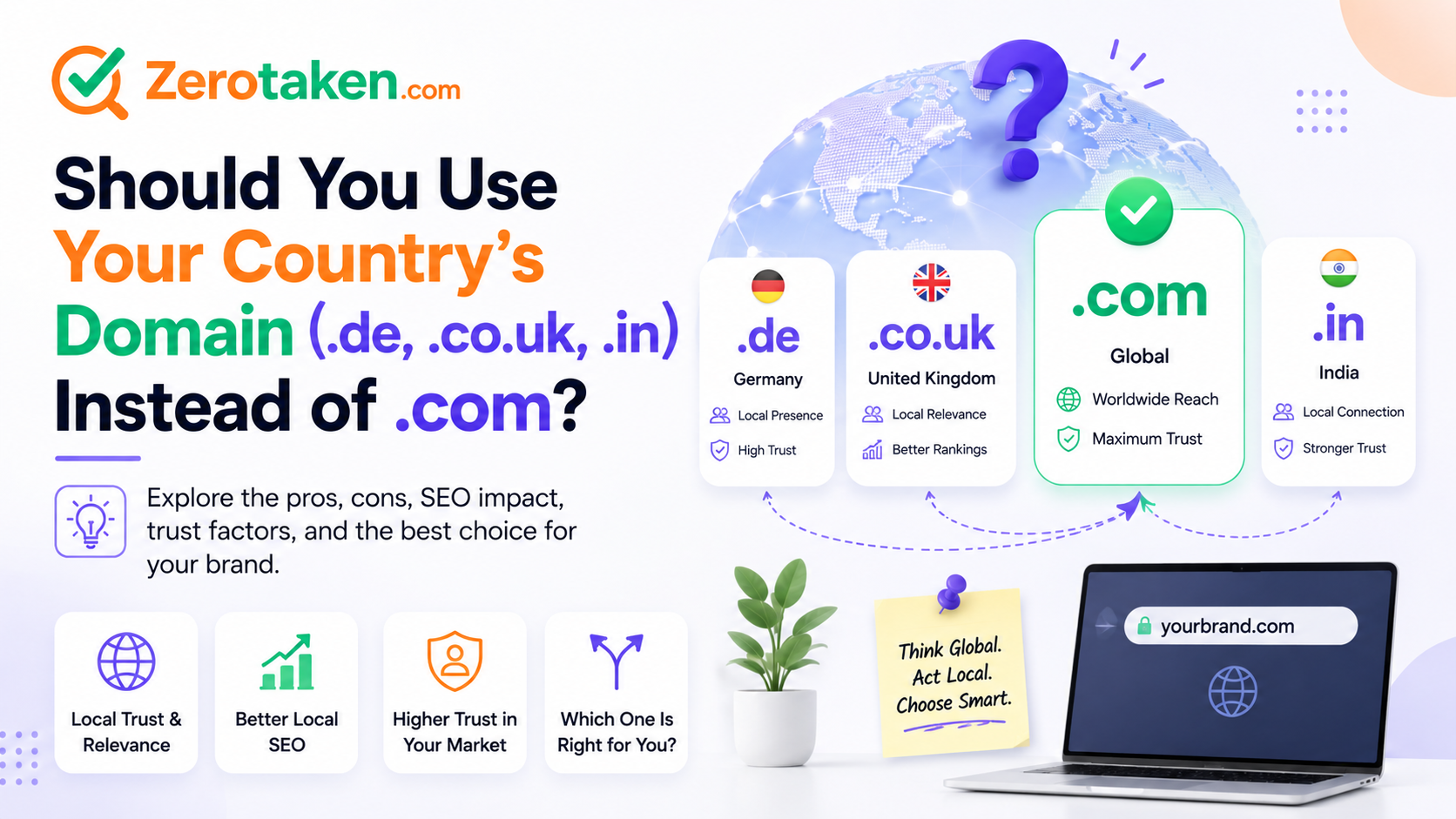
What is a country-code domain, and how is it different from .com?
A country-code top-level domain (ccTLD) is a two-letter extension assigned to a specific country or territory: .de for Germany, .co.uk for the United Kingdom, .in for India, .fr for France, .ca for Canada, .com.au for Australia. Each one is run by a national registry under its own rules, and those rules are where the differences start. .com is a generic TLD (gTLD) — open to anyone on Earth, no strings attached. A ccTLD is the local option, and 'local' is doing more work than it looks.
Some ccTLDs are wide open — .de and .co.uk will sell to anyone in the world with a credit card. Others gate registration behind a real connection to the country: .ca wants a Canadian presence, .com.au requires an Australian business number, .us asks for a US 'nexus,' .fr expects an address in the EU. Before you fall for a name on a ccTLD, check whether you're even eligible to keep it — a registrar will happily take your money at signup and then have the registry claw the domain back months later if you don't meet the residency rule.
The mental model that matters: a .com says nothing about where you are. A ccTLD says 'this company belongs to this country.' Whether that's an asset or a liability is the entire decision.
Does a country-code domain hurt your SEO or limit you to one country?
This is the fact that should drive the whole choice, and almost nobody mentions it: a ccTLD carries a permanent, built-in geographic target that you cannot turn off. Google treats .de as 'this site is for Germany,' .fr as 'this site is for France,' and so on — automatically. In Google Search Console, the international targeting setting that lets a .com say 'actually, I serve the whole world' (or a specific different country) is simply greyed out for a true ccTLD. The flag is welded on.
For a business whose customers are all in one country, that's not a bug — it's free local ranking help. A .de domain gets a gentle relevance boost for German searchers, which is exactly what a German bakery, a UK accountancy firm, or an Australian trades business wants. The ccTLD is quietly telling Google 'rank me for the people who are actually my market.'
But if you have any ambition to sell across borders, that same welded-on flag is a ceiling. Ranking a .co.uk site for searchers in the US, Germany, or India means fighting the geo-signal instead of using it, and there's no switch to flip. This is the real reason the ccTLD-vs-.com question isn't about vibes or price — it's about whether you're building for one country or many, because a ccTLD makes that call for you and makes it hard to undo.
When does a country's domain actually beat .com?
When your market is your country, a local ccTLD often wins outright. In several countries the national extension isn't the fallback — it's the default users expect and trust more than .com. In Germany, .de is everywhere and reads as more established than a .com for a local business. In the UK, plenty of consumers see .co.uk as the 'proper' British option. Show up on the extension your customers already associate with 'a real company here,' and you're borrowing trust instead of building it from zero.
The availability math helps too. Because ccTLDs are pools that most of the world ignores, the short, exact-match name you want is far more likely to still be sitting there — and at standard local pricing rather than five figures on the .com aftermarket. Owning yourbrand.de outright beats renting a hyphenated or misspelled .com compromise, especially when German customers were going to type .de anyway.
And for anything genuinely tied to a place — a regional marketplace, a local services app, a national news site, a brick-and-mortar with a delivery radius — the geo-targeting 'limitation' from the last section is actually the point. You want to be unmistakably the local option. The ccTLD says it before a visitor reads a single word.
When is a ccTLD a mistake you'll regret later?
The classic trap is launching a startup with global ambitions on your home-country domain because it was the only clean name available on day one. It feels harmless — you're just getting started, all your early users are local anyway. Then you raise money, expand, and discover your brand is a .co.uk in a market that's now half American, your geo-signal is fighting you in every new country, and migrating to a .com means a risky domain move plus re-earning every backlink and every scrap of ranking you built. The cheap, convenient choice became an expensive one on a delay.
There's also a perception cost outside your borders. A .com is the universal default; a US customer landing on a .de or .in domain may hesitate, wonder if the site is even meant for them, or quietly trust it less — the same 'is this legit for me?' friction that costs you conversions on a checkout page. Inside your country the ccTLD builds trust; across borders it can leak it.
The honest test: if there's a real chance you'll want customers in more than one country within a few years, treat a ccTLD as a serious commitment, not a convenient placeholder. The time to choose .com is before the brand, the backlinks, and the printed materials all point at an extension you've outgrown.
Aren't some 'country' domains actually global?
Yes — and this is where the topic gets genuinely confusing. A handful of ccTLDs have been marketed so hard as generic that Google officially treats them as global gTLDs with no geographic targeting at all. .co (technically Colombia), .io (British Indian Ocean Territory), .me (Montenegro), .tv (Tuvalu), and .fm (Micronesia) all sit on Google's list of country codes handled as generic. For these, the 'you're locked to one country' rule in this guide simply doesn't apply — .io ranks worldwide exactly like a .com.
So the geo-targeting warning is specifically about ccTLDs that Google still treats as national — .de, .fr, .in, .co.uk, .ca, .com.au and the like. If you're eyeing .io or .co for a global tech product, you're not making the 'local domain' trade-off at all; you're picking a generic extension that happens to have exotic roots. Just don't assume every two-letter TLD behaves this way — .ai, for instance, is wildly popular but its treatment is less clear-cut, so verify before you build a global SEO plan on a guess.
The takeaway: 'ccTLD' isn't one category. A truly national extension bakes in a country; a generic-treated one doesn't. Know which one you're actually buying before you reason about it.
What control and ownership risks come with a foreign extension?
A ccTLD is governed by a national registry, and that registry answers to a government and to geopolitics — not just to ICANN's global rules. That's an abstract concern until it isn't. The starkest recent example is .io: it's tied to the British Indian Ocean Territory, and the 2024 agreement to hand the Chagos Islands to Mauritius put a real question mark over the extension's long-term future, unsettling thousands of tech companies who built their brand on it. Tiny-territory TLDs have wobbled before, and registries have suspended or seized domains over local law disputes.
Restricted ccTLDs add a quieter risk: if you registered under a local-presence rule and your situation changes — you close the local entity, move, lose the qualifying address — you can become ineligible and lose the name at renewal. That's a failure mode a .com simply doesn't have. Renewal terms, dispute policies, and transfer rules also vary by registry and are often less founder-friendly than the well-trodden .com process.
None of this means ccTLDs are dangerous. It means the extension is part of your risk surface. For a local business on its own country's stable, open registry, the risk is negligible. For a global company betting its entire brand on a small territory's two letters because they spelled a cute word, it's a bet worth pricing in with eyes open.
How do you check your name across .com and the ccTLDs at once?
The worst version of this decision is committing to a ccTLD, printing the cards, and only later checking the matching .com — to find it owned by someone who now knows exactly what it's worth to you. Decide with the full picture in front of you: is your exact name free on .com, on your national extension, or only one of them? ZeroTaken checks .com alongside country codes and other extensions in a single search and never logs your queries, so you can pressure-test a name across every option without tipping off an aftermarket bot.
So should you use your country's domain or .com?
Use your country's ccTLD when your market genuinely lives in that country and you expect it to stay there: local services, national retail, a regional brand, anything where 'the trusted local option' is the whole pitch. In that case the geo-targeting is a gift, the trust is real, the name is more likely available, and the risks are minimal on a stable, open registry. Owning yourbrand.de for a German business is often a better move than a compromised .com.
Choose .com the moment your ambitions cross a border — or might. It's the universal default, it carries no geographic ceiling, and it never makes you re-decide your company's scope later. If you're torn, the tie-break is simple: buy the .com for the global option value, and add your country's domain as a redirect if your local audience expects it. What you don't want is to back into a national extension by accident, discover the flag is welded on, and pay to move once your brand has already outgrown the country it was named in.