
Should You Register Your Domain for 1 Year or 10? A Founder's Rule of Thumb
The registration checkout asks a deceptively small question: how many years? One year is cheapest today. Ten years feels like commitment. Most founders click the default and never think about it again, which is how a company with real revenue ends up one expired credit card away from losing its name. The right answer is not one number. It scales with how much you have built on the domain, and you can decide it in about two minutes.
Добавьте ZeroTaken в избранные источники Google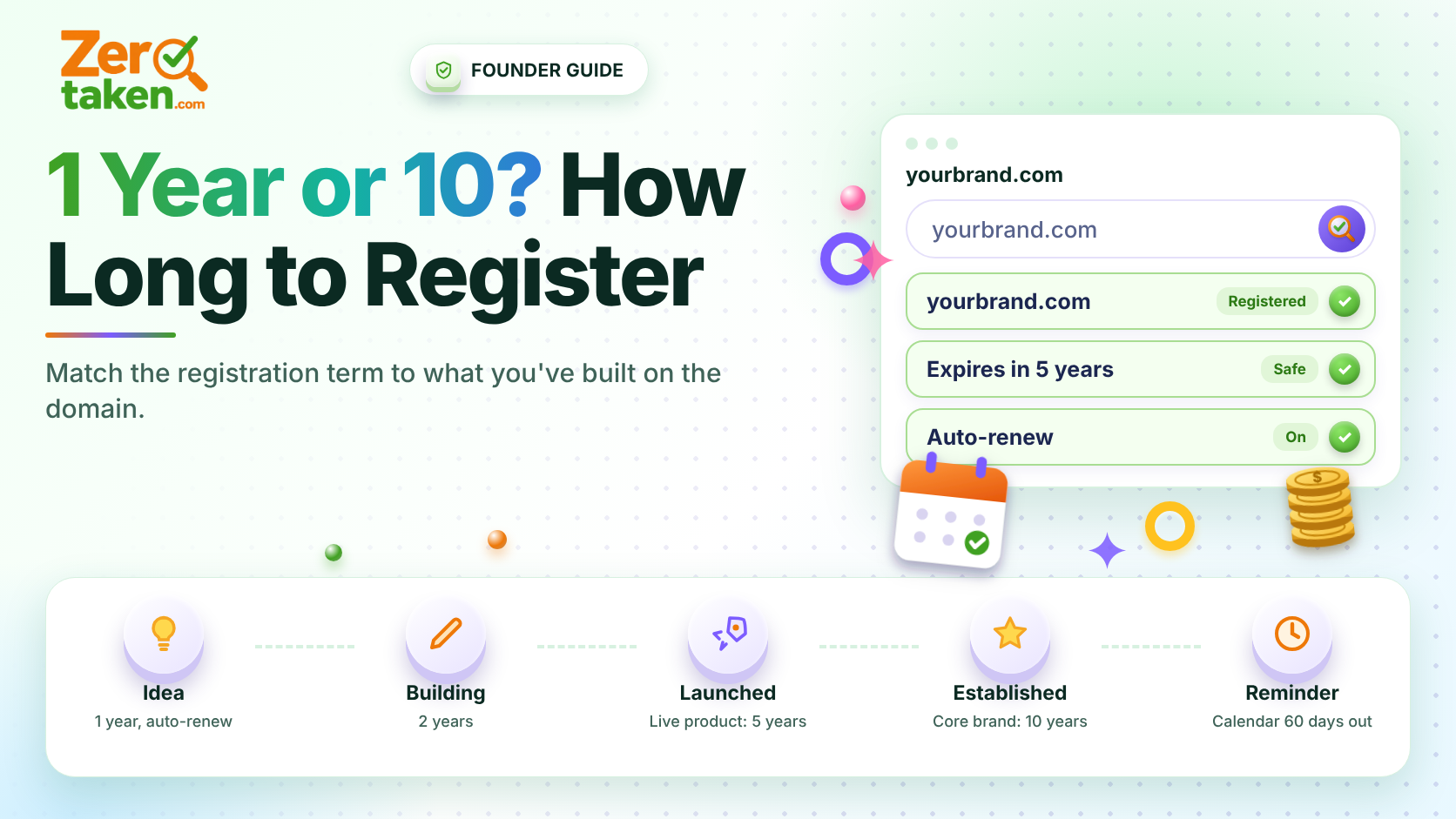
What does registering for more years actually change?
Less than people assume. A longer term does not make the domain more yours, does not add features, and does not change your DNS, email or privacy options. It does exactly two things: it pushes the expiry date further out, and it pre-pays the renewals at whatever the registrar charges now.
Registries cap a single registration at 10 years total. You can renew early at any time, and each renewal adds years on top of the current expiry up to that 10-year ceiling, so you are never forced to decide everything on day one.
Does a multi-year registration help SEO?
No, and you should be suspicious of any registrar who implies it does. Google has said repeatedly that it does not use how far ahead a domain is paid as a ranking signal. A 10-year registration will not lift a thin site, and a 1-year registration will not hold back a strong one.
What does matter for search is continuity: the domain staying live, the same owner, the same redirects. That is an argument for never letting a domain lapse, not for paying a decade up front.
Why is the first-year price a trap, and how do longer terms interact with it?
Most low headline prices apply to the first year only. Renewals revert to the registrar's regular rate, which is often several times higher on cheap-promo extensions. Whether a multi-year purchase keeps the promo rate for the extra years depends entirely on the registrar. Many apply the discount to year one and charge the standard rate for the remaining years in the same cart.
Read the order summary line by line before paying, and compare the total for N years, not the per-year figure in the banner. If the 2-year total is barely above 2x the regular renewal price, you are not getting a deal, you are just prepaying.
- Check the renewal price before you check the registration price.
- Compare the total for the term you want, not the 'from' price.
- Ask whether the promo carries across all years or only the first.
When is a longer registration genuinely worth it?
Two situations. First, wholesale prices drift upward. Under the registry agreement, .com's wholesale price is allowed to rise by up to 7% a year in four out of every six years, and other extensions have no such ceiling at all. Pre-paying locks today's price for the paid years, which is a real if modest hedge on the one domain your whole business depends on.
Second, risk reduction. Every expiry date is a chance for something to go wrong: a card on file that has been replaced, a billing email that bounces, the founder who handled it leaving the company. Pushing the date five years out removes four of those chances. For a domain with customers, email and backlinks on it, that is worth far more than the interest you would earn on the cash.
- Revenue, customers or investors depend on the domain: register for 5 years or more.
- Prices on your extension have been climbing: pre-pay while it is cheap.
- Your billing setup is fragile or owned by one person: extend the date.
When should you stay at one year?
Whenever the name is still an idea. A pre-launch founder who pre-pays 10 years on a name they abandon in three months has wasted money and, worse, gotten attached. Domains you are testing, side projects, and defensive extras you bought on impulse belong on 1-year terms with auto-renew on, so the decision to drop them is a non-event.
Cash also matters. In the first 12 months a startup's cash is worth more than a few dollars of renewal savings. Spend the difference on the thing that tests whether the company works.
What is the rule of thumb?
Match the term to what is built on the domain, and extend as the stakes rise.
- Idea stage, still comparing names: 1 year, auto-renew on.
- Name chosen, building and launching: 2 years.
- Live product, paying customers, real email: 5 years, and top up each year so it never drops below 3.
- Core brand of an established company: 10 years, plus a calendar reminder anyway.
- Throwaway or speculative extras: 1 year, no exceptions.
What does a long registration not protect you from?
It does not protect against transfers you did not authorise, an account takeover at the registrar, or a stale contact email. A domain paid until 2036 can still be hijacked in a day if the registrar login has a weak password and no two-factor authentication. Turn on 2FA, keep the registrar lock enabled, and use a role-based contact address such as domains@yourcompany.com rather than one person's inbox.
It also does not remove the need to look. Whatever term you choose, put the expiry date in a shared calendar for 60 days before it. If you track several names, a tool like ZeroTaken's expiration monitor can send the reminder so you are not relying on registrar emails that land in spam.
Does it matter if you later move registrars?
A little, and in your favour. A transfer adds one year to the expiry, and the combined term still cannot exceed 10 years, so a long prepayment is not wasted by moving; you simply get less benefit from the extra year. The one catch is timing: newly registered domains are generally locked from transfer for the first 60 days, so do not plan a registrar switch in the first two months.
The practical takeaway: pick the registrar you will actually use for years first, then pick the term. Prepaying a decade at a registrar you are about to leave is the only way this decision goes truly wrong.